Serie A’s weekend also left a familiar question for the refereeing department: where exactly is the threshold for intervention meant to stand? Simone Sozza’s performance drew particular scrutiny, with the Lazio-Venezia decisions exposing a contrast between a soft penalty at one end and a clear one at the other.
Key takeaways
- Sozza awarded Lazio a penalty for Yeboah’s late contact on Taylor, though the challenge was judged below the usual intervention threshold.
- Venezia’s penalty was clear: Mandas caught Correia’s legs while failing to play the ball.
- The goalkeeper was rightly not booked because the incident did not meet the criteria for a denied obvious scoring opportunity.
- Sozza recorded 22 fouls and showed six yellow cards, all to Venezia players, including three in the closing minutes.
- VAR official Pezzuto did not intervene on the principal decisions.
A difficult afternoon for Sozza
Sozza’s display was marked by uncertainty rather than control. He finished the match with a modest assessment after calling 22 fouls and producing six cautions, every one of them for Venezia. Three of those yellow cards arrived in quick succession near the end, adding to the impression of a referee whose line had become less assured as the game developed.
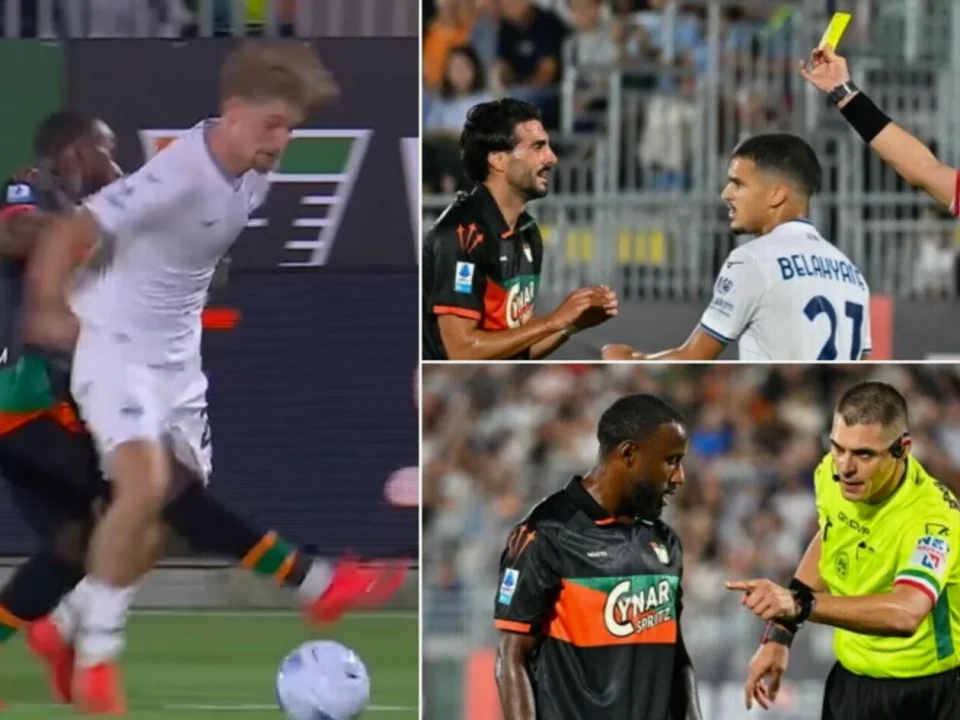
The most debated call was the penalty given to Lazio. Yeboah did make late contact from behind on Taylor, but the Lazio player’s attempt to strike the ball had already passed between his own legs. The decision therefore appeared lighter than the high bar that has been repeatedly associated with refereeing chief Orsato’s approach this season.
It was not a situation in which VAR had a clear basis to overturn the decision. Still, the award suggested that the practical standard for on-field penalties may have softened, even in an incident that did not appear to demand a spot-kick.
There was another moment that reflected Sozza’s uneven reading of the match. Belahyane committed a foul which could have brought a red card, had the attacking move not already been stopped by an offside decision.
Clearer calls in the penalty areas
Venezia’s own penalty, by contrast, was straightforward. Mandas came out to meet Correia, brought down the Venezia player and did not get the ball. The spot-kick was correctly awarded.
There was also no need for a yellow card for Mandas. The direction of the attack meant the case was not one of a goalkeeper denying an obvious scoring opportunity. Nor did it require the reduced sanction applied to some penalty-area fouls that stop promising attacks; no disciplinary action was the appropriate outcome.
Elsewhere, Cancellieri’s appeal for a penalty after a collision with Juan Jesus did not merit a spot-kick. Juan Jesus made contact only after Cancellieri had already gone to ground while sliding, leaving no meaningful basis for a penalty award.
Pezzuto’s work in the VAR room was largely defined by restraint. In the doubtful situations, he allowed the on-field decisions to stand, leaving the wider discussion centred on Sozza’s interpretation of the penalty threshold rather than on video intervention.