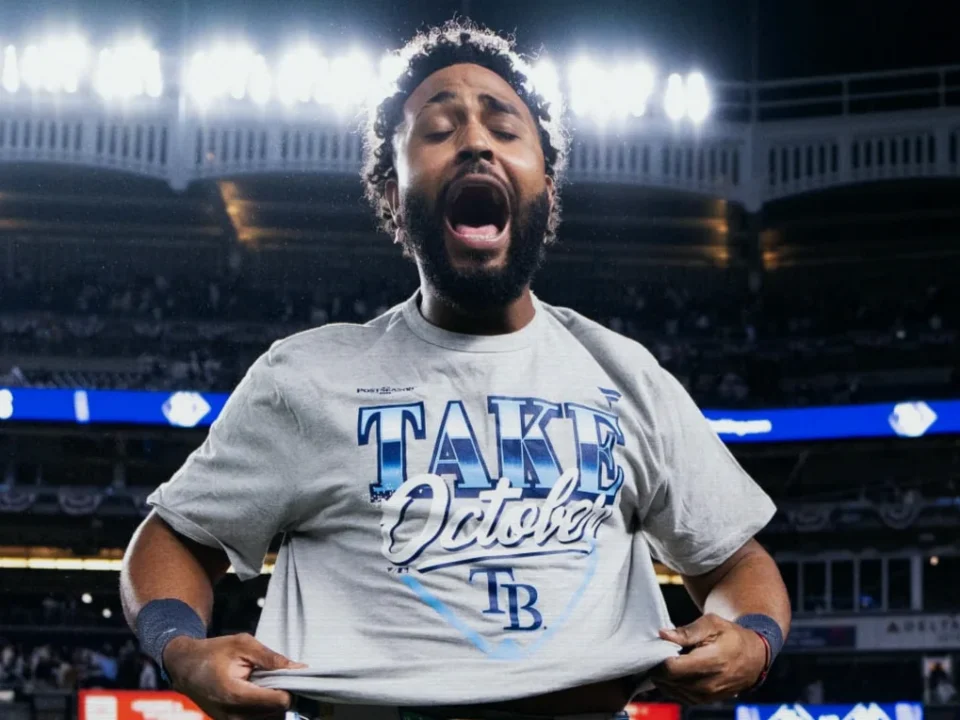
The Rays arrived at the American League Championship Series with 101 wins between the regular season and playoffs, but their calling card is not one narrow formula. Tampa Bay can win with pitching, rangy defense through the middle and across the outfield, contact at the plate or a sudden burst of power.
That versatility takes the spotlight Monday night, when the ALCS opens at Tropicana Field. For all the different routes available to them, the Rays have found one especially reliable marker: get to four runs.
Quick facts
- Tampa Bay went 75-17 (.815) in the regular season when scoring at least four runs, the American League’s best record in that situation.
- Playoff clubs are 18-1 this year and 51-10 (.836) across the past two postseasons when reaching four runs.
- The Rays swept the Yankees in the ALDS, winning 1-0, 5-2 and 4-3.
- Tampa Bay led the AL with 164 stolen bases and ranked first in the Majors in sacrifice hits (45), bunt hits (49) and singles (984).
The one-run Division Series opener was a reminder that Drew Rasmussen and the pitching staff can make a small lead stand up. Still, the next two games showed the broader offensive picture: five runs in Game 2, then four to complete the sweep.
Manager Kevin Cash said the club is built to adjust to the game in front of it. Some nights require matching an opponent’s power, he said, while others call for grinding out a run by any available means.
Pressure without a big swing
Tampa Bay’s speed-and-contact identity was visible all season. The Rays posted MLB’s lowest strikeout rate at 18.8% and made contact on 79.3% of their swings, then used that traffic to lead the AL in infield hits with 143.
They also captured the league stolen-base lead for a third consecutive year. Chandler Simpson supplied speed and contact, while Taylor Walls and Cedric Mullins gave the club capable bunt options.
Those traits can seem old-fashioned in a game centered on exit velocity and launch angle, but they fit Tampa Bay’s personnel. A ball put in play, a stolen base or a well-placed bunt can change an inning without waiting for a homer.
The Rays also led the AL in batting average (.258) and on-base percentage (.326). With runners in scoring position, they hit a Major League-best .284.
Hitting coach Chad Mottola tied that success to shorter swings and a team-first approach. Keeping the ball moving, he said, comes easier when hitters avoid trying to do too much and instead pass the opportunity to the next man.
Power arrived in the second half
The long ball is not Tampa Bay’s central identity, yet it can quickly become the deciding factor. The Rays were 50-2 when they hit more homers than their opponent, the strongest such record by any club in the modern era.
They finished 22nd in the Majors with 169 home runs, but Junior Caminero’s 42 homers gave the lineup a clear centerpiece. Jonathan Aranda and Yandy Díaz each added 22.
There was a sharp change after June 18. Tampa Bay had hit a Major League-low 58 homers through its first 71 games, then produced 111 in the final 91 games, tied for seventh most over that stretch.
Victor Mesa Jr.’s promotion and the addition of Liam Hicks helped deepen the group. Mullins hit 15 homers, Jonny DeLuca and Ryan Vilade each supplied 11, and Richie Palacios found more pop over the final two months than he had shown during the first four.
Palacios said the offensive balance starts with avoiding selfish at-bats. When hitters stop forcing outcomes and play for the group, he said, chances to contribute tend to show up.
That is the Rays’ clubhouse equation heading into the ALCS: take the extra base, put the ball in play, deliver with runners aboard, and do not be surprised when the bottom half of the order changes the game with a drive into the seats.