
In Kolkata, where Brazil meet India in a Saturday friendly, the hosts carry one of international football’s most enduring World Cup stories: India qualified for Brazil 1950, then chose not to travel. More than seven decades later, the episode is still often reduced to a tale of barefoot players and a FIFA ban, but the decision was rooted in the different priorities of the era.
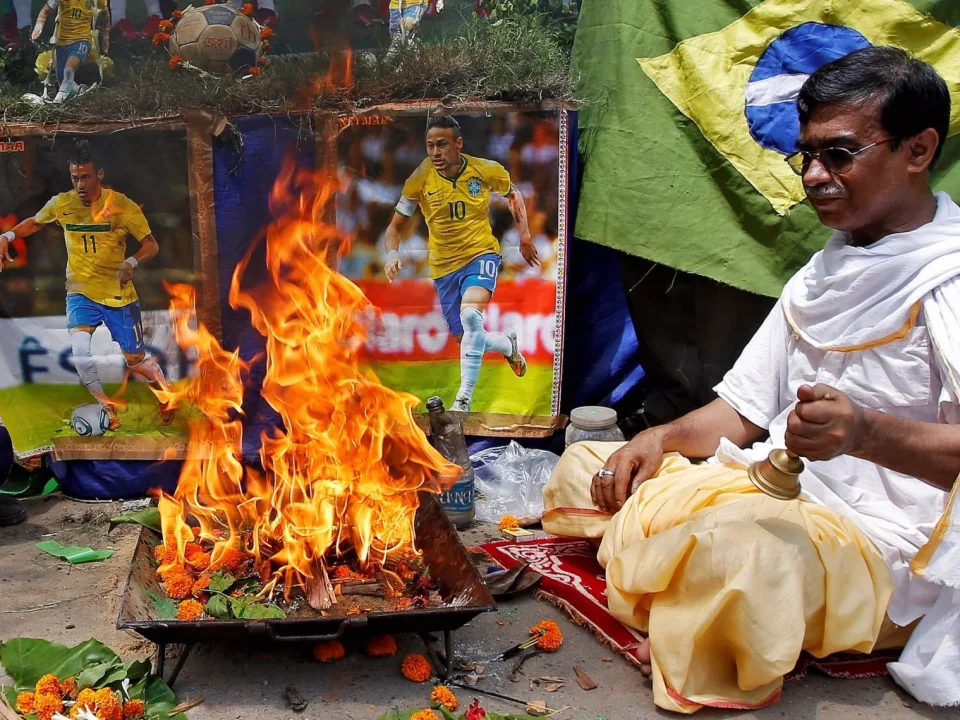
The match is scheduled for 11am Brasília time and brings Brazil to a city where supporters have marked the occasion with Hindu rituals involving the visiting national team. For India, it also revisits a link to the first World Cup staged in Brazil — a tournament the country had a place in but never played.
A place in Brazil that India did not use
India have never appeared at a World Cup. Their sole qualification came in 1950, when the Asian qualifying route collapsed before a ball was kicked. The Philippines, Indonesia and Burma — now Myanmar — all withdrew, leaving India automatically through to the finals.
India subsequently pulled out as well. The absence mattered in a difficult post-war edition of the tournament: the original plan had been for 16 teams, but only 13 took part in Brazil. Neither Asia nor Africa had a representative at the finals.
The most familiar explanation has long been that India withdrew because FIFA would not permit its players to play barefoot. There was some basis for the claim. FIFA did tell the Indian side that bare feet would not be allowed at the World Cup. But the footwear issue was not the decisive reason behind the withdrawal; the decision not to enter had already been made.
The barefoot image from London
The story gained force because India had made an extraordinary impression at the 1948 London Olympics, their first international tournament less than a year after independence from Britain.
In Ilford, on the outskirts of London, India faced France at the now-demolished Lynn Road stadium. Several Indian players took the field without boots, while others were reported to have worn only socks. India lost 2-1, but unsettled a strong French team and were beaten only when René Persillon scored in the 89th minute.
That image travelled far beyond the result and later fed the assumption that a demand to wear boots alone had cost India their World Cup place.
Olympic ambitions outweighed the World Cup
In 1950, however, the World Cup had not yet reached the unchallenged standing it holds today. The Olympic football tournament remained at least as important for many national teams, with no restrictions then separating Olympic squads from full senior international sides.
Financial difficulties were publicly cited around India’s withdrawal, but a closer examination found that the Indian federation had underestimated the value of appearing at the World Cup, despite assurances from the organisers that they would meet most of the touring costs. Kaushik Bandyopadhyay, the Indian football historian who examined the case, identified that failure of judgement as the underlying issue.
Sailen Manna, India’s captain in that period, also confirmed the different status attached to the two competitions. For the Indian team, the Olympics were the central target rather than a World Cup then only in its fourth edition.
India’s subsequent record underlined that focus. They competed at three more consecutive Olympic tournaments — Helsinki in 1952, Melbourne in 1956 and Rome in 1960 — and finished fourth in Melbourne, still the country’s best Olympic football placing.
- Asian Games champions in 1951, when India hosted the inaugural edition;
- Asian Games champions again in 1962 in Indonesia;
- Asian Cup runners-up in 1964.
That stretch remains Indian football’s most successful international era. The Kolkata friendly therefore places Brazil opposite a nation with no World Cup finals appearance, but one whose missing place at Brazil 1950 says as much about football’s changing hierarchy as it does about boots.