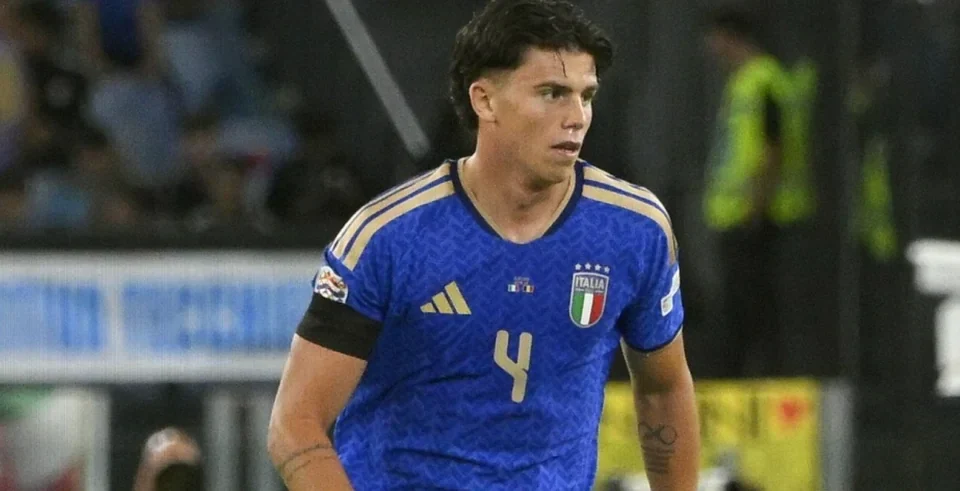
Alessandro Romano’s first mistake for Italy arrived in the most exposed corner of the pitch: an error while playing out from the back that led to Godts’ goal. It was an unhappy introduction to international football, but it has not altered the broader impression around the 20-year-old Cagliari midfielder. Romano has been selected by Mancini because he does not hide when opponents press, because he is prepared to move the ball with one touch, and because he sees a route forward where others might settle for safety.
That appetite has become one of the early themes of Cagliari’s season. Pisacane has handed Romano responsibility at the base of midfield, effectively telling him to take charge, and the response has been immediate. He has played 445 of a possible 450 minutes, scored against Parma and helped the Sardinian side collect 12 points from their first four league matches, a start that has placed them just behind Roma, Lazio and Inter.
For a player with roughly 30 professional appearances behind him, only seven of them in Serie A, it is a considerable vote of confidence. Romano learned his trade in Roma’s Primavera side before taking his first senior steps at Spezia in Serie B. At Cagliari, though, the responsibility is different. He is no longer simply adapting to adult football; he is being asked to give the side direction.
A midfielder who accepts the pressure
Cagliari have moved between a 4-2-3-1, used in their opening four fixtures, and a 3-5-2. The basic idea in possession has remained familiar. With Obert pushing higher and Ze Pedro staying deeper, the defence forms a back three, while Romano and Winks provide the next line in midfield. Romano has become a key reference point in that five-man construction.
His standing rests largely on how he handles the first challenge from the opposition. Romano ranks tenth in Serie A for completed passes under pressure, in company with far more established midfielders such as Nicolò Barella and Luka Modrić. His frequency of first-time passes is also among the highest for Serie A holding midfielders, an indication of a player who looks to speed up play rather than merely survive the press.
Against Udinese, that instinct was clear in a series of quick combinations. Romano played passes almost automatically, but not as hopeful clearances. He trusted that a free teammate would be available, with Mendy and Adopo often the intended outlets. It is an approach he has carried from Roma’s youth system through Spezia and into this Cagliari side: he wants possession, and he wants to use it constructively.
That desire also explains the risk in his game. Romano can lose the ball, particularly when he tries to play through congested areas rather than choosing the uncomplicated option. Yet Cagliari have accepted that trade-off because he recovers possession even more often. He averages 8.2 ball recoveries per match and around five interceptions, while ranking fourth in defensive duels and tenth among Serie A midfielders for total duels won.
His goal against Parma captured another side of the player. It began not with a quiet piece of distribution but with a defensive intervention designed to disrupt Parma’s own build-up. Romano often steps forward to harry the ball carrier, more regularly than Winks, and his influence therefore extends beyond the conventional image of a deep-lying playmaker.
He also takes free-kicks and averages at least one attempt on goal per game, often creating the shooting chance himself. There is personality in those decisions, as well as the occasional excess that comes with a young midfielder asked to play with initiative.
Inter are among the clubs monitoring him, with his role suggesting a possible long-term successor to Hakan Çalhanoğlu in positional terms. Any direct comparison would be premature. Romano is still at the beginning of his Serie A education, and his difficult Italy debut served as a reminder that development is rarely clean or linear.
But Cagliari’s opening weeks have offered a clearer picture than that one error. Romano is a midfielder willing to receive under pressure, to press without the ball and to take responsibility in a side enjoying an unexpectedly strong start. He will play often this season, make further mistakes and learn from them. What Cagliari have already discovered is that taking away his instinct to play quickly would mean taking away the quality that has brought him this far.