October does not always belong to the club that looked best across 162 games. A long season exposes thin rotations, soft spots in the lineup and unreliable middle innings. A short series can let a manager put his best arms on the mound, turn a lead over to the premium relievers and ride one hot hitter before the other dugout has time to adjust.
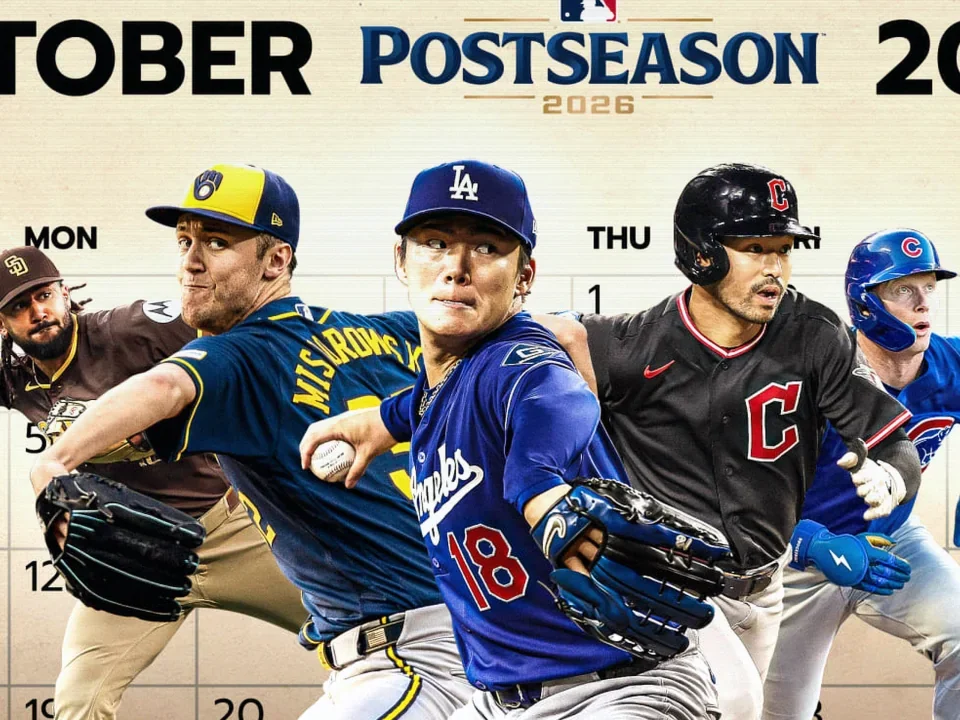
That is why the Dodgers remain the obvious problem in the projected field, but they are hardly the only one. Milwaukee has built the league’s most complete operation. Cleveland has discovered front-end pitching at the right moment. The Cubs can bury opponents with offense and defense, while San Diego has the late-game bullpen that can make a six-inning lead feel like a locked door.
Why October changes the equation
- Over six months, depth is the separator. A club can cover for a weak spot temporarily, but not forever.
- In the postseason, off-days allow the best starters to work more often and reduce the burden on the back end of a rotation.
- Managers can deploy their top relievers earlier, making a game effectively shorter once a lead is in hand.
- Power, an ace starter or one star’s hot streak can decide a series before the broader strengths of a roster have time to show.
- The flip side is brutal: a middle-of-the-order bat can survive a 2-for-20 stretch in April, but the same skid in October can send everybody home.
The clubs most capable of flipping a series quickly tend to have concentrated talent: two or three starters who can own a matchup, a bullpen that can finish the final three or four innings, and enough lineup thump to avoid needing a string of singles against October pitching.
Dodgers still set the standard
Los Angeles carries the clearest October profile. There are legitimate concerns around Blake Snell and Shohei Ohtani, Edwin Díaz has not become the late-inning answer the bullpen expected, and the club’s slugging percentage has fallen by more than 10 points from each of the previous two seasons. Even so, this remains the team most opponents would prefer to miss.
A rotation fronted by Snell, Tarik Skubal, Yoshinobu Yamamoto and Tyler Glasnow gives the Dodgers overwhelming options for a short series. The lineup is getting older, but it remains among baseball’s strongest, with eight qualified hitters carrying an OPS+ of at least 100. That is the most among the projected postseason teams.
They are still the World Series favorite, with FanGraphs placing their championship probability at 29.3%.
Milwaukee brings a fuller kind of danger
If the Dodgers have the most imposing star power, the Brewers may be the more difficult club to pick apart. Milwaukee leads the majors in run differential and has gone 82-44 since May 1, five games better than the next-best Rays over that stretch. After April, the Brewers have been above average in every month.
Jacob Misiorowski has been the sport’s most dominant pitcher this season and has not faded as the year moved along. His second-half K-BB rate sits at 29%, with his high-end velocity still intact. Logan Henderson has been nearly as hard to handle since the All-Star break, posting a 2.22 ERA, holding hitters to a .171 average and producing a 26.9% K-BB rate.
Getting through the starters does not solve much. Milwaukee’s relief group ranks fourth in the majors with a 3.41 ERA and third with 6.6 fWAR. The Brewers also pair that pitching with excellent defense.
The offense does not lean on elite home-run power, but it keeps the line moving. Seven qualified Milwaukee hitters own an OPS+ of 100 or better, second only to Los Angeles among the expected playoff field. For perspective, Philadelphia has two such qualified hitters.
The Brewers entered Tuesday having gone 17-9 over the prior 30 days, tied for the second-best record in baseball. Their 13.9% title chance trails only the Dodgers, and their roster has the balance to travel from the regular season into October.
Cleveland has found a route through the American League
The Guardians appeared headed nowhere only a few weeks ago. Now they are closing in on a postseason berth and could even land a bye in a wide-open American League race.
- Cleveland strengthened its roster at the Trade Deadline, one of the clubs that came away meaningfully better.
- Steven Kwan and other first-half strugglers began to rebound, helping wake up an offense that had dragged for much of the year.
- Since Aug. 1, the Guardians have scored 216 runs, eighth most in the majors entering Tuesday.
- The club has also created platoon edges in 77% of its plate appearances, leading baseball and well ahead of the 58.3% league average.
- Gavin Williams and Parker Messick have developed into front-line starters, with Tanner Bibee providing a formidable third option.
That rotation is Cleveland’s real October calling card. The Guardians are one of three projected playoff teams with two pitchers ranked in the top 10 in second-half fWAR, joining the Dodgers and Phillies. Middle relief has been a season-long concern, but postseason scheduling could allow Cleveland to shift a starter into relief and create a better bridge to closer Cade Smith.
Most teams that hover near .500 for long portions of a season do not have that kind of rotation ceiling. Cleveland entered Tuesday tied with the Dodgers, Brewers, Braves and Padres at 17-9 during the previous month. Only Tampa Bay, at 19-8, had been better.
As the bracket stood entering Tuesday, Cleveland would draw the winner between the White Sox, with a +42 run differential, and Rangers, at -34, in the ALDS. The AL East contenders would be positioned on the opposite side. That is a favorable road for a team that has become far more dangerous than its earlier record suggested.
The Cubs are trying a different October formula
Chicago’s case is built less on a dominant rotation than an offense and defense capable of overwhelming even playoff-caliber pitching. The Cubs lead the majors in runs, with 835, home runs, with 217, and wRC+, at 115.
Alex Bregman’s availability remains uncertain, but the rest of the lineup has been surging. Chicago has recorded a 125 wRC+ in the second half, then raised that number to 134 over the past month. The club is also the major-league leader in both Defensive Runs Saved and Outs Above Average.
The 2018 Dodgers offer a useful historical parallel. That Los Angeles club led the National League with a 111 wRC+, produced a 134 mark across its final 30 days, played elite defense and did not possess an overpowering rotation. It won 92 regular-season games, then reached the World Series.
An ace always helps, but the Cubs have shown that a club can take another route: score relentlessly, catch everything and make an opponent keep pace for nine innings.
San Diego is peaking behind Tatis and a shutdown bullpen
The Padres have spent much of the season as a hard club to read, much like Fernando Tatis Jr. himself. He did not hit his first homer until May 30, then turned around and launched 24 from the start of June onward, including 10 in the past month. Since June began, his 150 wRC+ ranks eighth in the majors.
He has company. Jackson Merrill has led San Diego with a 162 wRC+ over the past month, and Ty France has matched him. As a team, the Padres own a 118 wRC+ in that span, third best in baseball.
The pitching staff has gained depth and health at an ideal time.
- Nick Pivetta returned from a lengthy absence and delivered a 1.93 ERA in three September starts.
- Michael King has won 12 games while posting a 3.03 ERA, outperforming his underlying indicators.
- Trade Deadline addition Robbie Ray supplies another experienced rotation choice.
- With a lead, San Diego can hand the ball to Adrian Morejon and Mason Miller, giving the Padres one of the game’s most intimidating finishing combinations.
That final point may be the one that matters most. In October, a bullpen that can erase the last few innings changes the math of every close game. The Padres may be the wild card among the wild cards, but if Tatis and the lineup stay hot and the late innings belong to Morejon and Miller, they will be nobody’s comfortable draw.