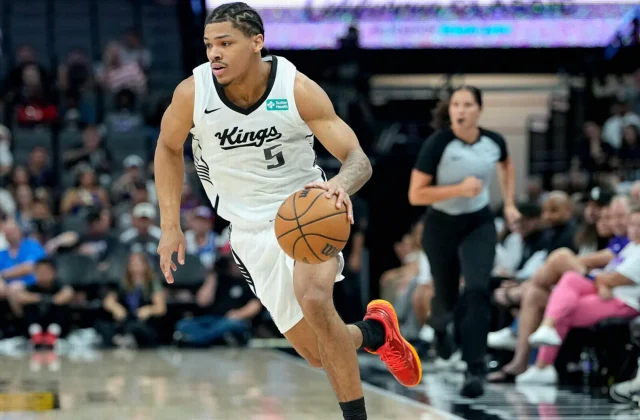
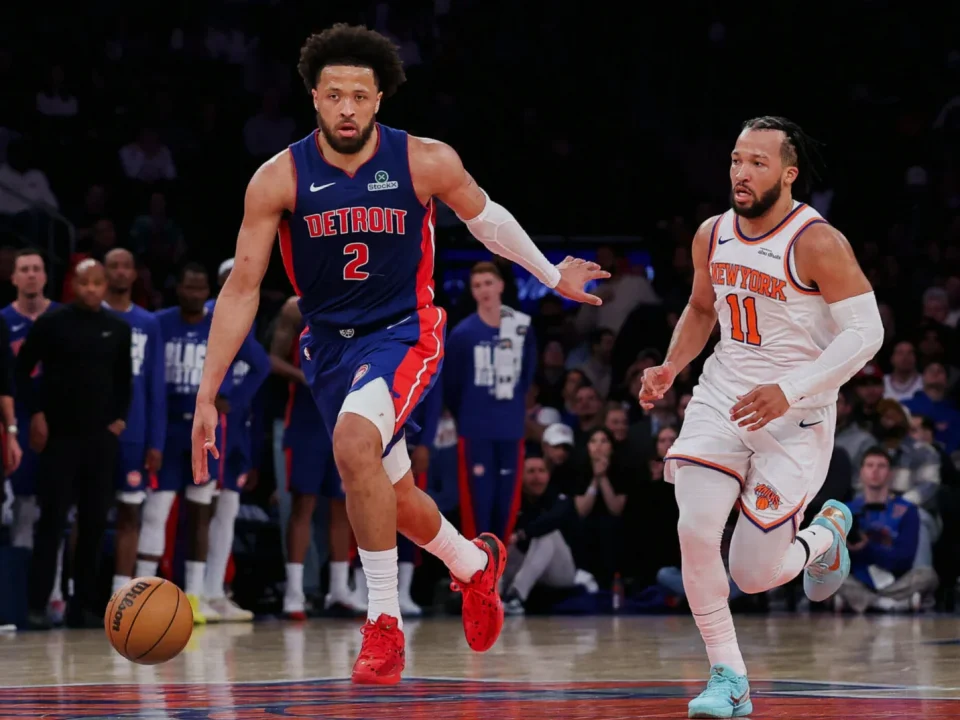
With the 2026-27 NBA season two weeks away, a 12-team Yahoo points mock draft offered a clear warning for managers building from the back half of the first round: do not confuse a quiet early market for a deep center pool. The bigs lasted longer than expected, then disappeared in a hurry once Round 6 opened.
The 13-round exercise used Yahoo’s standard points settings and lineup requirements, including two starting center slots. Nikola Jokić went first overall, ahead of Victor Wembanyama, while the room leaned heavily toward ballhandlers through the opening two rounds. The board changed sharply once the middle tiers of starting centers came into play.
Jokić stays at the top in Yahoo points
Jokić was the No. 1 selection, followed by Wembanyama, Shai Gilgeous-Alexander and Luka Dončić. In a format that awards 1.5 points per assist, Jokić’s passing separates him even from Wembanyama. He is projected at 63.1 fantasy points per game, nearly four points ahead of the Spurs center.
Six of the first 12 players carried point-guard eligibility. Cade Cunningham went fifth, followed by Giannis Antetokounmpo, Anthony Edwards, Jayson Tatum, Jalen Johnson, Cooper Flagg, Tyrese Haliburton and Tyrese Maxey.
Johnson and Flagg came off the board at Nos. 9 and 10 because both can produce across the box score rather than relying on one scoring category. Haliburton went 11th after a missed season, with a projection of 9.3 assists against 1.9 turnovers over roughly 65 games.
The guard push continued in Round 2. Seven of the 12 selections had point-guard eligibility, including Donovan Mitchell at No. 14, Josh Giddey at 15, Austin Reaves, Amen Thompson, Jalen Brunson, Devin Booker and Jamal Murray. Trae Young then began Round 3 at No. 25.
Giddey went notably ahead of his Yahoo average draft position near 24, but the points-league case is straightforward: his projected 16.9 points, 8.0 rebounds and 9.1 assists translate to 41.4 fantasy points per game. Mitchell, meanwhile, is projected for 26 points, 5.1 assists and 1.4 steals across 69 games after posting 27.9 points, 5.7 assists and 1.5 steals on 48 percent shooting in 70 games last season.
The board turns when the centers arrive
Only six center-eligible players were drafted through the first two rounds. Then the first frontcourt wave landed in Round 3: Evan Mobley, Anthony Davis and Bam Adebayo went with consecutive picks from 26 through 28. Domantas Sabonis followed at 31, then Jalen Duren at 33.
Davis went well ahead of his 42.7 Yahoo ADP, but his projected 48.1 fantasy points per game led every player selected in that round. Availability remains the issue. LeBron James, selected at No. 35, is projected for a 20-point, 6.5-rebound, 7.5-assist line in Philadelphia, but only 63 games because of foot arthritis concerns at age 41.
Round 4 kept the pressure on center-needy rosters. Chet Holmgren was chosen 37th, Walker Kessler 42nd and Donovan Clingan 44th. Kessler is projected for only 13.3 points per night, but his 11.3 rebounds and 2.5 blocks lift him to 38.7 fantasy points per game. Clingan projects at the same 38.7 mark.
After four rounds, three rosters had not taken a center-eligible player: the groups built around Tatum, Reaves, Jaylen Brown and Jalen Williams; Flagg, Giddey, Kawhi Leonard and Deni Avdija; and Haliburton, Mitchell, James and Stephon Castle. One roster had already claimed Sabonis and Kessler, getting ahead of Yahoo’s two-center lineup requirement.
Castle, selected at No. 38, was one of the draft’s largest early value calls. His Yahoo ADP was 53.9, while a projection of 18 points, five rebounds, seven assists and more than one steal over at least 70 games put him far higher on the internal board. His role as Wembanyama’s primary setup man is central to that projection.
Round 6 becomes the frontcourt deadline
The decisive center run began at No. 62. From picks 62 through 79, 10 of 18 players had center eligibility: Ivica Zubac, Zach Edey, Jarrett Allen, Onyeka Okongwu, Rudy Gobert, Naz Reid, Alex Sarr, Kel’el Ware, Derik Queen and Zion Williamson.
That stretch effectively emptied the tier of starting centers projected for at least 35 fantasy points per game. For Yahoo points managers, the practical takeaway is to secure a starting center by the middle of the sixth round rather than assuming the position can be addressed later without giving up production.
- Zubac was selected at No. 62 with a projection of 14.8 points, 11.2 rebounds and 63 percent shooting, worth 38.1 fantasy points per game.
- Okongwu lasted to No. 69, 14 spots beyond his 54.9 ADP, making him a value at his projected production level.
- Williamson went 79th despite a 37.9 fantasy-points-per-game projection. The health risk remains, but the seventh-round price reflected it.
- Nic Claxton at No. 91 and Myles Turner at No. 95 represented the last starting-level center options in the mock.
The late-round lesson was just as stark. Jusuf Nurkić went at No. 120 with a 34.4 fantasy-points-per-game projection. Guards in that neighborhood, including Davion Mitchell at 117 and Jeremiah Fears at 111, projected at 23.1 and 26.5 respectively. One roster ended with six center-eligible players, more than any other team, and Jokić was only the headliner.
Risks, rookies and notable values
Joel Embiid lasted until No. 58 as the first big taken by the Flagg-Giddey-Leonard-Avdija roster. He remains projected for 41.6 points per game, but the games-played projection is just 48. His reportedly lighter weight entering the season provides some optimism, though his recent availability keeps him in a different tier of risk.
Rookie Cameron Boozer was the first first-year player taken, at No. 51. His projected 16.8 points and 8.0 rebounds should fit points scoring, although that selection came ahead of his 55.9 ADP. The youth-heavy roster later added Caleb Wilson at 84, AJ Dybantsa at 85, Darryn Peterson in Round 10 and second-year forward Ace Bailey in Round 11.
That construction leaned into a points-league quirk: inefficient, shot-hunting young players can still return value when field-goal percentage does not carry its usual category-league penalty. The necessary condition is a reliable minutes load and a defined offensive role.
Kon Knueppel was the draft’s biggest tumble, lasting to No. 81 after carrying a 47.6 Yahoo ADP. He is expected to miss the full preseason with a hamstring injury, and his efficiency-based strengths matter less in points formats. Ja Morant, by contrast, became a discounted upside play at No. 86. His ADP sat at 90, but a healthy season could put him back in the top 50 after a projected 20-point, three-rebound and seven-assist profile.
De’Aaron Fox went 83rd despite a ranking 26 places higher on the board. His injury affected his biggest-stage performance, but his first full regular season in San Antonio still supported a buy-low case. Pairing Fox with Castle created a double investment in the Spurs’ backcourt.
Other value calls included RJ Barrett at No. 107, Keegan Murray at No. 110 and Darius Acuff Jr. at No. 103. Barrett’s volume is especially useful in points leagues, where turnovers, free-throw percentage and cold shooting are less damaging. Murray is projected for 34.4 minutes, six rebounds, close to one steal and one block, totaling 31.5 fantasy points per game. Acuff’s ranking sat at 87 despite a Yahoo ADP of 109.6.
Draft board highlights
| Round | Key selections | What it showed |
|---|---|---|
| 1 | Jokić, Wembanyama, Gilgeous-Alexander, Dončić, Cunningham, Antetokounmpo, Edwards, Tatum, Johnson, Flagg, Haliburton, Maxey | Elite guards drove the opening round, but Jokić’s assists made him the preferred points-league anchor. |
| 2 | Sengun, Mitchell, Giddey, Barnes, Reaves, Banchero, Thompson, Towns, Durant, Brunson, Booker, Murray | Point-guard eligibility remained the market’s priority. |
| 3 | Young, Mobley, Davis, Adebayo, Ball, Harden, Sabonis, Brown, Duren, Leonard, James, Curry | The first meaningful center wave hit the board. |
| 4 | Holmgren, Castle, Avdija, Miller, Williams, Kessler, Irving, Clingan, Markkanen, Garland, White, Murphy | Managers without a center began to feel the squeeze. |
| 5 | Jackson, Wagner, Boozer, Siakam, George, Bane, Alexander-Walker, Murray, Buzelis, Embiid, Randle, Porter | Embiid’s fifth-round placement captured the gap between per-game upside and availability. |
| 6-7 | Zubac, Edey, Allen, Okongwu, Gobert, Reid, Sarr, Ware, Queen, Williamson | The draft’s defining center rush stripped the middle board of dependable starters. |
| 8-9 | Morant, George, Quickley, Hart, Bridges, Claxton, Turner, Hartenstein, Smith, Sharpe, Queta, Acuff, Barrett | Risk-reward guards and the final credible center options came into focus. |
| 10-13 | Peterson, Murray, Fears, Collins, Nurkić, Poeltl, Gordon, Green, Gafford, Carter, Mitchell, Wallace, Porter, Wagler, Butler | Managers increasingly ignored ADP, chased role-specific sleepers and added frontcourt depth. |
Late rounds move away from ADP
Early on, the room stayed close to Yahoo’s market. Players in Rounds 1 through 3 were selected within roughly four spots of their ADP on average. By Rounds 10 through 13, the average difference climbed to 25 spots, partly because late Yahoo ADPs cluster tightly around the 116-to-121 range and partly because managers started drafting for individual projections.
The final round was built around upside rather than floor. Keaton Wagler was selected with the possibility that Max Strus’ foot injury could create opportunity. Ajay Mitchell, Cason Wallace and Kevin Porter Jr. also went as higher-ceiling swings.
Kristaps Porziņģis went undrafted because he is out indefinitely with an undisclosed illness. Jonathan Kuminga, Bennedict Mathurin and Nikola Vučević were also not selected. Kuminga showed some early preseason pop with Minnesota and could merit a late selection in a future draft, while Mathurin and Vučević project more as waiver options unless injuries alter their workloads.
A closing build of Aaron Gordon at No. 131, Draymond Green at 134 and Jimmy Butler III at 155 addressed delayed frontcourt depth while using the final pick as a stash. Butler is projected for only 36 games, but a return in early 2027 could make him a useful second-half starter in Yahoo points formats.
The mock’s main message was simple: guards can be found throughout the board, and late fliers at the position frequently project for modest totals. Center scarcity is different. Once Round 6 turns, a manager waiting for a second starting big is no longer hunting for value; that manager is trying to survive the run.