AC Milan’s season is only a month old, yet the central concern at Milanello is not the first defeat itself but the lack of a discernible direction. Since the opening match against Torino on 22 August, Ruben Amorim’s side have appeared to lose rather than gain certainty in selection, defensive work, approach and attacking play.
Results still leave room for patience, but the technical picture has become harder to read. Amorim wants an assertive, attacking team, while his repeated changes have made it difficult for the players to establish connections. The issue is particularly clear behind striker Ramos, where Milan are still looking for the right pair of attacking midfielders.
Pulisic offers the clearest answer
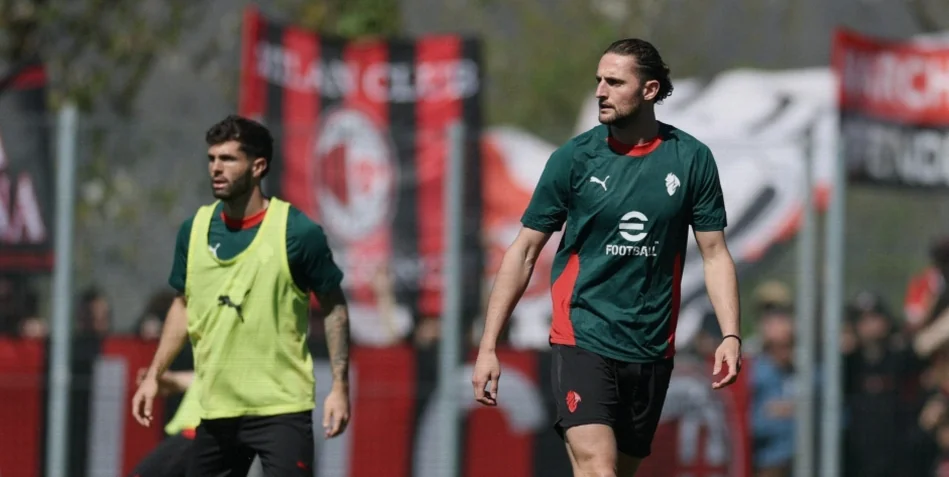
Christian Pulisic is expected to become a regular once he has fully put his injury after-effects behind him, potentially as soon as the meeting with Lecce. He is likely to operate on the left of the two positions behind Ramos, with licence to move across the forward line.
His contribution in Rome against Lazio showed why he is valued in that role: Pulisic moved over to the right before creating Moreira’s goal. Unlike several of Milan’s other options, he can also attack space beyond the defence rather than simply coming short to receive the ball.
That leaves the other position unsettled. Adrien Rabiot and Omari Hutchinson are the left-footed candidates, although Hutchinson has yet to make a convincing case. Rabiot has found the crowded areas higher up the pitch less comfortable than the spaces he sees when starting deeper. Moreira could be tried there, while Jashari may also enter Amorim’s thinking.
Five pairings, no settled partnership
Across the first five matches, Amorim has used five different starting combinations behind Ramos. None has yet established itself as the partnership around which Milan can build their attacking identity.
- Ruben Loftus-Cheek and Alpha Cisse started against Torino, Venezia and Lazio. It has been the most frequently used pairing, but without a decisive collective impact. Loftus-Cheek has not matched the level he reached under Stefano Pioli, while Cisse has been one of the early surprises, scoring twice. The young player’s promise is clear, though Milan must avoid placing too much responsibility on him too quickly.
- Rabiot and Alexis Saelemaekers were selected against Juventus, where the combination did not work, particularly for the Belgian. Saelemaekers did, however, supply Ramos for the opening goal after coming on against Venezia.
- Cisse and Hutchinson began against Benfica. Both tend to ask for the ball to feet, take on opponents and move towards possession, rather than repeatedly running in behind.
Amorim has also tested alternatives during matches. Hutchinson and Pulisic shared the line for the final ten minutes of the comeback against Lazio, after Milan had recovered from a two-goal deficit. They were often too far apart, with Omari still adapting to Italian football.
Pulisic and Saelemaekers then featured together for the final half-hour against Benfica. Both are right-footed and can work in tight spaces, but their tendency to drift towards the left created congestion rather than complementing each other.
Fresh legs versus familiarity
There is a clear logic to Amorim’s management: he wants energy around the penalty area late in games. Yet he has not finished any match with the same two attacking midfielders who started it, making changes in that department at roughly the 59th minute on average.
The policy may help Milan maintain intensity, but it also delays the development of the automatisms the side currently lacks. The team do not yet have a settled starting XI or a recognisable attacking framework, and the uncertainty around the two players behind Ramos reflects a broader instability.
For now, Pulisic is the one established point in the equation. The search continues on the opposite side, ideally for a left-footed player. Hutchinson was brought in with that job in mind, but his place is not secure. Amorim has further experiments available, and Milan need him to turn them into a coherent plan quickly.