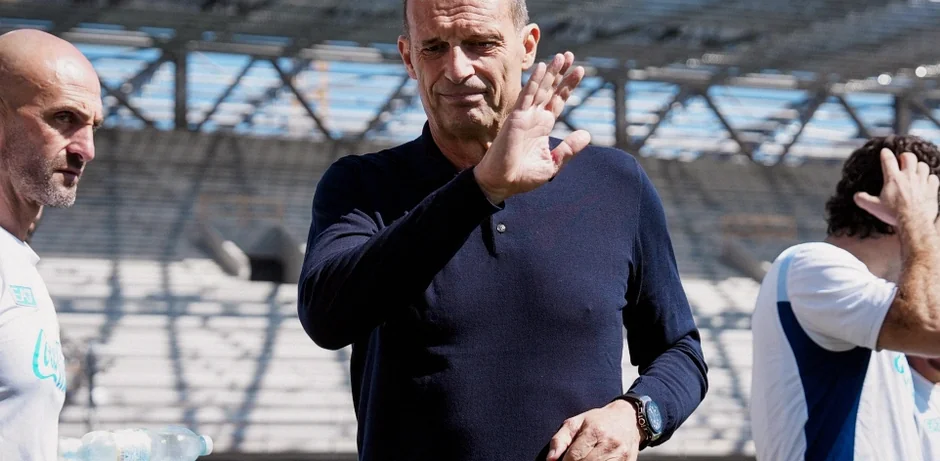
Napoli’s October has become a test of Massimiliano Allegri’s place in the modern Italian game. A coach long defined by his ability to protect a team in difficult moments is instead overseeing a side that looks uncertain, vulnerable and increasingly short of conviction.
The numbers give the concern its shape. Napoli have lost five of their first nine matches in all competitions, including the Champions League. Across Allegri’s past 15 Serie A fixtures — eight with Milan last season and seven with Napoli — his record is five wins, two draws and eight defeats, worth 1.13 points per game.
That was relegation-level form in the long run, and it helped Milan miss Champions League qualification. At Napoli, it has already placed a heavy weight on a season that was meant to begin a new chapter after Antonio Conte.
Quick facts
- Napoli have suffered five defeats in nine games across league and Europe.
- Allegri’s last 15 Serie A matches have produced five victories, two draws and eight losses.
- Napoli have switched between three- and four-man defensive lines, while also altering Kevin De Bruyne’s role and their midfield structure.
- Recent losses to Villarreal and Venezia featured major individual errors, despite Napoli posting substantially higher expected-goals totals than their opponents.
- De Laurentiis chose Allegri after delaying a wider squad rebuild following Conte’s departure.
Allegri has always been associated with results before spectacle. His old line that those seeking entertainment should go to the circus captured a philosophy built on control, balance and defensive reliability. In earlier years, his teams were rarely allowed to collapse; even when their ceiling was limited, they usually reached the minimum target.
That protection is missing now. Napoli do not appear to have a settled identity in mid-October, and the frequent adjustments have not yet looked like the product of a clear, rehearsed plan. A back three becomes a back four, one deep midfielder becomes two, and De Bruyne moves higher or lower without the impression of a side fully comfortable in any version.
Flexibility can be an asset, particularly with players capable of changing positions during a match. Here, though, the changes have often resembled responses to immediate problems rather than variations developed over time on the training ground.
Conte’s Napoli, even during poorer spells, were more recognisable. They carried authority in their positioning and appeared to understand the task in front of them. When Conte warned last year that he did not want to “carry a dead body”, he was speaking after a poor display, but he eventually brought the group together and finished second.
Allegri’s Napoli have not found the same response. The distances between the lines have opened up, the defensive structure has become loose and opponents have been offered too much. The side have also maintained their intensity only in spells, which has fed the sense of a squad losing faith in its direction.
A coach under a harsher light
The criticism goes beyond one difficult month. Allegri’s detractors argue that the football has become too predictable: slower possession, priority given to cover behind the ball, and insufficient attacking construction. Preventing goals remains an essential basis for winning, but it cannot be the entire plan.
There was a more inventive Allegri in his first Juventus cycle. In 2016-17, he reshaped the side into a 4-2-3-1 with Mario Mandzukic wide on the left, Miralem Pjanic and Sami Khedira as the midfield pair, and Dani Alves allowed to move inside as an additional playmaker.
That Juventus side, protected by the BBC defensive unit, did not merely wait for moments to fall its way. It attacked with force and clarity, notably in the Champions League quarter-final against Barcelona. The quality of the squad mattered, but so did the coach’s ideas.
Since then, the argument is that Allegri has become more rigid. His belief that players’ technical level matters more than coaching work has been increasingly challenged by results, especially once he stopped working with elite groups. His second Juventus spell brought one Coppa Italia in three seasons, followed by disappointments at Milan and now a difficult start in Naples.
Allegri once divided coaches into those who win and those who do not, insisting that the former are simply better. His recent record makes that judgement uncomfortable when applied to himself.
The club’s unfinished transition
There are, however, factors that cannot be placed entirely on the bench. Aurelio De Laurentiis selected Allegri partly because he is a coach who publicly works within the club’s limits. He rarely confronts the hierarchy in public and tends to offer reassurance rather than demands.
Conte had made clear that Napoli required rebuilding, while Vincenzo Italiano, also considered for the role, requested additions to the squad. De Laurentiis instead restricted spending in the last summer window and turned to Allegri, who did not insist on major arrivals. Gabriel Jesus appealed to him, but it quickly became clear that such a move was not realistic.
Napoli are carrying the end of a memorable cycle, one that delivered two Scudetti and many defining wins. Yet the renewal has been postponed, creating the risk of wasting a campaign while rivals move ahead.
Allegri has also worked through difficult institutional settings before. At Milan, he inherited a club without a sufficiently strong sporting structure. At Juventus in 2022-23, he navigated the repeated uncertainty of points deductions being imposed, removed and restored.
Those experiences have often left him as the principal reference point inside troubled dressing rooms. Napoli’s current limitations in resources and squad renewal are therefore part of the case in his defence.
Fine margins in Villarreal and Venice
The last two matches also offered evidence that performance and result have not always aligned neatly. Against Villarreal, Rasmus Hojlund struck the crossbar from close range when he could have doubled Napoli’s lead, before Matteo Politano sent an opponent through on goal.
Against Venezia, Amir Rrahmani handed Adams the opening goal and De Bruyne missed a penalty. Napoli finished both matches with expected-goals figures clearly higher than those of their opponents.
That does not erase the deeper issues. In Spain, Napoli fell apart after the first setback and created little after the interval. In Venice, their first half was far below the required level. Still, they could realistically have drawn with Villarreal and beaten Venezia, and the language around a full-blown crisis would have been less severe.
De Bruyne remains another unresolved part of the story. One missed penalty is an isolated incident, but his struggle to adapt to life at Napoli has been more persistent. He had misunderstandings under both Conte and Allegri, two coaches with very different methods, which suggests the responsibility cannot sit only with the current manager.
When De Bruyne has connected with the team, as he did against Frosinone, Napoli’s level has risen sharply. It has happened too rarely, and Allegri needs more than occasional flashes if he is to restore order to the campaign.
The defence of the coach has substance: an aging cycle, limited investment, individual mistakes and chances missed at decisive moments. But the case against him remains stronger for now, because Napoli lack both the solidity traditionally associated with Allegri and a convincing alternative with the ball.
In Italy, the final judgement is rarely delivered in October. It is written over Sunday afternoons, by points, performances and the ability of a coach to give his side a direction when the season begins to turn against it.