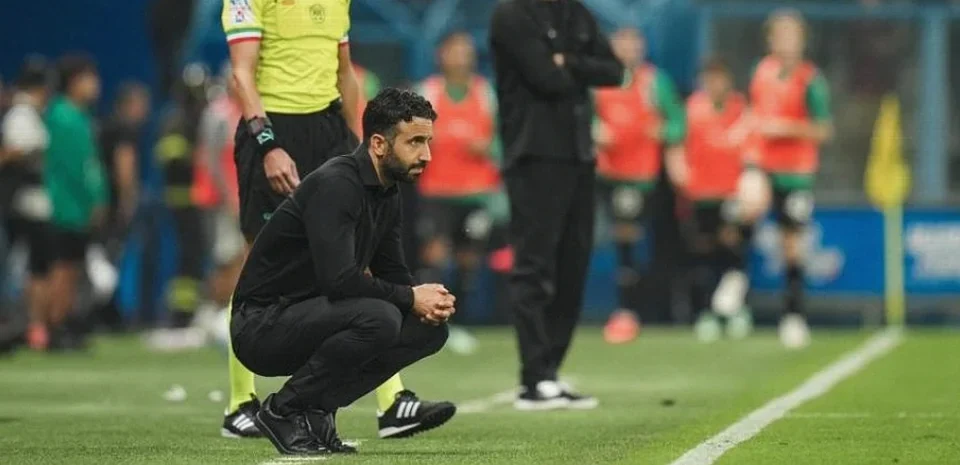
Ruben Amorim’s Milan are learning that tactical flexibility is not a cure in itself. The Portuguese coach took his side to Reggio Emilia with a 4-4-2 from the opening whistle against Sassuolo, only to return to his more familiar 3-4-2-1 after the interval, when Milan finally moved in front. The evening at the Mapei Stadium offered a clear reminder: changing the shape can create possibilities, but the players’ movement, tempo and concentration still decide whether those possibilities matter.
Key takeaways
- Amorim started Milan in a 4-4-2 against Sassuolo before restoring the 3-4-2-1 in the second half.
- The new approach had previously appeared after half-time against Benfica and Lecce, before being tested again in a Milanello friendly with Padova.
- Milan’s squad for the Padova test was heavily reduced by the absence of 15 players on international duty.
- Amorim believes the issue is not simply three defenders versus four, but the principles and freedom within the team’s play.
- Samuel Chukwueze had fewer defensive responsibilities in the four-man system, yet Milan’s slow attacking performance limited its value.
- Sassuolo’s Odenthal scored from a set piece while Milan were set defensively but failed to react to the ball’s path.
A coach adjusting his old certainties
For much of his career, Amorim has been portrayed as a coach wedded to his system. He did little to discourage that view. During his time in Manchester, he said that nobody could persuade him to alter his approach, not even the Pope.
At Milan, however, the outlines of a compromise have become increasingly visible. A back four, once difficult to associate with a coach so closely linked to a three-man defensive line, has entered the discussion. Amorim’s point is that the numbers on the team sheet do not tell the whole story. “It is not about a back four or a back three,” he explained. “It is about interpretation and playing principles. If you look closely, the players are ultimately the same.”
There is truth in that argument. Modern teams frequently alter their structure between possession and defending, sometimes more than once during a match. A side may defend with four players across the back and build attacks with three, as Milan themselves had done before Amorim arrived.
Still, the distinction is not merely theoretical. A four-man defence can release an extra player higher up the pitch, changing the balance of duties and offering greater attacking support. The early signs of Amorim’s greater openness came in the second halves against Benfica and Lecce, and he repeated the idea in the friendly against Padova at Milanello. Even with 15 internationals missing, the exercise suggested the coach was exploring more than a one-off solution.
Reggio Emilia exposed the limits of the system
Before facing Sassuolo, Amorim had presented the adjustment as a practical tool rather than a declaration of tactical revolution. He said Milan had shown more mobility in recent matches and that the increased positional freedom could help the side play in a different manner. Against Benfica, he noted, there had been more possession but not enough movement. The change was necessary, he said, not because one formation was automatically better, but because it gave Milan another way to seek victory.
That distinction mattered at the Mapei Stadium. The initial 4-4-2 did not produce the performance Milan had hoped for. The circulation of the ball was too slow, movement away from it was limited, and the team rarely threatened the opposition penalty area. In those conditions, the extra attacking freedom offered by the shape brought little reward.
Chukwueze illustrated the point. With fewer defensive tasks to fulfil, he was able to focus more on attacking situations. Yet without collective speed or conviction, that individual freedom did not turn into a sustained Milan threat.
Amorim’s switch back to 3-4-2-1 after the break coincided with Milan taking the lead, but the match also underlined that no formation can compensate for basic failures of execution. Sassuolo’s Odenthal found the net from a dead-ball situation despite Milan being in their defensive positions, with the team watching rather than responding as the delivery travelled through the area.
There will be those who argue that Amorim should settle on one system and pursue it consistently. For Milan, though, the more urgent question is not whether the defence contains three or four players. It is whether the side can play with the intensity, movement and attention required to make either structure work on a Sunday afternoon in Serie A.