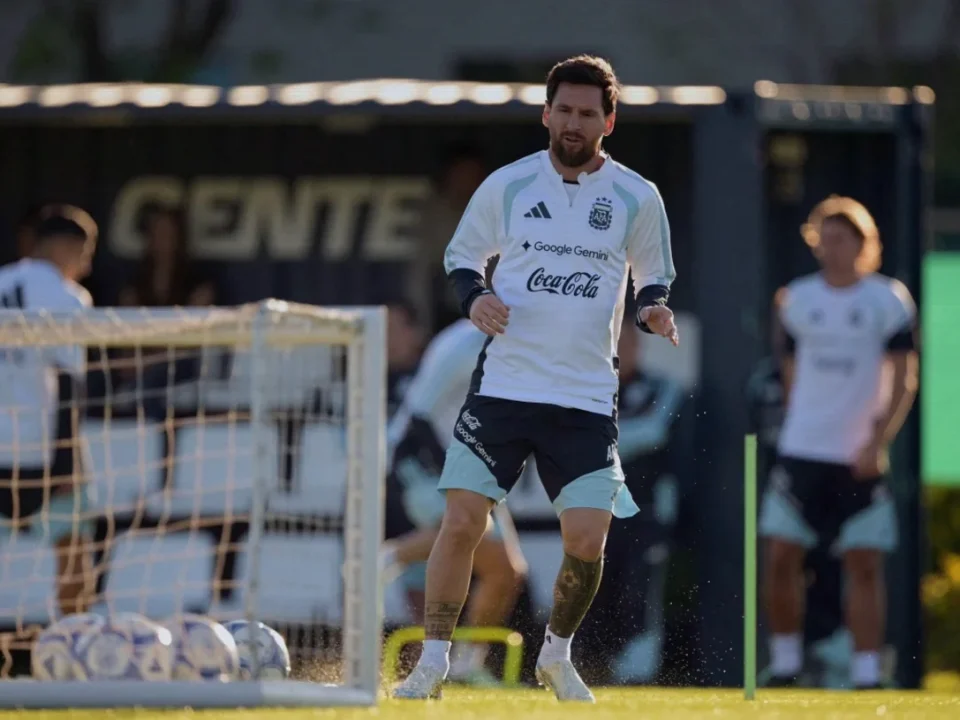
Buenos Aires is preparing for a final night with Lionel Messi in Argentina colours, as the world champions face Benin at the Monumental de Núñez on Tuesday. The farewell has filled the city’s football conversation, with tickets sold out and the stadium being adapted to hold 101,000 spectators for the occasion.
Messi completed his last training session with the national team before the match, bringing an end to a spell in which Argentina’s No. 10 shirt was not merely a squad number but the centre of the side’s sporting identity. His departure leaves Lionel Scaloni’s team facing a broader task than naming a replacement: Argentina must reshape its leadership, its attacking reference points and its next competitive cycle.
The shirt has been left unused for Argentina’s previous two friendlies as a mark of respect. After Tuesday, the federation will have to decide whether to assign it immediately or allow the number to remain vacant while a new team takes shape.
Nico Paz emerges in the No. 10 discussion
Nico Paz is the strongest early candidate to inherit the shirt. The 22-year-old midfielder has become one of the faces of Argentina’s emerging generation and arrives with a compelling season in Italy behind him.
He was named Serie A’s best young player for 2025-26 after scoring 13 goals and supplying seven assists, while also earning a place in the league’s team of the season. His profile has made him a central figure in the discussion around the post-Messi side, although taking the No. 10 would not automatically make him the team’s principal leader.
There is admiration within the Argentina set-up for Paz, and the prospect of the shirt being handed to him is increasingly plausible. The number could offer him a major footballing opportunity, even if its symbolic weight will ensure constant comparisons with Messi.
One view around the national-team scene is that such scrutiny could become a motivating challenge for Paz: he is still young, has much to learn, and could use the standard set by Messi as an incentive to develop further rather than as an impossible burden.
Franco Mastantuono is another young player being considered in the succession debate. Argentina may also choose not to designate a permanent successor straight away, recognising that a shirt can be passed on more easily than Messi’s range of responsibilities on the pitch.
A new Argentina needs more than one replacement
The transition already reaches beyond the famous number. Cristian “Cuti” Romero is set to assume the captaincy, while Scaloni has begun opening the squad to younger players and reassessing figures who were central to the previous era.
Rodrigo De Paul illustrates that shift. A key figure under Scaloni and an important unifying presence within the squad, De Paul was not selected for these friendlies, although he will attend Messi’s farewell. Argentina must find new voices in the dressing room as well as new solutions in possession.
The task is not to locate one player capable of doing everything Messi did. For years, Messi concentrated creative direction, scoring threat, technical authority and the ability to settle matches with a single action. The more realistic response is a younger side built around collective play and several sources of responsibility.
Scaloni has faced a reconstruction before. When he took charge on an interim basis in September 2018, Argentina were dealing with the aftermath of the World Cup in Russia and seeking a new base around Messi. His stated aim at that time was to develop players with the personality and understanding required to represent Argentina, leaving a strong foundation for whoever would coach the team in the future.
Eight years on, the circumstances have changed. Scaloni now presides over the generation that returned Argentina to the summit of international football, but the next rebuild may be more demanding: this time the team must establish itself without Messi.
Scaloni’s contract adds another question
How that process develops may depend on the man overseeing it. Scaloni’s contract expires in December, and discussions over an extension have begun, but no renewed agreement has been announced.
Keeping him would provide continuity at a delicate moment. He knows the internal dynamics of the group and the foundations built during the trophy-winning cycle, while a new deal would allow him to guide the integration of Paz, Mastantuono and other younger players over a longer period.
If he remains, Scaloni’s challenge will be to plant the foundations of another Argentina without relying on the player around whom his first great Argentina was constructed. If he leaves, his successor would inherit a team already entering that transition.
The shadow of previous No. 10s
Argentina understands the difficulty of replacing an era-defining No. 10. Diego Maradona’s retirement began a long search for a new reference point, despite the later presence of gifted players such as Juan Román Riquelme and Juan Sebastián Verón. Messi eventually made the shirt his own and created another defining chapter.
There is an acceptance that the years immediately after Messi may be difficult, particularly when it comes to sustaining the expectation of winning every major title. Yet there is also confidence that Argentina’s football culture can renew itself and remain competitive.
Tuesday at the Monumental will therefore be both a celebration and a departure point. Messi’s final appearance closes nearly two decades of certainty over who wore No. 10. What follows will be less about finding another Messi than constructing an Argentina capable of carrying on without him.