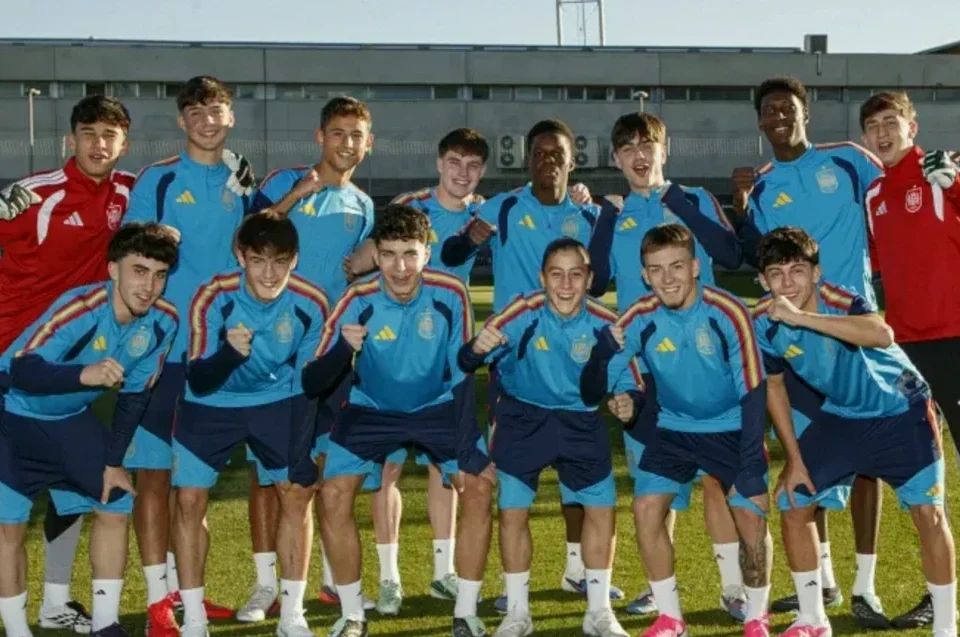
Baku is staging an unprecedented youth international gathering from 24 to 30 October, with 189 FIFA member associations, more than 3,000 players and roughly 950 matches packed into six days at the inaugural FIFA Under-15 World Cup and Festival. Spain’s Under-16 group, made up of players born in 2011, has already begun Group E with a 4-2 win over Chile.
Key takeaways
- The event brings together 189 of FIFA’s 211 member associations, while 78 teams are entering a FIFA World Cup competition for the first time in any format or age group.
- Teams play eight-a-side matches, with 20-minute halves, unlimited substitutions, reduced pitches and kick-ins rather than throw-ins.
- Every side remains involved throughout the week: after three days of league fixtures, teams move into six performance levels, from A to F.
- Spain is coached in Baku by David Gordo, with usual Under-16 coach Hernán Pérez working with the Under-15s at a UEFA development tournament in Austria.
- Russia’s participation, its first FIFA competition since the 2022 invasion of Ukraine, has led to a boycott by 22 associations.
A World Cup built around access
The scale is unlike any previous FIFA youth event. The 2026 senior World Cup, expanded to 48 national teams, had 104 games across six weeks; the Baku festival is set to stage around nine times that number in under a week. For countries including Afghanistan, Andorra, Bhutan, Cyprus, Georgia, Gibraltar, Lebanon, Pakistan, Palestine, Somalia, Timor-Leste and the Cook Islands, it offers a first appearance on a FIFA World Cup stage.
Most fixtures will be held at the Hovsan Sports Complex, where 10 artificial pitches can be divided into 20 smaller fields, allowing close to 20 matches to take place simultaneously. Baku Crystal Hall, the venue used for the 2012 Eurovision Song Contest, will host the opening ceremony and all six finals on 30 October.
The competition’s structure is designed to avoid early exits. Following a three-day group phase, the standings will place teams in Levels A through F, ensuring each delegation continues playing until the final day. The winner of Level A will become the first champion of the new Under-15 World Cup and Festival.
The festival element runs alongside the football. All 189 delegations will stay in a shared athletes’ village, with educational sessions, meetings with former football figures and awareness initiatives included in the programme. Arsène Wenger, FIFA’s Chief of Global Football Development, said the priority at this age is simply to play, arguing that ability can be found everywhere but chances to develop are not equally available.
FIFA approved the competition concept in December 2025. A girls’ edition is planned for 2027, followed by annual men’s and women’s tournaments from 2028. Azerbaijan will also co-host the 2027 Under-20 World Cup.
Spain’s route and the debate around Baku
Spain has brought 14 players and six staff members, with Gordo taking charge while also fresh from guiding Spain’s Under-21s to qualification for the 2027 European Championship. He has previously worked with Spain’s Under-15, Under-16 and Under-17 teams.
Real Madrid, Barcelona and Real Betis each supply three players to the travelling squad, Valencia have two representatives, and Atlético Madrid, Villarreal and Espanyol contribute one apiece. Among the players attracting attention are Betis attacking midfielder Tiago Polo, the standout player in his age group and an admirer of Isco, plus Real Madrid’s Mikel López and Barcelona youth scorer Divine Ikenna.
Polo, who wrote at the age of eight that he hoped to play for Spain one day, has set an ambitious target for the group: “We are a very strong team and we can bring this World Cup home.”
Spain’s Group E also includes Congo, Tajikistan, Barbados and Kuwait. The 4-2 result against Chile, viewed as the strongest opponent in the section, has put the team on a favourable course for Level A. The decisive top-level matches are scheduled between 28 and 30 October.
The tournament arrives after a productive period for Spain’s national-team development pathway: the Under-19s won the European title this summer, while the Under-21s have secured their place at the next European Championship. A first title in this new FIFA competition would nevertheless carry particular significance for a country whose youth sides have often found global tournaments more difficult than continental events.
Political and developmental concerns have also surrounded the event. Twenty-two associations have chosen not to attend, including 18 European federations. Germany, the Netherlands, Belgium, Switzerland and Denmark are among the absentees, as are the United States. Ukraine, which called for a boycott, said Russia’s involvement helps “legitimise a terrorist state.”
The German Football Association has raised a separate objection, warning against what it sees as growing professionalisation at ever younger ages. Its concern is that a World Cup for 14- and 15-year-olds creates an environment in which agents are already circling children.