Milwaukee and Tampa Bay will open the World Series on Friday night, with Game 1 scheduled for 8 p.m. ET. It is a meeting of regular-season win leaders, two clubs still chasing the first championship in franchise history, and two front offices that have learned to compete without the payroll muscle of the sport’s biggest spenders.
The result
The Brewers arrive after making the postseason eight times in nine years, generally operating at less than half the payroll of baseball’s most expensive club. The Rays have reached October in six of the last eight seasons, often with a budget below one-third of the game’s highest spender.
Both teams develop talent as well as anybody. Tampa Bay ranked second and Milwaukee third in the midseason farm-system evaluations, a familiar neighborhood for both organizations. But the routes that built these pennant winners have been noticeably different.
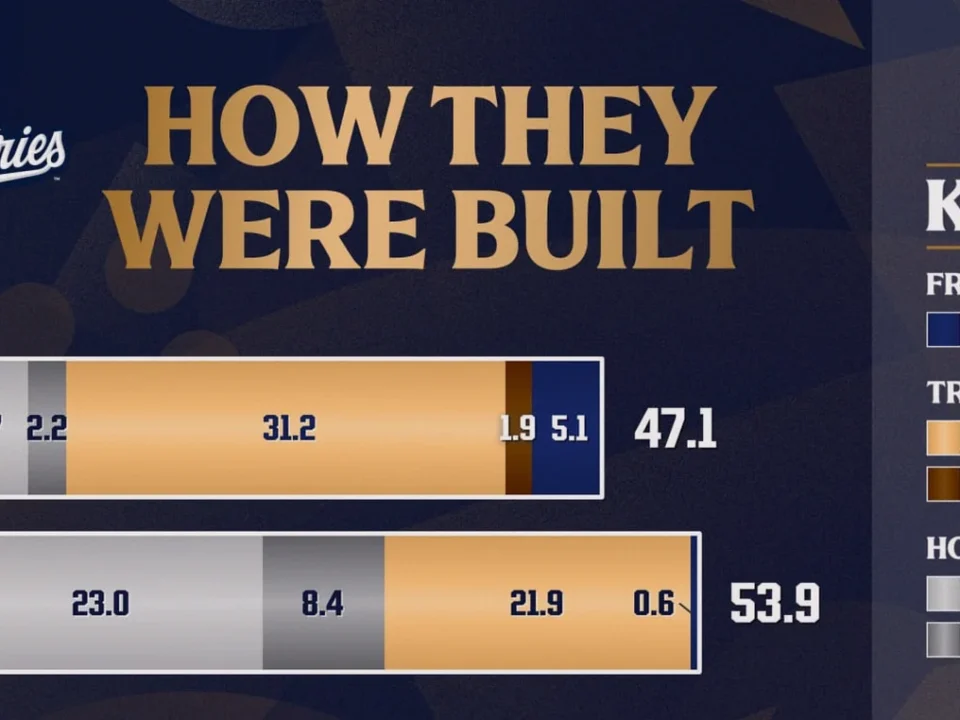
Milwaukee brought one of October’s most homegrown rosters into the World Series. Only Cleveland had more developed-in-house players and more production from them. The Brewers have 10 homegrown contributors worth 31.4 Baseball-Reference WAR, while the Rays have four, totaling 8.9 WAR.
Drafting has been a major part of Milwaukee’s run. Seven drafted Brewers have supplied 23.0 WAR, second among playoff clubs only to Cleveland. First-round selections Brice Turang, taken in 2018, and Garrett Mitchell, selected in 2020, have paid off. Sal Frelick, the 2021 first-rounder, remains a regular despite having the toughest big league season of his three-year career.
The Brewers have also found useful players in junior colleges. Jacob Misiorowski was a second-round pick in 2022, Logan Henderson went in the fourth round in 2021, and Aaron Ashby was chosen in the fourth round in 2017. Cooper Pratt became another worthwhile investment after Milwaukee spent $1.35 million, four times slot value, to sign the 2023 sixth-rounder.
Tampa Bay has only three drafted players on its postseason club, tied for the second-smallest total in the field. Taylor Walls, a 2017 third-round pick, and 2022 second-rounder Chandler Simpson have been important pieces. Ian Seymour, drafted in the second round in 2020, is the third, though he was hit hard during the American League Championship Series.
International scouting has tilted sharply toward Milwaukee as well. Three international amateurs have accounted for 8.4 WAR, the best total among postseason teams. The Brewers signed Venezuelan outfielders Jackson Chourio for $1.8 million in 2021 and Luis Lara for $1.1 million a year later. Dominican right-hander Abner Uribe signed for $85,000 in 2018.
The Rays have one international amateur signing on the roster, but he is no small part of the lineup. Jonathan Aranda, obtained from the Tijuana Toros of the Mexican League for $130,000 in 2015, has become Tampa Bay’s second-most threatening hitter.
Neither club has leaned heavily on free agency. Tampa Bay has five free-agent additions on its World Series roster, though right-hander Nick Martinez is the only one with a major role. Martinez signed in February for $13 million guaranteed on a one-year deal with a mutual option, then made the first All-Star team of his 16-year professional career.
Milwaukee has one free-agent signing in backup catcher Gary Sánchez. His February agreement guaranteed $1.75 million for one year with a mutual option, but he has appeared in only one of the Brewers’ eight postseason games this month.
The trade routes to October
The trade market, more than any other lane, has supplied the Rays. Tampa Bay leads all playoff teams with 16 acquired players and 31.2 WAR from trades.
The most prominent deals brought in third baseman Junior Caminero, acquired from Cleveland for Tobias Myers in November 2021, and right-hander Drew Rasmussen, who came over from Milwaukee in the Willy Adames trade six months earlier. Caminero has become the Rays’ best hitter, while Rasmussen has developed into their top pitcher.
Other Tampa Bay trade additions include Liam Hicks, Bryan Baker, Victor Mesa Jr., Yandy Díaz, Tyler Wells, Richie Palacios and Jonny DeLuca. The bullpen also has a Rule 5 success story in Kevin Kelly, selected from Colorado at the 2022 Winter Meetings. Kelly has been a dependable Rays reliever ever since and led the Majors with 33 holds this season.
Milwaukee is close behind in trade volume, with 15 acquired players, and ranks third among playoff clubs with 21.9 WAR gained through deals. Catcher William Contreras, the Brewers’ only position-player All-Star, is at the center of that group. Joey Ortiz, D.L. Hall, David Hamilton, Trevor Megill, Chad Patrick and Robert Gasser are other notable additions.
Jake Bauers is another important trade pickup, and his path carries a little World Series symmetry. He began his Major League career with Tampa Bay in 2018, then moved through six organizations before the Yankees dealt him to Milwaukee in November 2023 for prospects Jace Avina and Brian Sánchez. New York’s chief purpose in the move was to clear a roster spot, but Bauers went on to become the Brewers’ League Championship Series MVP.
Rays League Championship Series MVP Freddy Peralta also started in the Majors with the club he now faces, debuting for Milwaukee in 2018. After eight seasons with the Brewers, Peralta was moved in January, along with Tobias Myers, to the Mets for Brandon Sproat and prospect Jett Williams, then ranked No. 10 in Milwaukee’s system.
Seven months later, the Mets sent Peralta to Tampa Bay for Émilien Pitre, ranked No. 10 in New York’s system, plus Aidan Smith at No. 15 and Gary Gill Hill at No. 16. That pair of 2018 debuts, rerouted through trades, has left Bauers and Peralta standing on opposite sides of a World Series built by two small-market clubs that found very different ways to get here.