Milwaukee enters October with the best record in baseball and a rotation built around a conviction most of the sport has softened on: make hitters deal with the fastball. The Brewers won 103 games, claimed the No. 1 playoff seed and turned the four-seamer into their calling card rather than a pitch to hide behind secondary stuff.
That identity will be on display in the National League Division Series. Milwaukee opens Saturday against either the Cubs or Padres; a Cubs matchup would begin at 4 p.m. ET, while a Padres series would put Game 1 at 8:30 p.m. ET.
Quick facts
- Brewers starters struck out 446 hitters on four-seam fastballs, the most by any rotation in the pitch-tracking era dating to 2008.
- Milwaukee starters used four-seamers 41% of the time, the highest rate in the Majors.
- Jacob Misiorowski led MLB starters with a 100.6 mph average four-seamer and 166 strikeouts with the pitch.
- The Brewers produced 850 four-seam whiffs, second-most for a rotation in the tracking era.
The record came with room to spare. The 2017 Red Sox had held the rotation mark at 435 four-seam strikeouts, followed by the 2023 Mariners at 398, the 2019 Astros at 389 and the 2019 Guardians at 366. Milwaukee also finished well ahead of this year’s nearest clubs: Yankees starters had 348 four-seam strikeouts and the Dodgers had 337.
It is an unusual lane in a game where fastball use has fallen to its lowest point since pitch tracking began. Some playoff rotations use the four-seamer less than a quarter of the time; the Rays were below 25%, while the Phillies sat at a league-low 22%.
Brewers pitching coach Chris Hook sees the heater as an invitation to take control of an at-bat. The club’s preference is not to throw a fastball merely because it is traditional, but because its pitchers possess versions of the pitch that can win.
“There has to be some fearlessness if I’m going to dominate with my fastball,” Hook said. “Either the pitcher controls the hitter, or the hitter controls the pitcher. We want to be intentional about bullying them.”
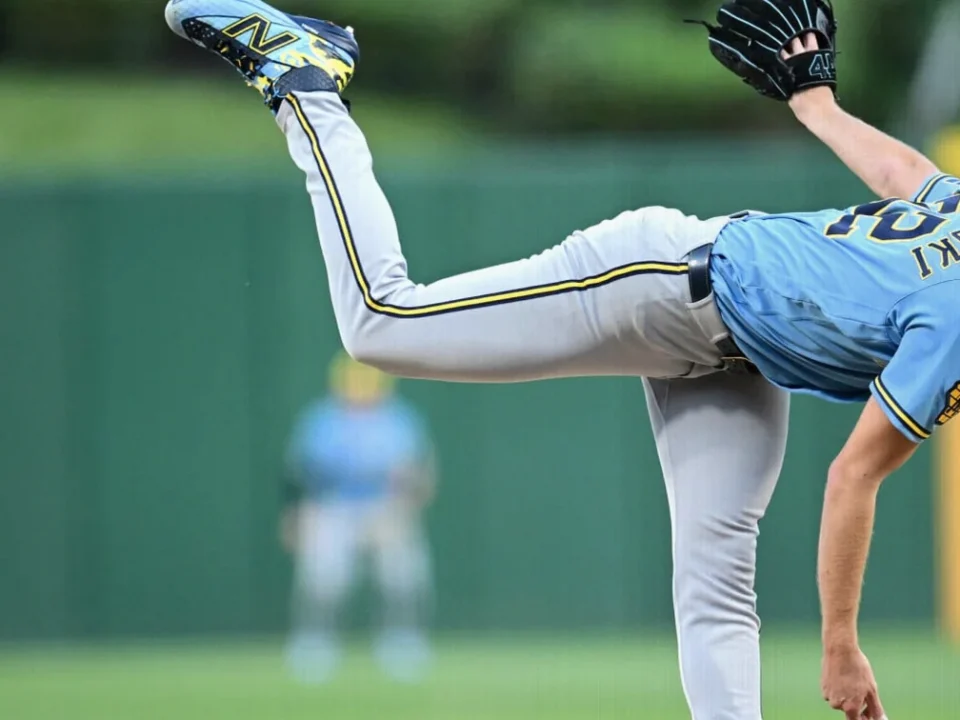
Misiorowski is the loudest example. His four-seamer accounted for 63% of his pitches, and he paired that usage with 345 whiffs and 166 of his MLB-leading 252 strikeouts. He is the hardest-throwing starting pitcher tracked in the modern data era, capable of piling up 100 mph fastballs over a full season.
“My approach is basically, ‘Good luck,’” Misiorowski said.
The big right-hander credits Hook and Major League pitching coordinator Jim Henderson with pushing a simple early-count plan: get ahead with the heater and trust it. Misiorowski acknowledges a fastball can be hit, but he also knows the burden remains on the hitter.
“Hitting is hard,” Misiorowski said.
Milwaukee’s rotation is not a one-man velocity show. Logan Henderson threw four-seamers 46% of the time and collected 59 strikeouts with them. Kyle Harrison used the pitch 57% of the time and fanned 86 hitters on it, while Robert Gasser and Shane Drohan each added more than 30 four-seam strikeouts.
Henderson and Harrison provide a different kind of discomfort. Misiorowski lives around 101 mph, but Henderson’s fastball sits around 93 and Harrison’s near 95. From lower arm slots and flatter approach angles, both create late ride and movement that can make their more modest radar-gun readings play bigger.
“The fastball is the best pitch in baseball,” Henderson said. “If you execute it, especially later in counts, you’ll have success. A lot of it is knowing what we do well.”
Henderson’s four-seamer was especially stingy, holding opponents to a .156 average. It ranked among the 10 most valuable four-seamers in the majors at plus-14 runs prevented, while Misiorowski’s rated first.
The rookie right-hander has another weapon in a high-spin changeup with nearly 20 inches of horizontal break and the best whiff rate in his mix. But the changeup works in part because hitters must honor the fastball.
Hook said that is the point of Milwaukee’s design. The fastball produces its own swing-and-miss, and it also gives the club’s secondary pitches more room to operate. “It’s not old school against new school,” he said. “It’s using what you have as well as possible.”
Harrison’s season complicates the October picture. He was strong for most of the year, then saw fatigue alter his arm slot down the stretch. The lowered release came with reduced velocity and less of the rising action that made his four-seamer effective, and although he made some progress late in September, his postseason roster spot is uncertain.
Still, Milwaukee can line up Misiorowski and Henderson at the front of its Division Series plan. Their fastballs arrive roughly eight mph apart, but each creates the same uncomfortable question for an opposing lineup: can it handle the pitch the Brewers are most eager to throw?
For Hook, the answer to the league-wide retreat from four-seamers is not complicated. Bad fastballs should not be forced into the zone. Milwaukee believes its fastballs are different, and its 103-win season says that belief has carried plenty of weight.