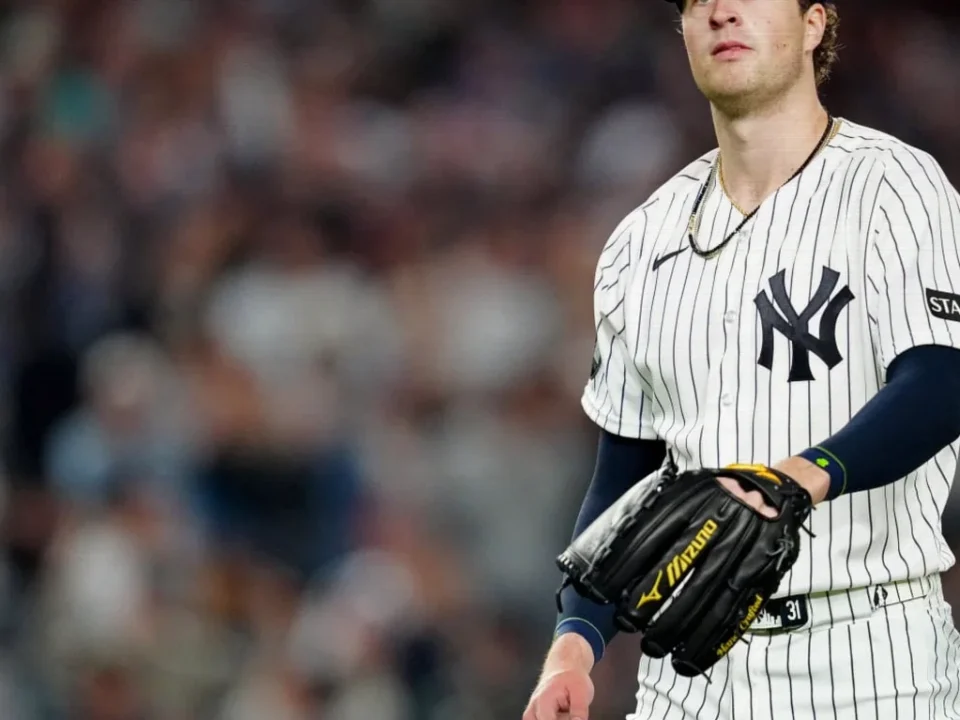
Cam Schlittler built his season on fastballs, then brought a different answer when Boston arrived ready for heat. The Yankees right-hander leaned hard on a sharpened curveball in his postseason opener against the Red Sox, throwing 32 of them among 117 pitches and striking out 10.
That new wrinkle follows him into Monday night, when Schlittler is scheduled to start Game 2 of the American League Division Series against the Rays at Tropicana Field. Tampa Bay has seen the power arm before, but the curveball now gives a fastball-heavy pitcher another lane to attack.
Quick facts
- Schlittler used a career-high 32 curveballs against Boston, 27% of his pitches.
- His curve drew eight misses on 16 swings and produced four of his 10 strikeouts.
- He averaged 85.8 mph on the pitch in the postseason, compared with 84.2 mph in March and April.
- Boston hit .195 against curveballs during the regular season, second worst in MLB.
- Tampa Bay posted a .262 wOBA against curveballs, the fifth-lowest mark in the majors.
The Red Sox had spent the previous weekend preparing for Schlittler’s velocity, working against the Trajekt pitching machine at Tropicana Field to get acclimated to his fastball shapes. That was sensible preparation. During the regular season, 89.2% of Schlittler’s pitches were four-seamers, sinkers or cutters, the highest fastball rate among qualified starters with at least 750 pitches.
He also brings upper-tier velocity, ranking in the 94th percentile in average fastball speed. That foundation has put the 25-year-old in position to be viewed as the likely American League Cy Young Award winner next month.
But Boston’s preparation did not fully account for the curve. Schlittler had never exceeded 20 curveballs in a major league game before this postseason start, and he had thrown only 41 across five earlier outings against the Red Sox. Against Boston this time, he threw more curves than either sinkers or cutters.
The pitch was not simply a surprise offering. Schlittler’s curve generated eight whiffs, a personal high for misses with that pitch in a game, and hitters swung over 67% of the curves they offered at. Meanwhile, they swung beneath 65% of his four-seam fastballs.
That is the high-low picture Schlittler wants. He rides the four-seamer near the top of the zone, then sends the curve beneath it, asking hitters to distinguish between pitches that initially arrive with a similar look.
His fastball and curve also carry opposite-but-related spin directions. The four-seamer spins roughly toward 12:45 on a clock face, while the curve works closer to 7:15. It is not a perfect 180-degree mirror, but the release can make the pitches difficult to separate before the ball is well on its way.
The curve has become firmer without losing its drop. It averaged 84.2 mph with 48.8 inches of vertical break in March and April; in the postseason, it checked in at 85.8 mph with 48.7 inches of break. Earlier in August, it had reached an 87.5 mph average.
After the All-Star break, the pitch rated among the sport’s best curveball shapes by Stuff+, a model that evaluates a pitch’s raw quality. Its value is amplified by the rest of Schlittler’s arsenal, particularly the way his sinker and cutter leave his hand with fastball-like speed and appearance before moving differently at the plate.
Boston’s reaction made clear that the curveball was not part of the old scouting report. “That’s something that was new for today’s game,” outfielder Wilyer Abreu said. “He pitched to our weakness, and we couldn’t make the adjustment.”
The numbers support that assessment. Only Baltimore carried a lower regular-season batting average against curves than Boston’s .195, and the Red Sox ranked second from the bottom in wOBA against the pitch.
Schlittler already owns a remarkable record against Boston: his 0.47 ERA through his first six career starts against the club, including postseason work, is the lowest such mark since earned runs became official in 1913. The curve gave him another way to stay ahead of a lineup that had faced him four times during the regular season.
He had hinted in August that the pitch could become more than an occasional change of pace. “It’s like, screw it, I’ll start throwing it more if I need to,” Schlittler said then. “You don’t always need to do that. But it’s better to get that pitch under control, and if I do need to bring it out, then I can get in the zone and get swing-and-miss with it.”
The Rays present another possible opening. Their .262 wOBA against curveballs ranked fifth lowest in baseball, while All-Star third baseman Junior Caminero’s .481 slugging percentage against curves was his second-lowest figure against any pitch type; only changeups held him to less power.
More specifically, Tampa Bay was tied with Boston for the second-worst batting run value against right-handed power curves of at least 85 mph, at minus-5. Schlittler’s curve fits that category.
In three previous starts against the Rays, Schlittler threw only 22 curveballs, including 10 in his latest meeting with them on Sept. 24. He does not need the pitch to dominate, but October rewards an extra weapon held back until the right moment.
Other top arms work the same way. Brewers All-Star Jacob Misiorowski has not used his changeup in a game since June, yet continues throwing it in catch play and bullpen sessions in case a postseason matchup calls for it. Schlittler’s curve is no longer just something he keeps in reserve. Against Boston, it became part of the main card.