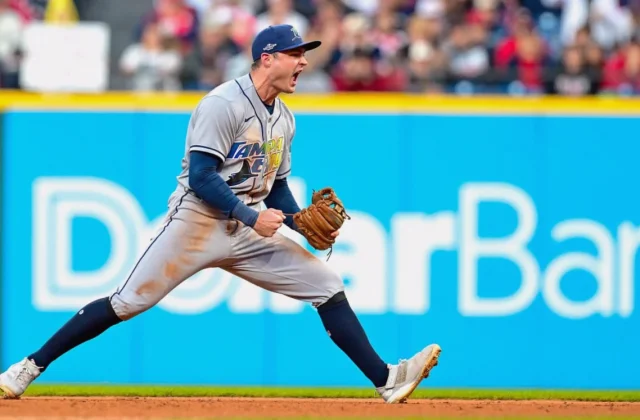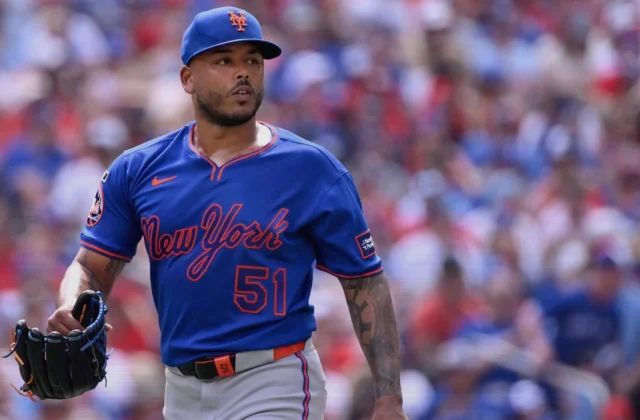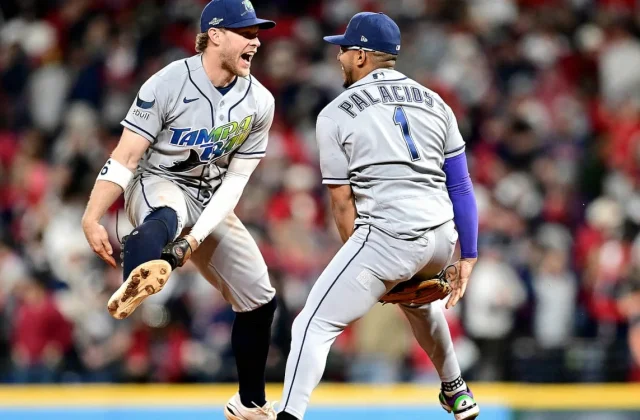

Baseball had barely opened its 2026 ledger when the Cardinals and Rays turned Opening Day into a record-book oddity, each hanging at least six runs in the sixth inning. The last opener with both clubs reaching that threshold in one frame had been Boston Beaneaters-Brooklyn Bridegrooms on April 19, 1890. With the regular season nearly complete, the strange numbers have only kept coming.
A Cubs turnaround and young arms at historic heights
Pete Crow-Armstrong was carrying a .673 OPS one-third of the way through Chicago’s schedule, a modest line for a player who has since reached 10 FanGraphs WAR and appears headed toward the National League MVP Award. At that early checkpoint, he had produced only 1.4 fWAR. Nobody else who ultimately reached 10 fWAR had started the year anywhere near that quietly.
- Eddie Collins posted an .826 OPS through one-third of 1909 before his 10-fWAR year with the Philadelphia Athletics.
- Mike Trout was at .835 in 2012 and .920 in 2013 for the Angels.
- Honus Wagner stood at .894 in 1908 and .924 in 1905 with Pittsburgh.
Crow-Armstrong’s second and third acts have put him in position for what can reasonably be called one of the greatest individual seasons in Cubs history.
The league’s pitching story has also belonged to pitchers still learning the rhythms of a second big-league season. Milwaukee’s Jacob Misiorowski owns a 223 ERA+, while Yankees right-hander Cam Schlittler is at 217. Both marks mean they have prevented runs at more than twice the league-average rate, and both pitchers have emerged as leading Cy Young candidates.
Two pitchers reaching a 200 ERA+ in the same full season has occurred only twice this century: Jake Arrieta and Zack Greinke in 2015, then Jacob deGrom and Blake Snell in 2018. The youth of Misiorowski and Schlittler makes this pairing even rarer. Since 1920, the only other pitchers to post a 200-plus ERA+ in either their first or second MLB campaign were Doc Gooden, at 229 in 1985, and Paul Skenes, at 226 during last season’s Cy Young run.
Schlittler’s work away from Yankee Stadium has been especially sharp. His 1.16 road ERA over at least 100 innings is the third-lowest Live Ball Era figure in that workload. Bob Gibson had a 0.81 road ERA in 1968, and Greg Maddux recorded a 1.12 in 1995. Neither was in his second major-league year.
Guardians rookie Parker Messick has made his own case with command. His 3.98 strikeout-to-walk ratio puts him in the discussion for an American League Cy Young finalist spot. Among Modern Era rookies with at least 180 innings, only Don Sutton’s 4.02 ratio for the 1966 Dodgers was better.
Detroit’s Kevin McGonigle has added a position-player version of that youth movement. His 6.7 Baseball-Reference WAR is the best debut-season mark ever for a player who spent most of the year aged 21 or younger. Albert Pujols in 2001, Frank Robinson in 1956 and Ted Williams in 1939 had shared the prior top mark of 6.6.
Milestones, oddities and a two-way reminder
Shohei Ohtani’s pitching season ended early in July because of injury trouble, but his 85 2/3 innings were still extraordinary. He compiled a 235 ERA+, then paired it with a .902 OPS in nearly 600 plate appearances as a hitter.
Only a select group of AL/NL starters in the Modern Era have reached at least a 235 ERA+ while throwing 85 or more innings:
- Jacob deGrom, 373 ERA+ for the 2021 Mets.
- Pedro Martinez, 291 with the 2000 Red Sox.
- Greg Maddux, 271 in 1994 and 260 in 1995 for Atlanta.
- Bob Gibson, 258 for the 1968 Cardinals.
- Clayton Kershaw, 237 with the 2016 Dodgers.
- Clay Buchholz, 237 for the 2013 Red Sox.
A longer pitching season would carry its own weight, of course. But a 235 ERA+ while maintaining a .902 OPS remains an Ohtani-sized outlier.
Marlins ace Sandy Alcantara has supplied another rare line: one save alongside an MLB-leading 212 innings. Since saves became official in 1969, Phil Niekro in 1978 had been the only other pitcher to lead the majors in innings during a season in which he also earned a save.
Jo Adell made Statcast-era history with two different clubs. He hit the Angels’ longest homer of the season, a 449-foot shot on May 10, then was traded to Cleveland and delivered the Guardians’ season-longest blast, measured at 455 feet on Aug. 18. No player in the pitch-tracking era had previously owned the longest home run for two teams in one season.
Sixteen players homered in their MLB debuts this year, setting a new record. The previous high was 13, reached in 2022.
The standings races have their own strange footprints
The White Sox have won 81 games after enduring three consecutive seasons with at least 100 losses. No club coming off that kind of three-year skid had previously won more than 70 games; the 2014 Astros, 1965 Washington Senators and 1925 Boston Braves shared that earlier mark.
Chicago could still make a larger piece of history. No team has reached the postseason after even two straight 100-loss seasons, leaving the White Sox with a chance to become the first.
Houston’s Yordan Alvarez leads the majors with 106 walks and still has an outside route to an American League Triple Crown. He would need to overtake Pete Alonso in the RBI race. If he gets there, Alvarez would become the first Triple Crown winner in either league since Miguel Cabrera in 2012. He would also join Ted Williams as the only players to win a Triple Crown while leading their league in walks; Williams did it in 1942 and again in 1947.
At the other end of the offensive spectrum, Nationals second baseman Nasim Nuñez has stolen an MLB-best 47 bases despite a .529 OPS. In the Modern Era, only Rollie Zeider had previously posted an OPS below .550 while stealing at least 40 bags: Zeider finished at .548 with 49 steals for the 1910 White Sox.
Cal Raleigh’s year has swung in the opposite direction from his 60-homer 2025. His .374 slugging percentage sits more than 100 points below the weakest follow-up slugging mark ever recorded after a 60-homer campaign. Roger Maris hit .485 in 1962 after his record-setting 1961 season. Raleigh ranked third among qualified major leaguers with a .589 slugging percentage last season; this year, he has fallen into the bottom 25.
Washington’s bullpen has carried the less welcome record. The Nationals have blown 42 saves, the highest total in MLB history. The 2024 White Sox, who lost 121 games, previously held the record with 36.
Strikeout extremes and the game’s rising velocity
The Phillies have housed two opposite ends of the strikeout spectrum. Kyle Schwarber has struck out 217 times and is chasing the MLB lead, while Luis Arraez has only 28 strikeouts after arriving from the Giants at the Trade Deadline. Arraez is set to finish with the fewest strikeouts among qualified hitters.
Since expansion began in 1961, the league strikeout leader and the qualified hitter with the fewest strikeouts have ended the season as teammates only four times. Two of those instances have involved Philadelphia.
Then there is the fastball. Just 0.8% of all major-league pitches this season have registered at 100 mph or faster, but that small slice is the largest of the tracking era, which began in 2008. The total number of triple-digit pitches has climbed 43.5% from last season alone.
In a year that began with a sixth-inning explosion on Opening Day, the final weeks have offered the same reminder: baseball still finds fresh ways to make old records look small.