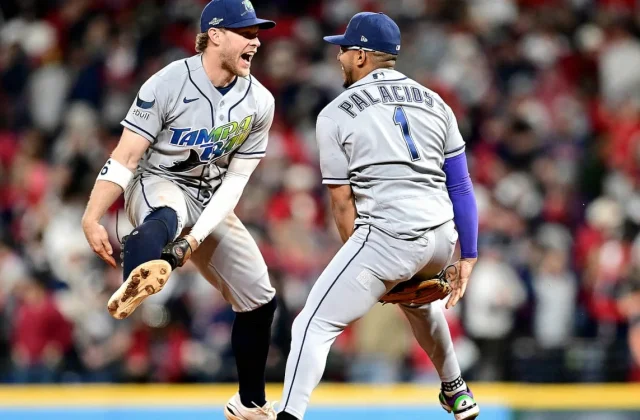
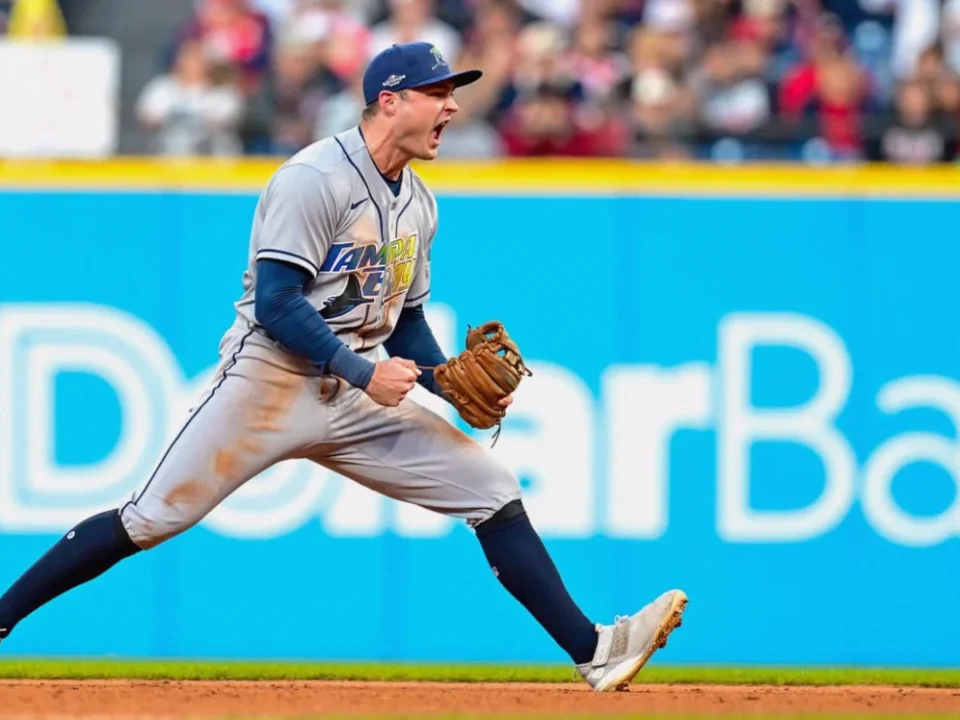
The Rays left Cleveland with a 3-1 Game 5 win on Sunday and a 3-2 American League Championship Series edge, one victory from the World Series. Drew Rasmussen set the tone by taking the noise out of Progressive Field and keeping the Guardians’ offense under control, but Tampa Bay’s work was as familiar as it was frustrating: put balls in play, make the pitcher work, take the extra base and turn grounders into outs that appear destined to get through.
Game 6 is scheduled for Monday at 8 p.m. ET, with the series moving back to Tropicana Field. Tampa Bay has won the past two games to erase Cleveland’s earlier advantage, finding the offensive rhythm that appeared absent after a first-round bye and a Division Series sweep.
The fourth inning of Game 5 offered a clean snapshot of the Rays’ style. José Ramírez scorched a ground ball toward center field, only for second baseman Ben Williamson to dive to his right, secure it and throw him out. It was the first out of the inning and the third straight defensive out recorded by Tampa Bay’s middle infield. A frustrated Cleveland fan reacted as though the Rays were performing tricks. When Chase DeLauter followed with another grounder that Williamson handled while moving back, another voice from the stands sarcastically acknowledged that the second baseman could, indeed, field.
That is the daily irritation Tampa Bay creates. The Rays do not need a barrage of long balls to make an opponent feel squeezed. Their hitters extended Guardians rookie starter Parker Messick’s afternoon to 57 pitches in only two innings, producing two runs on five hits and two walks before Cleveland turned the game over to its bullpen.
Kevin Cash said the club took advantage of favorable counts and found important hits against a pitcher he described as very good. The Rays manager noted that constructing large innings becomes difficult once an opponent begins mixing relievers from the third or fourth inning onward, but he remains confident in Tampa Bay’s offense. With a laugh, Cash added that he hopes the home runs begin arriving soon.
The Rays have managed just two homers in the ALCS, and neither decided the game in which it was hit. Cedric Mullins’ solo drive came in Tampa Bay’s 7-3 Game 1 defeat, while Yandy Díaz’s two-run ninth-inning homer in Game 4 merely added breathing room to another 7-3 result. That works out to 0.4 homers per game in the series.
A pennant at that rate would be rare in the best-of-seven League Championship Series era, which began in 1985. The 2001 Diamondbacks also averaged 0.4 homers per game on their way to the pennant; the 2013 Cardinals and 1993 Blue Jays each posted 0.33; the 1987 Cardinals finished at 0.29; the 1997 Marlins at 0.17; and the 1990 Athletics did not hit one at all. The contrast is sharp considering teams that outhomered their opponents have gone 21-4 this postseason and own an .850 winning percentage across the past two postseasons.
Tampa Bay has nevertheless found another route. Over Games 4 and 5, the Rays went 23-for-71 as a club, a .324 average, and were 8-for-21 with runners in scoring position. Díaz said the change came from maintaining a positive approach, selecting pitches aggressively and attacking the strikes they wanted. On the bases, the Rays are a flawless 6-for-6 in stolen-base attempts during this ALCS.
The defense has been equally central. Tampa Bay ranked second in the Majors with 87 defensive runs saved during the regular season, trailing only the Cubs’ 115. Unlike Chicago, whose middle-infield excellence is built around standout defenders Pete Crow-Armstrong and Nico Hoerner, the Rays lean heavily on preparation and placement. The organization helped make aggressive infield shifting a major-league issue before MLB introduced restrictions, and it continues to use unconventional alignments within the current rules. One middle infielder will often set up nearly on a direct line with second base.
That positioning has helped shortstop Taylor Walls and second basemen Williamson and Richie Palacios turn balls into outs despite each rating below the 20th percentile in range during the regular season. Entering Game 5, Tampa Bay had converted 80 percent of straightaway ground balls into outs this postseason. Guardians manager Stephen Vogt called Walls one of baseball’s finest shortstops, saying that a ball hit in his direction usually becomes an out while praising the Rays’ overall defense.
The Rays’ formula is not flashy, but it travels: reach base, steal when the opening is there, make contact and deny rallies behind the pitcher. If the home-run production joins the contact attack—much as the Brewers’ offense did against the Dodgers in the NLCS—Tampa Bay could become even harder to contain. For now, the Rays have taken control without waiting for that power surge, turning two nights of efficient baseball into a chance to finish the Guardians at home.