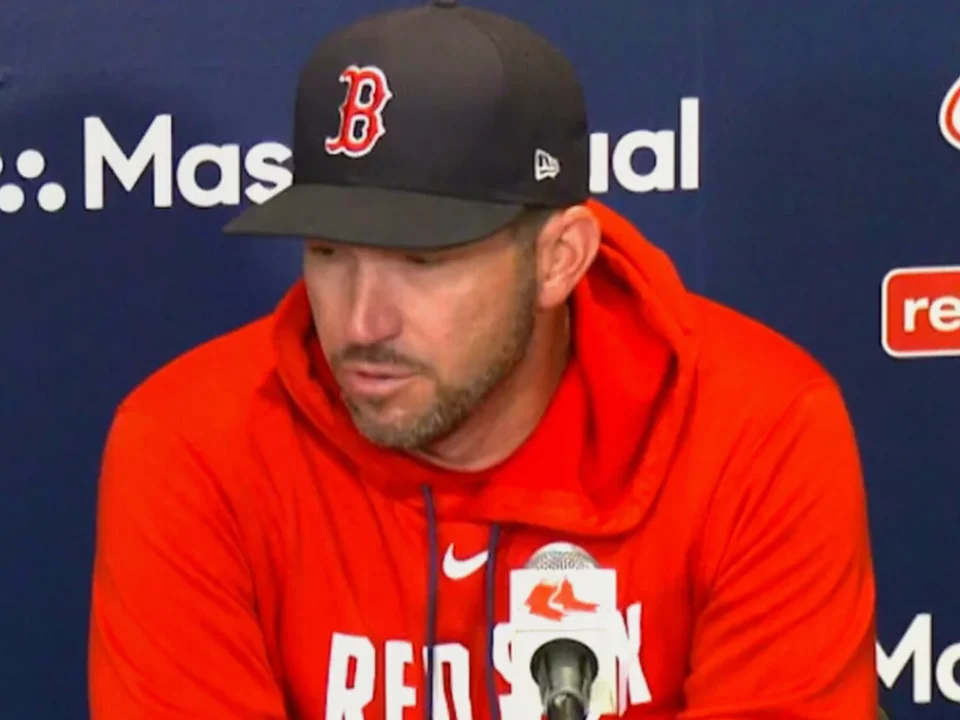
The Red Sox left their 2026 season with more than a two-game Wild Card sweep by the Yankees to unpack. At Monday’s season-ending press conference, manager Chad Tracy took full ownership of the pitching changes that turned both losses in the fifth inning, insisting the calls were his rather than instructions handed down by Boston’s analytics department.
Two fifth-inning decisions set the tone
-
In Game 1 of the American League Wild Card Series, Boston trailed 1-0 in the bottom of the fifth. Payton Tolle had recorded two outs with nobody aboard, but Ben Rice was due up. Tracy went to left-hander Erik Miller, and Rice greeted the move with a home run.
-
Game 2 brought another high-leverage fifth. Sonny Gray faced Cody Bellinger with two runners on and two outs. Gray had been Boston’s steadiest starter through the season and had held opposing hitters to a .180 average the third time through a lineup, best in the American League. Tracy again called for Miller, who surrendered an RBI single to Bellinger.
-
The Yankees completed the two-game sweep, ending Boston’s season and leaving the bullpen decisions as the central subject of the club’s postmortem.
Tracy did not duck the result, particularly the Gray decision. He said no one had ever mapped out his games for him or directed him to make an inning-specific move based on a computer model. Boston uses data, he said, as every club does, but he said there was nobody beside him demanding a prescribed sequence of decisions.
“The decisions are mine,” Tracy said. “That Game 2 decision clearly did not work, and that is on me.”
Miller’s recent track record only intensified the outside criticism. Acquired from the Giants at the Aug. 3 Trade Deadline, the left-hander allowed at least one run in four of his final five regular-season outings. His only scoreless appearance in that stretch came against the Guardians on Sept. 24.
Tracy pointed to Miller’s strong final Fenway Park appearance while acknowledging that the reliever had battled through much of September. He said he understood why the choices were being questioned and conceded that he could have stayed with either starter. In another version of the inning, Tracy said, a different choice might have worked and the debate would not have followed.
Gray wanted the ball
Gray’s removal drew the sharper reaction because of his standing in the rotation and the spot on the calendar. After the loss, the right-hander said he wanted the opportunity to decide the game himself.
“I would have preferred to live or die with me in that spot,” Gray said. “That is the competitor I am. I felt strong, confident and convicted.”
His shortest assessment carried the same message: “I would’ve liked to have been trusted in that moment.”
Tracy said he has since spoken with Gray, who is headed into free agency. The manager said Gray understandably wanted to remain in the game, but maintained that the relationship built over five months remains solid.
“I do trust Sonny Gray,” Tracy said. “I trust the bullpen, too. But it was my call, my decision, and it went south.”
For Tracy, the Monday session was also about drawing a line between information and command. The manager said he wanted to remove any impression that Boston’s moves are settled before first pitch by a sheet of paper or a computer. When a decision fails, he said, responsibility belongs in his office.
Contreras meeting covered a wide range
First baseman Willson Contreras also spoke forcefully after the elimination loss. When asked about Gray’s exit, he made a gesture suggesting he was holding back his thoughts, while also voicing concern that analytics had become too prominent in the club’s decision-making.
Unlike Gray, Contreras is under contract for 2027, and Boston also controls a club option for 2028. Before Contreras departed for the offseason, Tracy and chief baseball officer Craig Breslow met with him to address the concerns.
Breslow said the conversation lasted more than two hours and was productive, covering far more than the public reaction to one pitching change. He said his reading of Contreras’ comments was not simply that the player wanted wholesale changes, but that there were matters worth discussing within the organization.
The Red Sox now head into the winter with the disappointment of October still fresh: two fifth innings, two calls to the bullpen, and a manager making clear that the final responsibility rests with him.