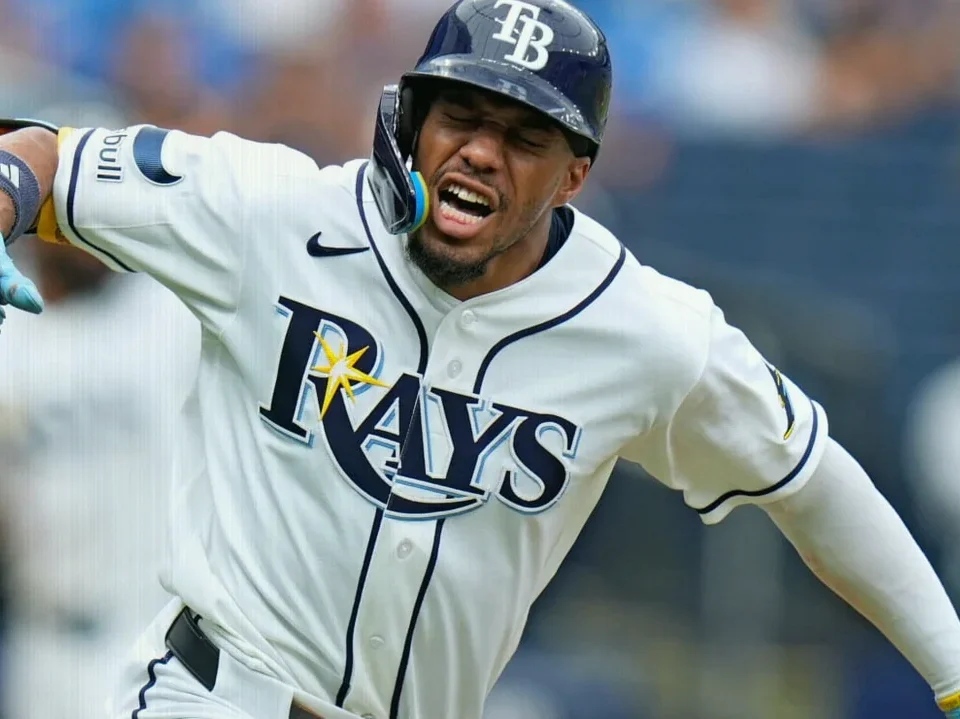
Chandler Simpson has built his Major League game on everything that happens before a ball reaches the wall. The Rays’ speedster can pressure an infield, swipe a bag, score from first and, on occasion, hit third. What he has not done in 985 regular-season plate appearances is hit a home run.
There is no postseason homer, either. Simpson’s Major League ledger still reads zero, a remarkable number for a player who has already crossed the 900-plate-appearance mark. If that continues, he could soon enter the conversation for the most career trips to the plate without a homer since the Live Ball Era began in 1920.
That is not a shortcoming in Tampa Bay’s eyes. Simpson has plenty of ways to impact a game, and slugging has never been the assignment. His profile is about contact, chaos and speed. He has not recorded a Statcast barrel in the majors, and only one ball he has put in play would have cleared a fence in any other MLB park. That was a Sept. 15 double against Oakland, and it would have been a homer only at Yankee Stadium.
Still, zero big-league homers does not mean Simpson has never rounded the bases after one. Across more than 3,000 plate appearances over eight seasons — beginning as an 18-year-old with the Brookhaven Bucks in 2019, continuing through UAB and Georgia Tech, then four years in the Rays’ farm system — he has three home runs to his name.
The college grand slam that needed a bounce
Simpson’s first homer arrived on Feb. 25, 2022, during Georgia Tech’s 14-0 win over Gardner-Webb. It came in the fifth inning, and it was not a modest first entry on the list: Simpson drove in four with a grand slam to right field.
The ball was struck in the air and carried enough to give Gardner-Webb right fielder Curtis Robison a chance at the wall. Robison reached the spot, leaped and got his glove on the baseball, but the deflection carried it over the fence. Simpson circled the bases after what became his only homer in three college seasons.
“It still counted,” Simpson said in 2025.
His college line from that inning recorded the grand slam, with Jackson Anderson, Tres Borden and Colin Hall scoring ahead of him. It was a power hit on the scorecard, even if a little help from the right fielder was part of the story.
Speed takes over in Double-A
The second homer had a far more familiar Simpson feel. On June 7, 2024, while playing for Double-A Montgomery against Biloxi, he chopped a ball down the third-base line against Adam Seminaris.
Simpson hesitated out of the box, believing the ball might drift foul. Even with that delayed start, the third baseman had no realistic play while positioned off the line. At worst, it appeared headed for extra bases.
Then the ball got beyond left fielder Zavier Warren near the short wall by the on-field bullpens and continued rolling toward the deeper fence. Simpson did the rest, racing around the diamond for an inside-the-park homer in Montgomery’s 5-4 victory.
It was his first Minor League home run after Tampa Bay had selected him in the second round of the draft two years earlier.
“When I hit the inside-the-park home run, that was my first one in the Minor Leagues,” Simpson said afterward. “Just seeing a one under home runs when I look at the stats is pretty cool.”
It was the kind of homer that makes sense for a player whose legs are often his loudest tool.
A spring blast off Altavilla
Then came the unexpected one: a conventional home run off a Major League pitcher.
On March 21, 2026, Simpson went deep against the Twins in a Rays 3-2 Grapefruit League win at Charlotte Sports Park. The blast did not enter his official regular-season record, but it came against Dan Altavilla, a veteran with parts of eight big-league seasons on his résumé.
Even this homer came with a Simpson-style wrinkle. The ball struck a railing beyond the fence and ricocheted back onto the field. Simpson stopped at second while the umpires sorted it out, then received confirmation that the ball had indeed gone out.
“I knew it cleared,” Simpson said that day. “I saw it hit the wood, but I stopped at second just to make sure. When they waved their finger around, I knew I had to jog, do the Caminero celebration and enjoy it.”
The contact was more than a lucky flare. Simpson’s drive left the bat at 99.9 mph, qualifying as a hard-hit ball and ranking as his third-hardest airborne ball since reaching Tampa Bay. It was not a Judge-sized thunderclap, but neither was it a cheap home run.
Asked whether it marked the arrival of Chandler Simpson, power hitter, he shut that idea down immediately.
“Hell nah,” Simpson said with a laugh. “Nah, nah, nah, nah. I was really just trying to hit the ball to shortstop still, and it just so happened I hit that.”
Harder contact arrives in October
Simpson did not spend the following months threatening fences. His hard-hit rate was 17% during his 2025 rookie season, among the lowest figures in the majors, and it slipped to 14% this year. For perspective, Kyle Schwarber and Shohei Ohtani have operated near 60%.
But October has offered a small, intriguing shift. Simpson’s hard-hit rate climbed to 31% through the American League Division Series against the Yankees and the AL Championship Series against the Guardians. In Game 3 of the ALCS, he ripped a 102.1 mph triple to right field, the hardest ball he has hit in the air as a Major Leaguer.
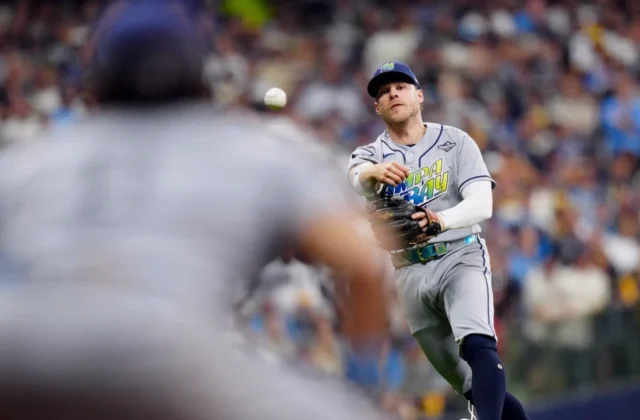
Entering the World Series against Milwaukee, Simpson is 3-for-8 through two games, all singles, with two stolen bases. Against a Brewers club built on quality pitching and defense, another official homer remains an extreme long shot. If Simpson adds a four-bagger, the safer bet is that his wheels will be involved.
But Simpson has already shown there is more than one route to the rarest number on his stat line. A wall-assisted college grand slam, a sprint around the bases in Double-A and a spring drive that required an umpiring conference have all counted somewhere. The Major League version remains waiting, and that is part of the fun now: no one is quite sure what it will look like when it finally arrives.