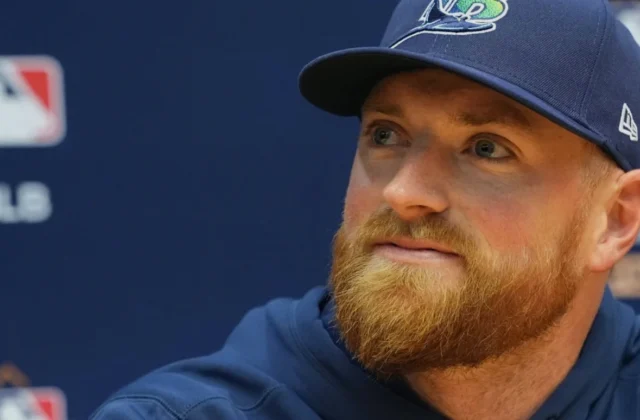
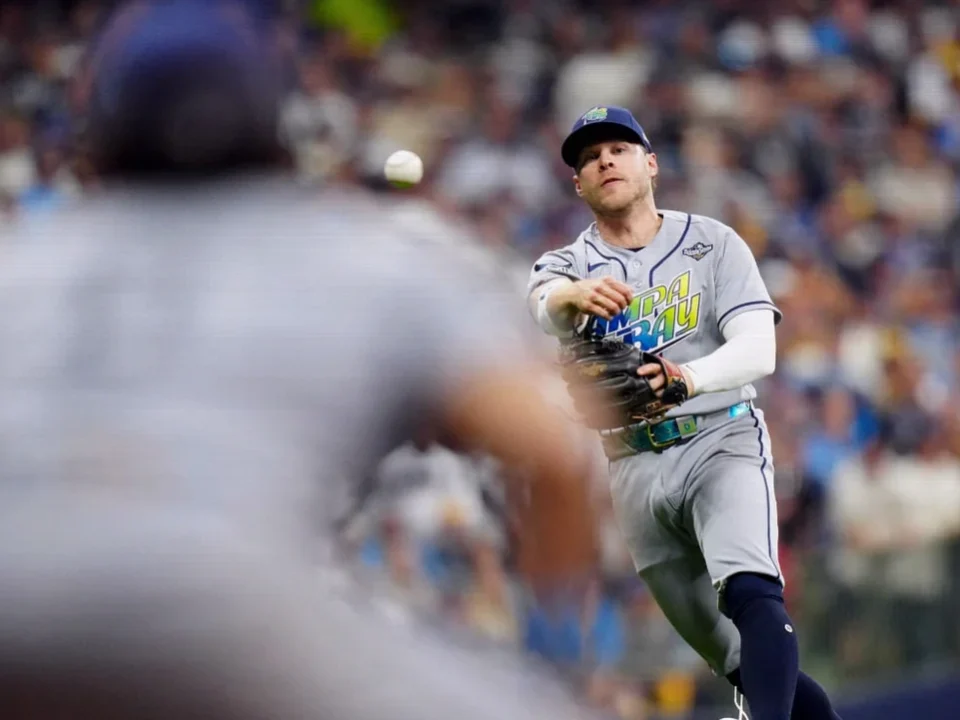
Taylor Walls does not wait for the ball to tell him where to go. By the time a pitch is on its way, Tampa Bay’s shortstop has already weighed the hitter, the pitch call, the runners, and the positioning around him — then started moving toward the spot where trouble is most likely to find him.
That instinct was on display in the Rays’ 5-4 World Series Game 2 loss to the Brewers in Milwaukee, when Walls kept a late rally from getting further out of hand. With Milwaukee leading by one in the bottom of the eighth, he charged a chopper by William Contreras and threw out Jackson Chourio at the plate, preserving the one-run margin.
It was the sort of play that explains why Tampa Bay will live with Walls’ light bat. Across six Major League seasons, he owns a .200 career average and a .589 OPS. But on the other side of the ball, few players turn more chances into outs.
A shortstop always in motion
Walls posted an 81% success rate this season, the top mark among infielders with at least 250 chances. That number measures how frequently a defender converts an opportunity into an out. It has not been a one-season spike, either: since his 2021 debut, Walls has maintained the same 81% rate, best among qualifying infielders over that span.
His 21 defensive runs saved this year ranked fourth among all players, regardless of position. His 73 DRS since 2021 trails only two players.
Rays bench coach Rodney Linares jokingly described the process earlier this season as Walls “cheating,” though there is nothing improper in it. Walls uses every legal piece of information available to get a head start — from the batter’s timing and swing path to the pitcher’s selection, which he receives through the PitchCom device in his cap.
Pitcher Ian Seymour has watched Walls closely enough to notice that the shortstop is rarely still. Seymour said Walls has a defensive gift unlike anyone else in the game. Guardians manager Stephen Vogt put Walls in even broader terms, calling him one of baseball’s finest shortstops.
The eighth-inning play in Milwaukee
The inning offered a clean look at Walls’ preparation. Chourio stood at third with another runner on second, and Kevin Kelly had worked a full count against Contreras. A 3-2 sinker was coming down and away, with Chourio — an above-average runner — 90 feet from tying the game’s urgency to every bounce.
First baseman Jonathan Aranda and third baseman Junior Caminero largely held their positions. Second baseman Richie Palacios rose into his usual ready hop and came down in place. Walls, already playing in to cut off a run at home, gained more ground as Kelly began his delivery. He took a step in, then a small hop toward the edge of the dirt.
Contreras pulled the outside sinker on the ground. The extra few feet Walls had gained gave him the play. He attacked the high hop, handled it with his glove, transferred quickly and threw accurately to catcher Nick Fortes while running. Fortes applied the tag to Chourio.
The Brewers still had the lead, but Walls had prevented the inning from becoming a two-run game.
Defense as offense
Walls said a defender has to begin every pitch assuming the ball will come his way. From there, he believes the job is anticipation: keep the feet active, field outside the body when necessary, use one hand when the play calls for it, and be ready to throw while moving.
For Walls, a run saved carries the same value as a run produced. Taking away hits and manufacturing outs, he said, can change a game just as surely as a home run can. He also made clear that he takes pride in the work — and knows it is his best tool.
Tampa Bay agrees. In a World Series decided by thin margins, Walls’ glove gives the Rays a defender who seems to arrive at the ball before the play has fully announced itself.