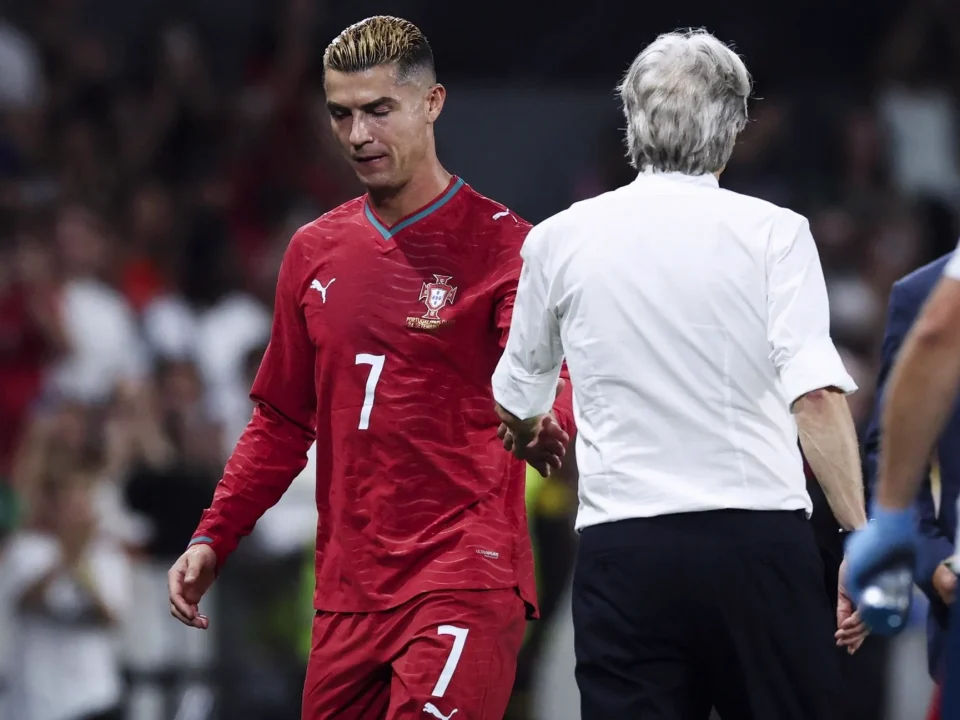
Portugal’s camp has seldom been a place where Cristiano Ronaldo passes unnoticed, and the latest disagreement has carried him away from the national side’s gathering after Jorge Jesus addressed the situation publicly. The forward was angered after warming up without being used against Norway, a frustration Jesus acknowledged with the blunt observation that no player anywhere is pleased to prepare for a match and remain on the bench.
The episode adds another chapter to a Portugal career that began in August 2003, when Ronaldo made his senior debut in a friendly against Kazakhstan under Luiz Felipe Scolari. More than two decades later, the country’s record-setting forward has worked under six national-team managers: Scolari, Carlos Queiroz, Paulo Bento, Fernando Santos, Roberto Martínez and now Jorge Jesus. The current dispute is therefore not an isolated rupture, but part of a history in which status, selection choices and the captain’s commanding presence have periodically collided.
A long international career, with difficult turns
Carlos Queiroz arrived in 2008 with an apparent advantage. He had spent four years on Alex Ferguson’s staff at Manchester United, where Ronaldo was playing, and was viewed as someone who understood the forward closely. Their partnership did not endure. By the 2010 World Cup in South Africa, tensions over Portugal’s football and Queiroz’s decisions had already developed.
Portugal’s last-16 exit against Spain proved the defining moment. Ronaldo had scored once across four appearances at that tournament, despite having been named the world’s best player in 2008. Queiroz defended him against criticism of his return, but their relationship was left badly damaged. When they crossed paths again at the 2018 World Cup, they did not speak.
Paulo Bento, who led Portugal from 2010 to 2014, had known Ronaldo from the player’s Sporting youth years. The early results were encouraging: Portugal reached the Euro 2012 semi-finals and then qualified for the 2014 World Cup through the European play-offs. Yet Bento later accepted that the relationship had worsened, with questions of hierarchy and the forward’s role within the group becoming sensitive.
After his dismissal, Bento rejected the idea that any player should hold sway over the decisions of a federation or its directors. “If roles are reversed, then the hierarchy is turned upside down,” he said. “No player, however talented, should be able to influence the decision of a club or federation leadership.” Portugal’s World Cup in Brazil, where Ronaldo scored once, also brought criticism that Bento had delayed the side’s renewal, while Ronaldo’s positioning was another point of tension.
Glory with Santos, then a painful farewell
The longest and most productive partnership came with Fernando Santos, Portugal coach from 2014 until after the 2022 World Cup. Their years together delivered the country’s greatest modern triumphs: Euro 2016 and the 2019 Nations League. For Ronaldo, the European Championship in France remains the summit of his international career.
There were still warning signs. In 2021, Ronaldo threw down the captain’s armband during matches against Serbia and Belgium, reacting angrily to refereeing decisions and results. The incidents affected his relationship with Santos, although the deeper break came in Qatar the following year.
Ronaldo was taken off in every group-stage match at the 2022 World Cup and began Portugal’s knockout ties as a substitute. Santos was unhappy with comments made by his captain during the tournament. His own eight-year spell, comprising more than 100 matches, ended shortly after Portugal’s World Cup departure, and Ronaldo did not publish a farewell message for the coach.
Both Queiroz and Bento had also lost their jobs during international windows in which Ronaldo was absent from the squad because of physical issues. The Portugal shirt has brought him lasting acclaim, trophies and an extraordinary span of service, but it has never removed the tension that can emerge when a manager’s authority meets the expectations surrounding its most famous player. Jorge Jesus now finds himself in that familiar Portuguese landscape, with Ronaldo having left camp and the debate once again stretching well beyond one unused substitute appearance.