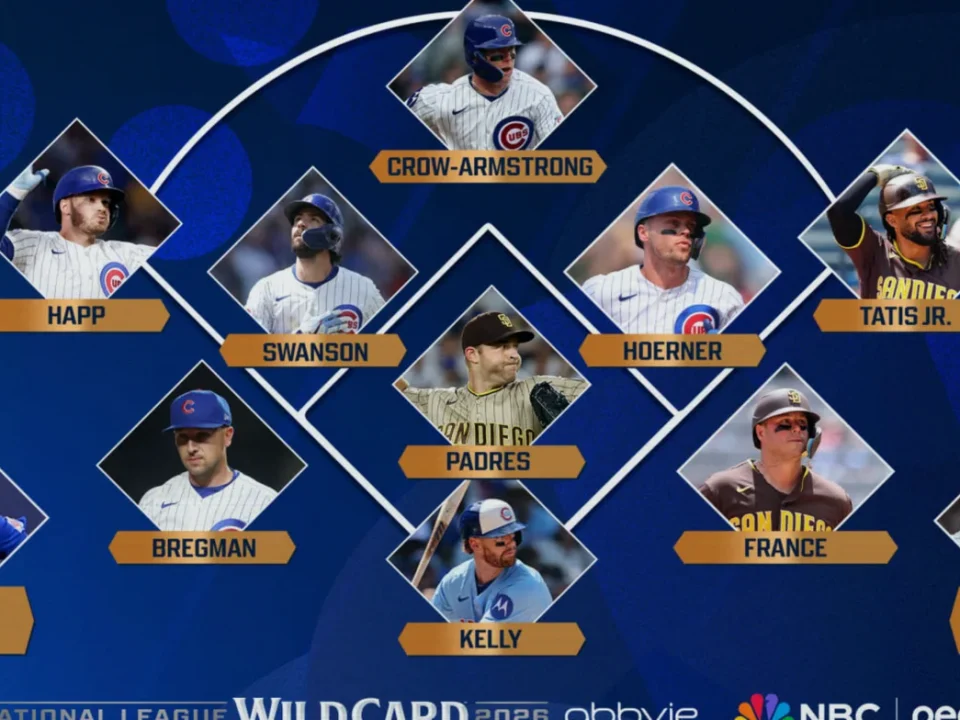
The Cubs and Padres are back in the same October room, only this time the furniture has been moved. Chicago took last year’s National League Wild Card Series in three games at Wrigley Field before its Division Series loss to Milwaukee. Now San Diego owns the park and the seeding, hosting as the NL’s No. 4 club against the fifth-seeded Cubs.
Game 1 is set for Tuesday at 10 p.m. ET, 9 p.m. CT and 7 p.m. PT, with Michael King taking the ball for the Padres. It is a rematch with enough familiar faces to stir up last October, but both clubs arrive with changed strengths, unsettled rotation questions and two centerpieces capable of putting a series on their shoulders.
How the rematch came together
- Chicago beat San Diego in last season’s Wild Card round, winning the three-game set at Wrigley Field.
- The Cubs then ran into the Brewers in the Division Series and were eliminated.
- San Diego earned home-field advantage for this year’s best-of-three Wild Card Series as the No. 4 seed, leaving the No. 5 Cubs to open their postseason on the road.
- The Padres went 51-30 at home during the regular season, making the setting a meaningful part of their case for turning around last year’s result.
Chicago’s everyday edge begins up the middle
The Cubs have the cleaner defensive picture, particularly where October games can get tightest. Nico Hoerner remains the steady hand at second base: high-contact at-bats, little need for power and top-shelf defense. He also showed up last postseason, batting .419 across Chicago’s two series. Jake Cronenworth gives San Diego versatility, and is expected to play second with Fernando Tatis Jr. in right field, but Hoerner brings more to both sides of the ball.
At shortstop, Xander Bogaerts and Dansby Swanson have produced comparable offensive lines. Bogaerts finished with 13 homers, 22 steals and a .676 OPS; Swanson had 19 home runs, 17 steals and a .694 OPS. Swanson’s range gives Chicago the edge, however. Bogaerts is a quality defender, but Swanson can turn balls in play into outs that other shortstops do not reach.
The center-field comparison is where the conversation ends quickly. Jackson Merrill is an outstanding player, but Pete Crow-Armstrong has been operating in a different class. Crow-Armstrong shared the Major League home-run lead with Kyle Schwarber at 45, stole 41 bases and supplied elite defense in center. His overall value gap over Yordan Alvarez and Bobby Witt Jr. has been described as baseball’s largest such separation since Mickey Mantle’s 1956 season.
If Chicago is going to ride anybody through the series, it will be its soon-to-be MVP. Crow-Armstrong gives the Cubs a player who can change a game with one swing, one stolen base or one ball run down in the gap.
San Diego’s stars and a few changing positions
Tatis is the Padres’ thunder in right field. He went without a home run over his first 55 games, then found his stroke on May 30 and has hit 25 since that point, posting a .914 OPS in 104 games. Seiya Suzuki is a dangerous Chicago hitter, but Tatis has carried San Diego’s lineup for months.
Ty France has been one of the season’s quieter surprises. He joined the Padres on a Minor League deal and turned into a top-10 National League hitter. France batted .321 with a .908 OPS after the break, giving San Diego a first baseman far more productive than many expected.
That production has helped offset a downshift from Michael Busch. The Cubs first baseman dropped from 34 homers and a 142 OPS+ in 2025 to 20 home runs and a 107 OPS+ this season. France’s second-half push gives the Padres the advantage at the position.
Manny Machado brings 30 home runs at third base, though his .217 average and .710 OPS left him near league-average offensively. Chicago counters with Alex Bregman, who returned from facial fractures only a week earlier and immediately went 4-for-4 with two homers in his second game back Sunday. Since the All-Star break, Bregman has been not merely one of the game’s best third basemen but one of its most productive players overall.
In left, San Diego can mix left-handed hitter Dustin Harris and right-handed hitter Samad Taylor, each around .300 since joining the club. Chicago has its dependable veteran in Ian Happ, who posted 24 homers, 55 extra-base hits and 68 RBIs.
The Cubs also hold an advantage at designated hitter for now. Michael Conforto bounced back with 15 homers and a 117 OPS+, and should see right-handed pitching in the Padres’ rotation. San Diego could use Gavin Sheets, Miguel Andujar or another arrangement, but neither has supplied the same production this year.
The catching question and the mound work
San Diego’s catcher room could become one of the series’ most interesting tactical calls. Twenty-year-old Ethan Salas has the talent to become a difference-maker, while Luis Campusano and Freddy Fermin are also in the mix. How the Padres allocate those three catchers is still unsettled.
Carson Kelly gives the Cubs a clearer lead option behind the plate, even if he has not matched last season’s production. He did deliver a major home run against the Padres in Game 1 of last year’s Wild Card Series.
King gives San Diego the most dependable starter in the matchup over the full season. Across 32 starts, he logged 185 innings with a 3.21 ERA and 159 strikeouts. Behind him, the Padres can turn to Nick Pivetta, who made eight starts and compiled a 2.86 ERA, nearly matching his 2.87 mark from the year before. Robbie Ray, a former Cy Young Award winner, and Walker Buehler are Game 3 possibilities.
The Cubs have Matthew Boyd and Kevin Gausman ready for the opening turns, followed by options including Clay Holmes, David Peterson and perhaps Shota Imanaga on short rest. Gausman helped the Blue Jays reach last year’s American League pennant, and Chicago’s candidates carry meaningful postseason experience. Still, San Diego’s starting group has been sharper in 2026.
The Padres’ late-inning hammer
If the Padres get a lead to the bullpen, they can turn the game into a narrow tunnel. Adrian Morejon posted a 2.83 ERA and struck out 107. Bradgley Rodriguez recorded a 2.19 ERA with 81 strikeouts. Then comes Mason Miller, the National League saves leader with 38, alongside a 1.67 ERA and 129 strikeouts.
Daniel Palencia, Ryan Zeferjahn and Ryan Rolison headline a capable Cubs relief group, but San Diego’s collection is the more intimidating unit. Miller in particular has the kind of late-inning stuff that can shorten a game to six innings.
The call
Chicago escaped San Diego’s bullpen last year by building leads before the late innings in Games 1 and 3. That remains the Cubs’ clearest path. Their lineup is powerful, their defense is the best in the Majors, and Crow-Armstrong is playing at the height of his abilities.
The Padres have the home field, King in Game 1, Tatis scorching the ball and a bullpen built for October. Yet the Cubs have enough position-player advantages to take this rematch, even with their pitching depth less certain. Chicago gets the nod again, with the hope that the series eventually hands everyone the showdown it deserves: Mason Miller against Crow-Armstrong, game hanging in the balance.