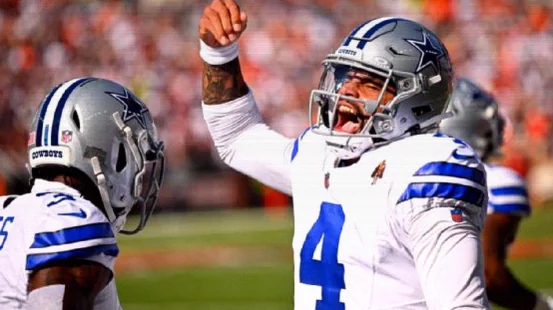
Dak Prescott’s game-day work begins well before the snap, with the Cowboys quarterback sorting through coverage, pressure threats, protection calls and clock management in a matter of seconds. In his 11th NFL season, Prescott views the mental demands of the position as the most rewarding part of playing quarterback.
Prescott processes the field before the ball is snapped
After Brian Schottenheimer delivers the call through the headset, Prescott relays it in the huddle and begins another rapid sequence of decisions at the line of scrimmage. He studies the defensive front, safety alignment, linebacker positioning, cornerback leverage and the number of defenders near the box.
Prescott must also account for down and distance, score, remaining time, quarter, weather and crowd noise. Working with center Cooper Beebe, he sets the protection, signals receivers and can move the offense from its original play to a built-in alternative before the snap.
- A typical snap requires anywhere from two to 10 decisions, Prescott said.
- Weekly film preparation helps him identify coordinator tendencies and smaller indicators, including defensive-line alignments or linebackers threatening an A-gap blitz.
- Once a play begins, he must quickly determine the appropriate placement and pace of a pass, whether it needs touch, velocity, an outside shoulder throw or a low ball away from coverage.
- Prescott said much of that processing becomes instinctive through repetition, practice and the work completed during the week.
What appears disorderly from the stands is more controlled from the quarterback’s view. Prescott said the game slowed down for him as he learned to focus on the limited information that truly matters on each play rather than trying to process everything at once.
A touchdown against Cleveland showed the adjustment process
A 21-yard touchdown to Brandin Cooks in the 2024 season opener against the Cleveland Browns offered a clear example of Prescott’s pre-snap and post-snap problem-solving. The score came hours after Prescott signed the extension that briefly made him the league’s highest-paid player.
Dallas had third-and-5 at Cleveland’s 21-yard line on its opening possession. Cooks said the Cowboys expected the Browns to use Cover 0 pressure in that part of the field, and both he and Prescott recognized the look before the snap.
With Cooks lined up as the innermost receiver in a three-by-one alignment, Browns safety Grant Delpit positioned himself inside. Prescott tightened tight end Jake Ferguson’s alignment to help deal with All-Pro edge rusher Myles Garrett.
Prescott acknowledged that leaving Ferguson against Garrett was not an ideal matchup, but said the plan depended on a quick release. Ferguson only needed to impede Garrett long enough for the ball to come out.
Protection changed after the snap
The Cowboys had six blockers available for six Browns defenders, but linebacker Jordan Hicks came free through the gap between left tackle Tyler Guyton and left guard Tyler Smith. Prescott said Smith, an All-Pro, made a minor assignment mistake, adding that quarterbacks make comparable errors through interceptions and other miscues.
Hicks had a direct lane toward Prescott as the quarterback remained focused downfield. With the pressure arriving, Prescott drifted toward the 30-yard line and released the throw with an awkward base, largely relying on arm strength.
- Cooks had reached the 14-yard line when Prescott began his throwing motion.
- Delpit was near the 9-yard line but had stopped his feet.
- Prescott released the pass earlier than he preferred because of the unblocked pressure.
- The throw sailed high, but it gave Cooks room to run beneath it for the touchdown.
Prescott said he would have preferred to place the ball deeper toward the pylon area, but the pressure required an immediate throw. During practice that week, he and Cooks had discussed the receiver locating the pass in the air rather than turning back toward the quarterback.
Prescott credited the timing of the ball and Delpit’s reaction. In Cover 0, he said, a safety can expect the blitz to reach the quarterback and may be caught flat-footed when protection fails only briefly.
Cooks, now with the San Francisco 49ers, said Prescott belongs among the quarterbacks who can handle the full pre-snap workload. He compared Prescott’s command at the line to that of Tom Brady and Drew Brees, saying quarterbacks with that skill can function as an extension of the coaching staff.
Experience and preparation have shaped Prescott’s command
Prescott said a key point in his development came in 2018, his third season, after Dallas acquired wide receiver Amari Cooper. In Cooper’s debut against the Tennessee Titans, Prescott made his 40th regular-season start.
The Cowboys lost 28-14 that night, and Prescott finished 21-of-31 for 243 yards, two touchdowns and one interception. Still, he said that game marked a change in the way he understood the pace and detail of the position.
Since then, Prescott has posted four seasons with at least 4,000 passing yards and all four of his campaigns with 30 or more touchdown passes. His career-high total was 37 touchdown throws in 2021.
Teammates see the work behind that production. Tyler Smith said Prescott is regularly among the final players to leave the team facility, even after normal work hours have ended. Smith said Prescott’s performance is not simply a product of natural ability, but also of steady daily preparation.
Receiver Ryan Flournoy said the quarterback’s responsibility goes far beyond his own assignment. Prescott must diagnose the defense, communicate the play to every offensive player and ensure the unit is aligned before the snap, a task Flournoy called remarkable from a receiver’s perspective.
Dallas is trimming language without limiting options
Offensive coordinator Klayton Adams said the coaching staff considers the length of each playcall, particularly when the call includes an audible or second option. Long terminology can consume valuable seconds on the play clock.
Prescott takes pride in delivering calls from memory rather than relying on a wristband play sheet, Adams said. That requires the quarterback to learn and own the terminology, while the coaches attempt to reduce unnecessary wording.
- Dallas tries to build shared understanding so players do not need every instruction repeated in the playcall.
- Coaches may still add details when a tight end, running back or another player has a particularly important responsibility.
- Prescott’s direct headset connection can tempt the staff to include extra information, but Adams said efficiency remains important.
Schottenheimer gives Prescott the call and room to operate
Prescott prefers limited communication after Schottenheimer delivers the play. The coach-to-player system cuts off with 15 seconds remaining on the play clock, and Prescott said he wants to use the time before that point to take command rather than hear more instruction.
He said the preference reflects the trust developed through the team’s preparation. Prescott wants the call, then the freedom to work through the defensive picture and execute the plan.
Schottenheimer said quarterback is among the sport’s most difficult assignments because players must beat a clock, face elite athletes and process a large amount of information. He added that quarterbacks sometimes must rescue an offense from a poor call as well.
Prescott embraces that weekly contest with opposing defensive coordinators. He said every coordinator tries to create looks that will fool him, and while he believes experience has given him more answers, he still can be surprised.
For Prescott, the separation at quarterback is not merely arm talent or improvisational ability. He said it comes from adapting, making changes, leading all 10 teammates on offense and keeping coaches and players aligned. The strategic work before the snap, he said, remains the part of the job he enjoys most.