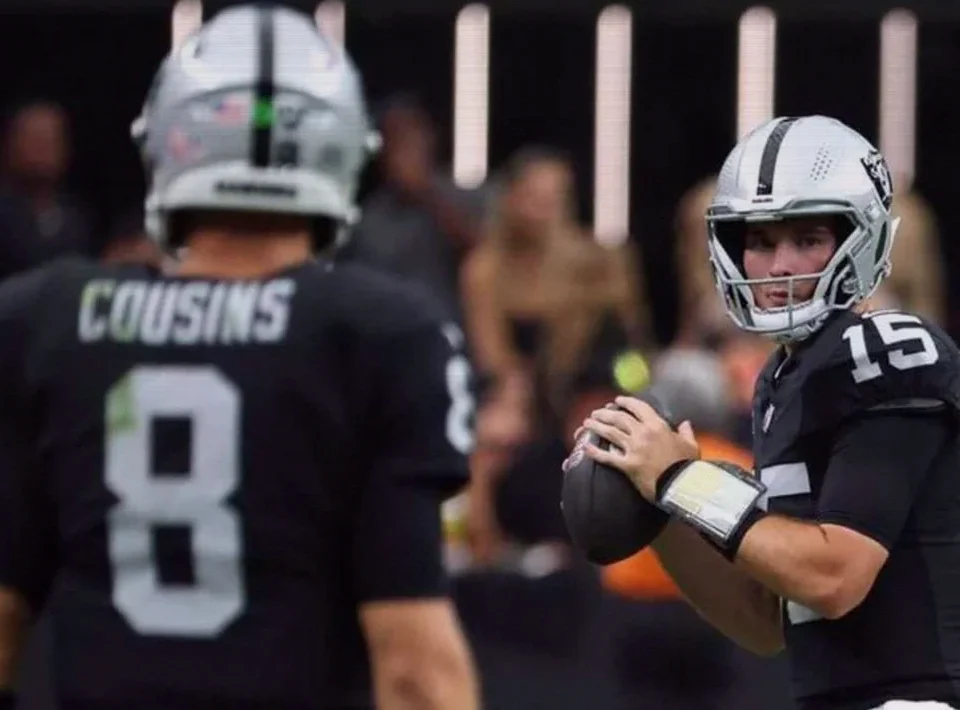
Fernando Mendoza did not take a snap in the Raiders’ season-opening victory over the Miami Dolphins, but the No. 1 overall draft pick treated every offensive play as if Las Vegas had sent him under center.
With Kirk Cousins starting at quarterback, Mendoza stood on the Allegiant Stadium sideline in his helmet, receiving Klint Kubiak’s calls through the communication system and repeating them aloud. He checked the play on his wristband, worked through protection adjustments and coverage-based alerts, then verbally mapped out where he would go with the ball.
At times, the rookie became so absorbed in the exercise that he nearly began his dropback and throwing motion alongside Cousins. Instead, he kept the physical part of the routine restrained so he would not telegraph whether the Raiders were about to run or pass.
“Some plays take you a different way depending on coverage, depending if there’s a blitz,” Mendoza said. “There’s some cans. There’s some alerts that get changed. There’s little tendencies in the plays that I have to remember.”
Mendoza has been the No. 2 quarterback since Kubiak named Cousins the starter on Sept. 2, making him the first top overall pick since 2018 not to open his team’s season as the starting quarterback. The Raiders’ plan is for him to develop behind the veteran, and Mendoza said the difference between practice, preseason football and the regular season became clear immediately.
“How efficient you need to be to win,” Mendoza said when asked what he learned from the opener. “The margin for error is smaller. It gets smaller from practice to the preseason to then the actual games. Windows are tighter. Everything is harder.”
Simulated reps on the sideline
On game days, Mendoza works beside quarterbacks coach Mike Sullivan. After receiving a call, he identifies the possible defensive looks, explains his check or progression, and discusses how he would respond. Sullivan adds scenarios and questions before the two watch the live snap, review the result quickly and begin the process again on the next play.
The approach carries over from practice, where Mendoza goes through what the staff calls “America’s Drill.” Before Cousins runs the starting offense against the scout defense, Mendoza performs the footwork and reads attached to the call. He said the sideline version allows him to see an opponent’s defense at full speed while continuing to make the same decisions he would make in the game.
“Being able to visualize what I would do in that specific scenario is very important,” Mendoza said. “Sometimes we have a pure progression play where I’m seeing it as it goes and reacting. ‘Hey, the No. 1 wasn’t there. Oh, the No. 2 is there,’ and throw.”
Mendoza believes saying the reads aloud reinforces the mental work and builds both memory and routine. Sullivan and offensive coordinator Andrew Janocko introduced the process, while Kubiak described it as part of the club’s effort to find every possible advantage in preparing the rookie to play.
Janocko said the work amounts to meaningful game preparation even when Mendoza remains on the sideline. “You’re putting yourself in the game, so you’re getting game reps just like you would at practice,” Janocko said. “When your number is called, whether it be the next snap or a while down the road, you’re establishing yourself for game reps.”
The practice is familiar to both quarterbacks around Mendoza. Cousins used a similar mindset when he backed up fellow rookie Robert Griffin III in Washington in 2012, saying a reserve quarterback has to remain ready because he is always one play away. Aidan O’Connell, now Las Vegas’ third-string quarterback, also told Mendoza he has followed the same routine during his time with the Raiders, including when he backed up Jimmy Garoppolo before starting the final nine games of the 2023 season.
“Any No. 2 quarterback, they’re listening to the call,” Kubiak said. “They’re saying it in their head what they’d be going through progression-wise, check-wise, putting themselves in the game on every snap.”
Mendoza’s helmet is part of that immersion. While many backup quarterbacks use a headset or earpiece while wearing a cap, Mendoza chose to stay in his helmet because it recreates the way he would receive calls on the field. He said he had not realized a separate headset was an option, but preferred the helmet because it provided the closest version of an in-game experience.
He kept his exchanges with Cousins limited during the Dolphins game, occasionally discussing coverages or offering another perspective, but largely allowing the veteran to focus. Mendoza watched as Cousins, Janocko and Sullivan reviewed plays on the sideline and used the iPad, saving any additional questions for the coaches.
His backup duties also extended beyond mental reps. Mendoza congratulated Cousins after each of the veteran’s three touchdown passes and tried to lift him up after two interceptions. On one possession change, he was also seen helping center Tyler Linderbaum adjust his shoulder pads.
Cousins’ opening-week performance gave Mendoza a live example of the standard he is trying to reach. While he waits for his opportunity, the rookie said he is embracing the weekly process of installing plays, practicing them and watching how they translate under game conditions.
“I think it’s going to help me going forward to see the battle rhythm,” Mendoza said. “Really see the battle through the week of how we install plays, how we practice plays and how they show up on game day with coach Kubiak doing it. Obviously, he was very successful last week, so I’m excited to keep on staying engaged and keep on learning and developing.”