
Wednesday brings the sharp edge of the Wild Card Series: four Game 2s, four clubs trying to close a door, and four others playing with their season on the line. Tuesday supplied the full October menu — Atlanta’s late comeback, Chicago’s surprising win in Houston, a Yankees staff led by two Massachusetts natives that smothered Boston, and San Diego watching Michael King carry a no-hit bid deep into the night. Now the best-of-three format leaves no room for a slow start.
Atlanta’s comeback changes the feel of Game 2
The Phillies appeared to have found a clean break from their difficult final week of the regular season in Tuesday’s opener at Truist Park. Their offense came through in key spots, interim manager Don Mattingly handled his bullpen aggressively, and the Atlanta crowd had grown uneasy as Philadelphia held control for seven and a half innings.
Mattingly’s decision to bring closer Jhoan Duran into the game in the seventh, with Atlanta’s toughest hitters due, reflected the urgency of a short series. Keeping Duran on into the eighth was defensible, too. But one fastball left in the wrong place changed the night when Austin Riley delivered the decisive blow. The Braves now have the chance to finish the series at home Wednesday at 2 p.m. ET on NBC and Peacock, with Cristopher Sánchez starting for Philadelphia against Tyler Mahle.
For the Phillies, the question is no longer whether they can look like a postseason-ready veteran club. They did for much of Game 1. It is whether they can recover from letting a game that close slip away.
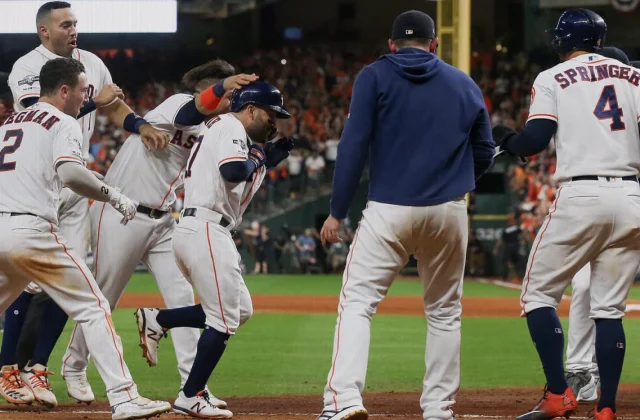
Houston faces a similarly urgent afternoon at Daikin Park, where the White Sox — coming off a win that carried an unusual papal stamp of approval — have put the Astros under immediate pressure. Houston has now dropped eight straight postseason games at home, a skid stretching back to Game 2 of the 2023 American League Division Series. It is a startling turn for a franchise that won the World Series four years ago, its second championship over the past decade.
But this Houston club has spent much of the season looking unlike those earlier editions. The Astros are four games below .500 at home and one game below .500 overall. Tuesday exposed familiar trouble spots: pitching depth was thin, and the lineup generated little outside of Yordan Alvarez. The club used eight pitchers, including closer Josh Hader, making a deep start from Hunter Brown especially important in Wednesday’s 5 p.m. ET game on Peacock and NBCSN.
Brown gives Houston a real chance to extend the series. The right-hander lost more than two months earlier this season to a right shoulder strain and was inconsistent after returning, but he finished strongly with a 2.47 ERA across his final eight outings. Three of those starts included at least 10 strikeouts. He has also handled Chicago well, posting a 2-0 record and 1.38 ERA in two starts against the White Sox this year. Sean Burke gets the ball for Chicago.
Boston needs offense, while Chicago needs a PCA answer
The Red Sox arrive in the Bronx at 8 p.m. ET with a month-long offensive drought threatening to end their October quickly. Boston scored just 71 runs in September, the fewest total in Major League Baseball and 18 fewer than Philadelphia, the club ranked 29th. That slump followed them into Game 1 against the Yankees.
Cam Schlittler continued his remarkable command over Boston, lowering his ERA in six starts against the Red Sox to 0.47. Boston also failed to gain traction against Paul Blackburn and John Schreiber, allowing the Yankees to avoid using their most trusted late-inning relievers. That could matter in Game 2, when New York starts Max Fried against Boston’s Sonny Gray on NBC and Peacock.
Fried’s record against the Red Sox is nearly as imposing as Schlittler’s. In seven career starts, he is 4-1 with a 1.93 ERA. The Yankees may always welcome a big Aaron Judge swing, but their Game 1 formula made a simpler point: they do not need much offense when Boston is not scoring. The Red Sox have one game left to revive their lineup.
Out in San Diego, the Cubs face the same elimination-game reality at 10 p.m. ET on Peacock and NBCSN. Kevin Gausman starts for Chicago against Nick Pivetta, with the Cubs trying to keep Pete Crow-Armstrong’s extraordinary 2026 from ending on a quiet note.
Crow-Armstrong produced a 10.6 FanGraphs WAR season, the highest by any player other than Aaron Judge since Barry Bonds posted 11.5 in 2004. Bonds reached base at a .609 clip that year; Crow-Armstrong’s accomplishment belongs in a different kind of conversation, but it still stands among the finest single seasons of this century and may rank at the very top in Cubs history.
Yet October has offered little reward so far. Crow-Armstrong went 0-for-3 with a walk in Game 1 and argued with third-base umpire Bill Miller after two check-swing strikeouts. He is now 5-for-30 in his postseason career and hitless in his past 11 at-bats. Those numbers do not erase what he did over the regular season, but they hang over one more nine-inning chance. If the Cubs cannot turn the series around, Crow-Armstrong will head into a long offseason with an historic year ending far earlier than he wanted.