
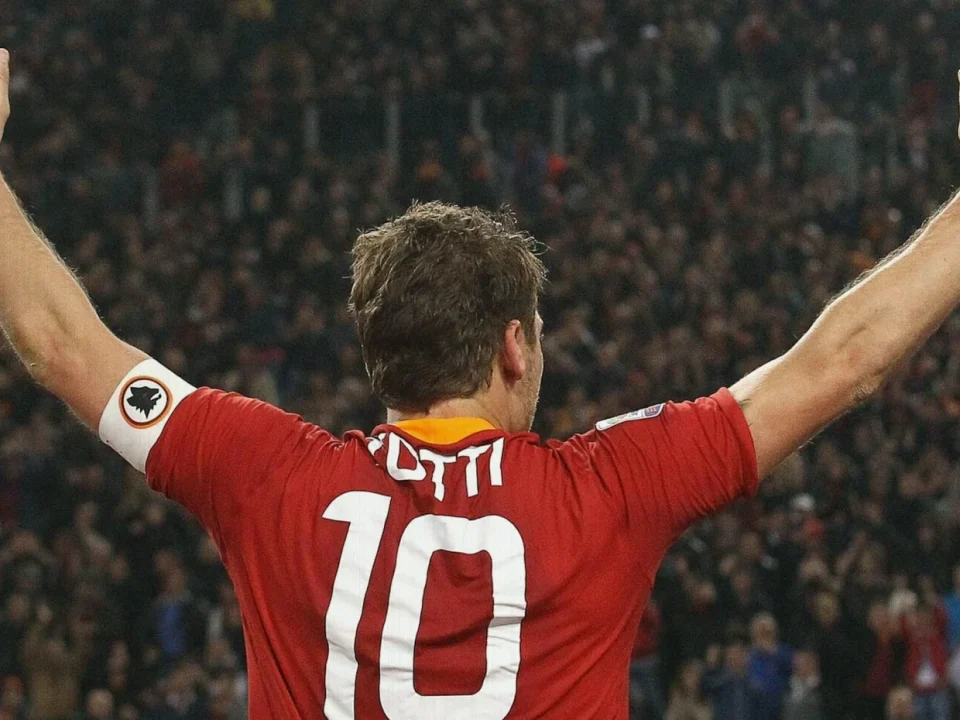
Francesco Totti reaches 50 with a place in Rome that extends well beyond the records of a remarkable football career. For generations of Roma supporters, he remains the captain who made the extraordinary appear local: a No. 10 of imagination and force, a one-club figure whose story has become part of the city’s sporting memory.
The numbers still give the scale of his bond with Roma. Totti played 786 matches and scored 307 goals for the Giallorossi, winning the 2001 Scudetto and two Coppa Italia trophies. His chipped finish, his power in front of goal and his creative command of the ball remain defining images, alongside Italy’s 2006 World Cup triumph.
Yet his public importance has never rested only on medals and highlights. Totti’s career became unusual because the player who could decide a match beneath the Curva Sud gradually learned to turn the caricature made of him into part of his own language.
From target of jokes to author of them
Early in his public life, Totti was often presented as shy, awkward and vulnerable to the sharp humour that surrounds football in Rome. His working-class upbringing, his limited interest in formal study and his unguarded manner became easy material for others.
The decisive change came through his connection with television host Maurizio Costanzo, who encouraged him to answer mockery with self-mockery. In 2003, Costanzo helped turn years of jokes about Totti into a popular book, All the Totti Jokes Collected by Me. The point was not to defend an image of perfection, but to make the player the owner of the joke.
Totti embraced that approach. Among the comic lines associated with him was the boast after struggling for months with a children’s puzzle: having read that it was suitable for ages two to three, he declared himself a genius. On television, when asked whether he had read a book, he answered that he had read “Rin Tin Tin”, misunderstanding the interviewer’s correction.
Those sketches helped reshape how he was seen. Rather than allowing the old stereotype of the unintelligent footballer to define him, Totti made his apparent naïveté a form of warmth and accessibility. It was an answer rooted in the same directness that supporters had always recognised in him.
A Roman presence beyond the pitch
That public persona carried Totti into Italian popular culture. In 2006 he and Ilary Blasi, then his partner and the mother of his children, provided voices for the Italian version of The Simpsons. Two years later he appeared in L’allenatore nel pallone 2, and he was later seen in the television series I Cesaroni.
Brands also understood the reach of a footballer perceived as unmistakably Roman and genuinely familiar. Totti worked with Nike and Diadora, while campaigns outside sport included Vodafone, FIAT, Pepsi, Dash, Very Mobile, Volkswagen and Grom.
In 2015, Rome’s public transport company ATAC marked his 39th birthday by issuing tickets bearing his image. The gesture was notable because the company had previously reserved that type of tribute for two popes.
Even his complicated relationship with Luciano Spalletti eventually became part of that wider story. Their separation at Roma began amid harsh exchanges, but the former captain and coach later appeared together in an advertisement, suggesting a more relaxed peace between two figures whose history had once been tense.
A captain still treated as one of the city’s own
Totti’s standing does not depend on presenting him as flawless. His appeal has endured precisely because he has been seen as a human figure as well as a football icon: brilliant in the opponent’s half, but imperfect and recognisably himself away from it.
At 50, the enduring image is therefore larger than a single goal, a trophy or a comic line. Totti remains Roma’s most complete symbol: a champion formed in the city, devoted to one shirt, and still received across Italy as a familiar footballing presence rather than a distant monument.