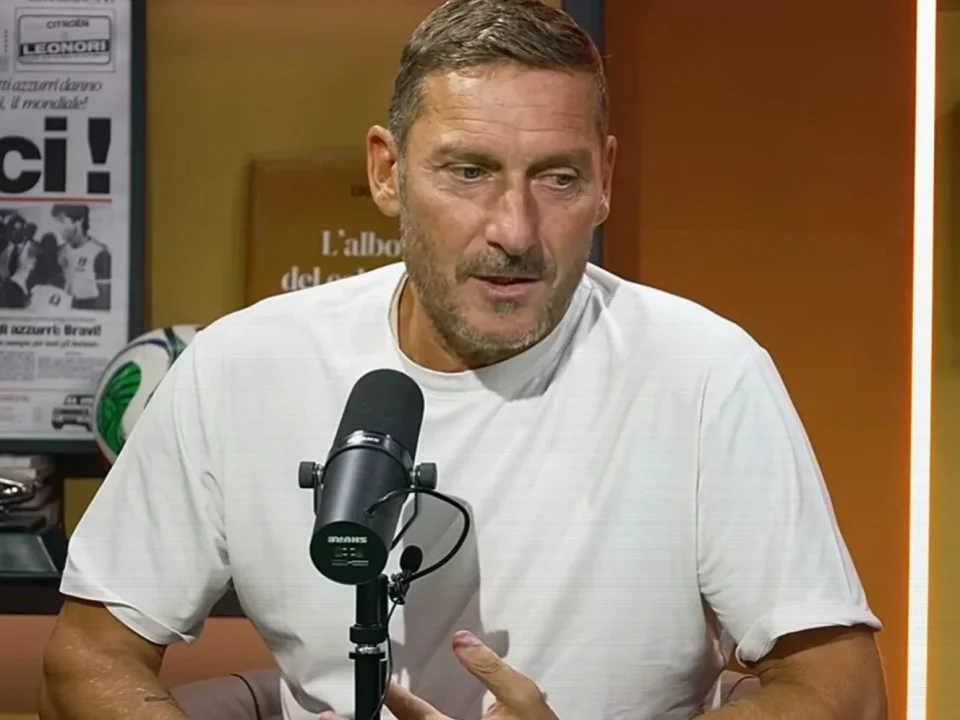
Francesco Totti turned 50 with his mind returning, first of all, to the afternoon that made the rest possible: 28 March 1993, when a 16-year-old Roman entered the field for Roma at Brescia. He remembers the minute almost exactly — the 87th, after initially saying 84th — and the details have not faded. Sinisa Mihajlovic scored, Claudio Caniggia was involved, while Roberto Muzzi was among the senior players urging Vujadin Boskov to give the boy his chance.
That first appearance remains the finest moment of Totti’s football life. “Every child carries the dream of making a debut,” he said. “I was fortunate enough to live it, and then to build something after it.” The subsequent story produced 307 goals for Roma, a Scudetto and a bond with the Olimpico that no later chapter could reproduce, but the former captain still speaks about the game with the enjoyment of the slight teenager once nicknamed “the gnome” in the Primavera. At 14, he was playing with boys four or five years older and was still waiting for the physical growth that would eventually arrive.
He believes his strongest years came between 2001 and 2008, a period in which, he said with a smile, everything seemed to work for him. Among his favourite goals is one against Udinese at the Olimpico, when Gabriel Batistuta lifted the ball forward and Totti controlled with his back to goal before striking a bouncing finish into the far top corner, with Morgan De Sanctis in goal. He also recalled memorable finishes in Genoa, Milan and the derby, while admitting that his left foot often gave him greater satisfaction than his more natural right.
The difficult final whistle
If the debut was the happiest footballing day, retirement was the hardest. Injuries belonged to the profession, Totti said, but ending his playing career felt different: the loss of a way of living rather than simply a job. For a player accustomed to the repeated rhythm of training, travel, meals, matches and Trigoria, the sudden absence of those routines created a void.
He remembered sitting alone on the steps by the players’ tunnel before his farewell at the Olimpico, thinking of 25 years with Roma, one shirt and one city. What troubled him was not merely leaving the pitch, but knowing he would no longer begin a pre-season camp or experience the opening home match of a new league campaign. “I knew I would become something else, but I was not ready,” he said.
The adjustment required him to build another life beyond football. He described the ordinary comfort of taking his children to school, travelling to Trigoria and living without the relentless obligations of a player’s schedule. He has also found a different public voice through writing, including books of jokes and biographies. Maurizio Costanzo, he said, helped him change his outlook at a time when he felt targeted over his Roman identity and perceived lack of education. Learning to make fun of himself altered how he was seen and gave him room to answer criticism with humour rather than resentment.
That temperament remains part of Totti’s self-assessment. He called himself sensitive and prone to holding grudges, and acknowledged that he made mistakes on the field as well as away from it. Looking back, he said he would not repeat his confrontation with Mario Balotelli, explaining that Balotelli’s comments about Romans and certain behaviour had provoked an angry reaction. “It was unpleasant to watch,” Totti said of his own response.
Family standards and a son’s burden
Totti also spoke warmly of his father, whose strictness shaped him. Praise was rare: even after two goals, his father could ask why there had not been a third. As a boy, Totti complained to his mother that his father appeared impossible to please. She assured him that the criticism was deliberate and that he was immensely proud. Totti said he has found himself adopting a similar approach with his own children, rooted in the values and education his father gave him.
His son Cristian has stopped playing after a medical issue was identified during a scan initially connected to a nasal problem. Doctors found an obstruction in the cerebral aqueduct, which was treated; Totti said the condition helped explain headaches Cristian had suffered from childhood. Until then, the family had not been overly alarmed because he was always active.
Football had already placed another weight on Cristian. He first wanted to become a tennis player, a prospect his father welcomed, before choosing football instead. Totti’s advice was simple: choose the sport he wanted, but approach it with commitment, desire, respect and the right mentality. Yet carrying the Totti surname made the experience harder, particularly when criticism was aimed at a teenager. “Speaking badly about a boy of 12 or 15 is shameful,” he said. “That hurt me.”
At 50, Totti’s memories still begin with that first call from the bench in Brescia and travel through a career inseparable from Roma. But they also show the harder work that followed: accepting the end of the matchday life, learning to laugh at the noise around him, and protecting his family from the expectations attached to a name that remains central to the club’s modern history.