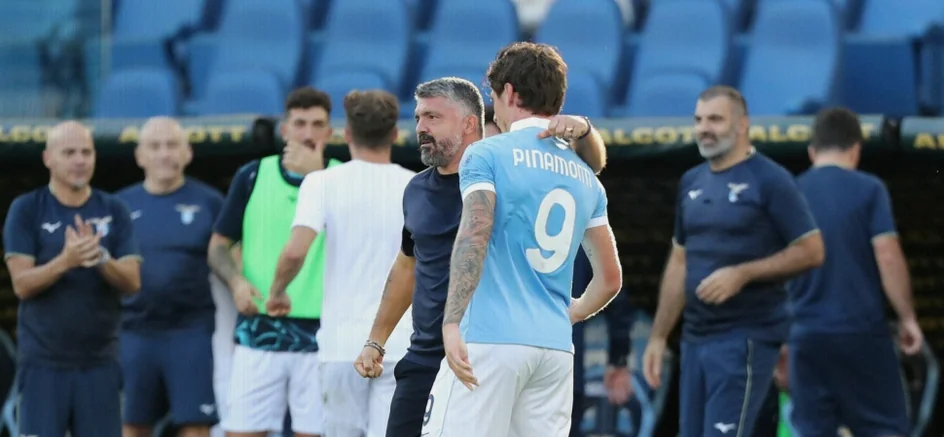
Lazio have turned the opening weeks of Serie A into a statement of resilience. The win over Monza was their fifth in six league matches, a start no Lazio side had previously achieved, and it has placed Gennaro Gattuso’s team level with Inter at the top of the table.
It is a position few expected before the season began. Lazio entered the campaign after a summer in which the transfer budget had to balance sales against purchases, while their Coppa Italia exit on 16 August deepened doubts around a squad that had missed European qualification for a second successive year.
Quick facts
- Lazio have won five of their first six Serie A fixtures, a club record.
- They share first place with Inter after defeating Monza.
- Davide Frattesi scored in each of Lazio’s first three league victories.
- Lazio have scored 11 goals across the first six rounds.
- Gattuso initially tested a 4-2-3-1 before returning to a more attacking 4-3-3.
The end of Maurizio Sarri’s spell had added another question mark. Sarri was no longer aligned with the club’s plans, yet Gattuso’s appointment did not immediately bring widespread confidence either, particularly after his unsuccessful time as Italy coach.
President Claudio Lotito had pursued Gattuso for the Lazio bench on two earlier occasions. This time, the coach arrived with a clear reading of the limitations around him. He spoke from the beginning about needing “to put on a helmet” and about spending wisely because resources were limited.
Those words were not simply defensive. At Formello, Gattuso set about building a group rather than merely overseeing one, combining his own desire for redemption after the Italy disappointment with a demand for discipline, work and mutual respect.
His authority appeared early in pre-season when Taylor was sent off the training pitch after an argument. The Dutch player later returned to form in the league, an example of a coach prepared to enforce standards without closing the door on a player.
Captain Mattia Zaccagni has described the manager as the side’s “secret” after the early victories. Gattuso has also been willing to protect the dressing-room balance in dealings above him.
He opposed the proposed arrival of Mauro Icardi, who had been put forward directly by Lotito. The coach feared that the forward could disturb the group and believed the strikers already at his disposal could recover their effectiveness; the early results have supported that decision.
Frattesi changes the mood
The key summer addition arrived on the eve of Ferragosto. Frattesi’s move from Inter gave Lazio both a player of Italy international calibre and an emotional link to the club: he had grown up in the Biancoceleste system, supported Lazio, and had left Formello 12 years earlier.
His first three league wins each carried a Frattesi goal. Beyond the decisive contributions, his arrival restored belief within the squad and around the club, even if the atmosphere at home matches remains affected by the supporters’ strike.
The scale of Lazio’s early surge is greater when measured against the losses they had absorbed. Mario Gila, Alessio Romagnoli and Ivan Provedel departed, while Pedro retired, leaving concerns that the team’s overall standard would fall.
The injury list then lengthened at the start of the campaign. Adam Marusic, Fisayo Dele-Bashiru and Nicolo Rovella were unavailable, while Danilo Cataldi and Gustav Isaksen were still working their way back.
Gattuso’s response has been to give renewed responsibility to players who had drifted from the foreground. Christos Mandas, Matteo Floriani, Oliver Provstgaard, Nuno Tavares, Reda Belahyane, Matteo Cancellieri and Tijjani Noslin have all started matches and found a more central role.
A team looking forward
From his first presentation, Gattuso signalled that he wanted a Lazio side with a more attacking identity than the final version under Sarri. The 4-2-3-1 used during the opening part of the training camp gave way to Sarri’s familiar 4-3-3, though with a more forward-minded interpretation.
Frattesi’s qualities have been important to that approach, as has the increased licence offered to Tavares when he advances. Lazio’s 11 goals in six games tell part of the story, but the greater change has been their attacking volume and willingness to take risks.
That intent leaves room for defensive exposure, yet it explains the tone of this early chapter. A club expected to navigate a constrained rebuild has instead found early momentum, and Gattuso’s Lazio are choosing to look ahead — on the pitch and in the standings.