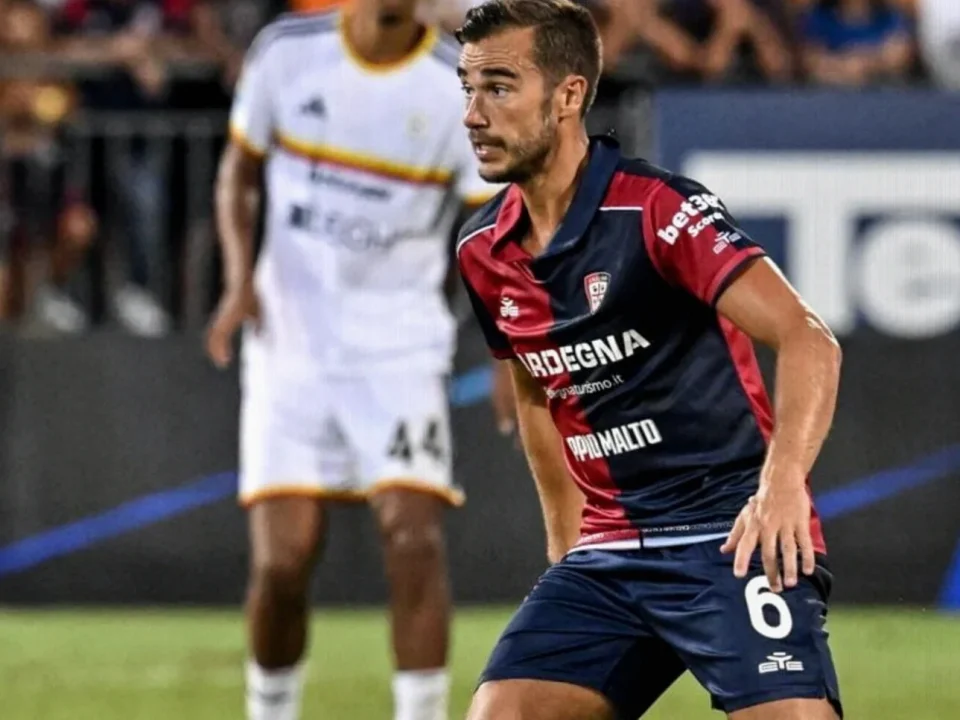
Cagliari’s early-season rise has given Fabio Pisacane more than points and a place in the top four: it has supplied the midfield reference point he had been seeking. Harry Winks has settled quickly in Sardinia, bringing order to possession and a calmness that has helped shape a side whose first weeks have exceeded expectations.
Winks gives Cagliari a midfield reference
Pisacane sees the 30-year-old Englishman as the natural organiser of his team. “Harry is the right man for us, a born playmaker,” the coach said.
Winks has become the player who chooses the rhythm of Cagliari’s attacks: playing forward when an opening appears, recycling the ball when patience is required and slowing the game to wait for the next space to emerge. His contribution has also extended away from the ball, where he has regularly found the correct positions and competed with determination despite not having the build of a traditional physical midfielder.
His arrival was not without reservations. Yet Pisacane and Accardi placed their faith in him, and Winks has soon established himself as a leading figure in the middle of the pitch.
An English career, with a difficult Italian lesson
- Winks was born in Hemel Hempstead, a Hertfordshire town of just over 80,000 people, around 60 kilometres north-west of London.
- He built his senior career at Tottenham, making 203 appearances and scoring five goals. During that spell, Spurs reached the 2019 Champions League final, where Liverpool won the all-English contest.
- He then joined Leicester City, recording 109 matches and another five goals for the club known in Italy as well as England for Claudio Ranieri’s remarkable 2016 title success.
- His previous experience in Serie A came with Sampdoria in 2022-23. He played 20 times without scoring in a season that brought few bright moments, although the whole club was already moving towards relegation and no part of the team’s structure truly flourished.
- On returning to Italy with Cagliari, he appeared to absorb the lessons of that earlier spell almost immediately, taking charge of the midfield within weeks.
The Sampdoria season was a poor one on an individual and collective level, but it also gave Winks his first close understanding of Italian football. At Cagliari, that familiarity has been paired with the experience acquired over many years in England’s top flight.
A collective platform behind the individual quality
Winks’ influence has not been presented as a one-man solution. Cagliari’s midfield has been supported by the work of Adopo and Romano, while Pisacane has found an effective balance across the side. In a functioning team structure, Winks’ qualities have become clearer.
Few Cagliari players have significantly fallen below their usual level so far; when they have, physical issues or a lack of match sharpness have generally been the explanation. The team’s encouraging start has therefore been built on a shared effort rather than the expectation that one midfielder can decide every match.
Juventus await after the break
The next major chapter comes on 11 October, when Juventus visit the Unipol Domus after the league resumes. Pisacane is continuing preparations without seven players away on international duty.
Juventus have begun to recover after early difficulties, and their visit will offer a demanding measure of Cagliari’s progress. The Sardinians sit fourth after an opening run containing four victories, including three successive away wins, with only a narrow defeat to Inter interrupting the sequence.
For Winks, the occasion should carry some of the intensity he knew from London derby afternoons, even if the surroundings will be very different. There will be no English autumn gloom in Sardinia: October is expected to retain the feel of summer, while Cagliari test whether their promising start can hold against one of the championship’s traditional powers.