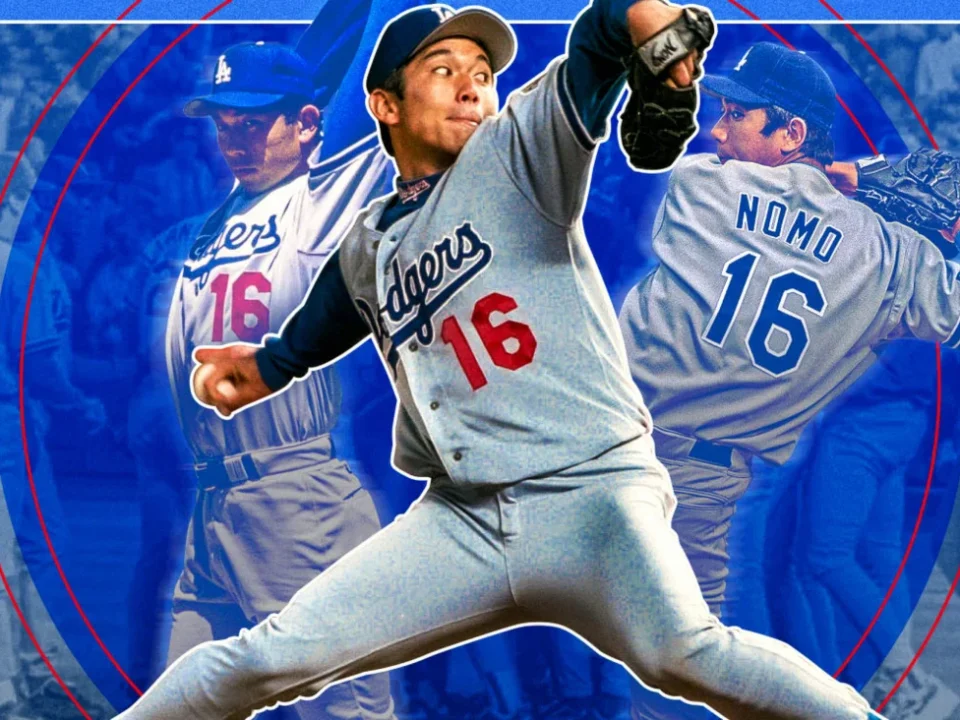
Thirty years later, Hideo Nomo’s no-hitter at Coors Field still reads like a baseball tall tale: a cold September night, a two-hour rain delay, a soaked mound, and a Dodgers right-hander deciding that the famous Tornado windup would have to wait. On Sept. 17, 1996, Nomo worked from the stretch for most of the night and held the Rockies without a hit in a 9-0 Los Angeles win, the only no-hitter ever thrown at Denver’s hitter-friendly park.
Hideo Nomo’s impossible night in Denver
Coors Field had barely been open long enough to build its reputation when Nomo arrived. It already had one. Colorado’s 1996 club tied the National League record with 221 home runs, including 149 at home. The Rockies hit .343 in Denver, scored 658 runs there, and finished with 961 runs overall. Visiting pitchers carried a 7.06 ERA at Coors that season, the highest single-season park ERA in Major League history.
There was no humidor then, only thin air and the Blake Street Bombers: Dante Bichette, Andres Galarraga, Vinny Castilla, Ellis Burks and Larry Walker. Walker was injured and absent from the lineup that evening, but Nomo still had Bichette, Galarraga, Castilla and Burks waiting for him. He also had bad memories of the ballpark. In June of that same season, he had allowed nine runs in five innings at Coors. His other Denver start, five days after his 1995 Major League debut, had produced seven runs in 4 2/3 innings.
Dodgers pitching coach Dave Wallace remembered that Nomo did not carry those outings with him. “He had a rare ability to throw the bad day away,” Wallace said. “It was always a fresh day for him.”
Nomo had shown that calm from the beginning of his American career. His May 2, 1995 debut against the Giants at Candlestick Park came under enormous attention in Japan and the United States. He was the first Japanese-born player to appear in the Majors in three decades, with hundreds of Japanese reporters watching. After getting two outs in the first inning, Nomo loaded the bases on walks.
Wallace came out with Nomo’s interpreter and, acting on instinct, greeted the Japanese rookie in Spanish: “¿Cómo está?” Catcher Mike Piazza quickly reminded his coach that Nomo was Japanese, not Spanish. Nomo understood the intent, answered that he was fine, then struck out Royce Clayton to end the inning. Against a San Francisco lineup featuring Barry Bonds and Matt Williams, he allowed only two more baserunners over his next four innings.
That unruffled presence returned at Coors. Nomo began from his trademark twisting delivery and walked Quinton McCracken in the first inning. McCracken stole second and reached third on a sacrifice fly, but Nomo escaped by striking out Bichette with his forkball. It was the first of three strikeouts of Bichette, who had finished second in the previous season’s National League MVP voting.
He walked Galarraga to begin the second, then struck out Castilla and Steve Decker before Neifi Perez popped up in foul ground. Nomo would issue four walks in all, hardly unusual for a pitcher whose 1996 walk rate was 9.1 percent. The free passes were part of the deal: hitters chased because his forkball so often began in the strike zone before falling away.
That forkball, also called a splitter, was the essential weapon. Nomo’s delivery concealed the ball while he turned his back to the hitter, and his arm speed gave little away. A fastball in the mid-90s followed by a forkball around 78 mph made both pitches more difficult to identify. Wallace recalled that Nomo could use the forkball two ways: steal a called strike with it or bury it below the zone for a chase.
Tom Candiotti, Nomo’s Dodgers teammate from 1995 through 1997, has watched generations of split-finger pitches as both a Major League pitcher and broadcaster. He said Colorado’s hitters had not encountered anything comparable. Modern pitchers may own quality splitters, Candiotti said, but Nomo’s had a different level of depth and deception.
The rain became part of the story. First-pitch temperature was 46 degrees after thunderstorms forced the two-hour delay. Nomo took a few warmup tosses before the third inning, did not like his footing from the windup, and switched to the stretch. He would stay there for the rest of the game.
“He told us he felt better from the stretch,” Wallace said. “For a pitcher with his track record, you listen. I told him to stay with what worked.”
Nomo’s change in routine was practical, but the conditions also helped keep the ball in the park. The cold, damp air and elevated humidity meant the baseballs absorbed moisture. The Rockies remained dangerous enough for the Dodgers to pile up nine runs on 14 hits, yet the weather took some life from batted balls. Wallace believed a warm, dry 78- or 80-degree Denver evening would have made the assignment very different.
Candiotti later asked Nomo why he did not use the stretch more often. Nomo’s answer fit the pitcher’s understated humor: he said he made too much money with the windup.
Defense, nerve and one final splitter
The no-hitter survived its sharpest tests in the middle innings. Ellis Burks opened the fourth with a walk, putting Nomo immediately in front of Bichette, Galarraga and Castilla. Nomo struck out Bichette, then watched Galarraga send a hard ground ball into the hole. Shortstop Greg Gagne slid, backhanded it and threw from a knee to second base for the force.
Castilla followed by driving a 3-0 fastball deep to right. He did not think it was an automatic homer, but he knew he had struck it well. Raul Mondesi tracked it to the wall and made the catch just in front of the fence.
Nomo retired the side in order in the fifth, then faced another tense moment in the sixth. Eric Young led off with a walk, but Piazza cut him down trying to steal second. McCracken bounced back to Nomo, and Burks hit a 2-1 fastball sharply toward the mound. The ball took a high hop that appeared headed over Nomo and into center field. Nomo reached up, caught it, and threw to first.
Burks was no ordinary final obstacle. He had been National League Player of the Week after batting .643 with two homers, and he would finish 1996 with 40 home runs, 32 stolen bases, the league slugging title and a third-place finish in MVP voting.
By the seventh, Nomo was still overpowering hitters rather than merely surviving them. Bichette said the fastball was what he remembered from his third trip to the plate. Usually, a hitter gets a clearer look at a starter by then. Against Nomo, Bichette felt as if he had no chance. Nomo struck him out, then retired Galarraga on a line drive to Mondesi and Castilla on a fly ball to center.
The eighth was cleaner: pinch-hitter Terry Jones struck out looking, Perez grounded out, and Jon Vander Wal popped to third. Vander Wal had set a record with 28 pinch-hits the season before, but Nomo gave him no opening.
Wallace said there was no visible change in Nomo as the game tightened. He was not the sort of pitcher who demanded silence in the dugout. His approach was simple: take the ball, do the work, accept the result.
Masanori Murakami, the only Japanese-born Major Leaguer before Nomo, understood the larger meaning of the night. Murakami had pitched for the Giants in 1964 and 1965, posting a 3.43 ERA over 89 1/3 innings, and had been at Candlestick for Nomo’s debut. On this night, he was calling the game for NHK in Japan alongside Kenichi Fukuhara.
Murakami recalled being so cold that his tongue became numb during the broadcast. Yet he also recognized how far the moment reached beyond the box score. When Murakami came to America less than two decades after World War II, he encountered an era in which racial discrimination remained widespread. He noted that even Willie Mays, his Giants teammate, had struggled to find housing. Three decades later, Murakami was describing a Japanese pitcher receiving a standing ovation in a Major League ballpark while chasing a no-hitter.
“I was thrilled to be there,” Murakami said. He described Nomo as quiet and reserved, but possessing a powerful inner determination that matched his ability.
Colorado knew what was at stake in the ninth. Burks said the hitters talked about it in the dugout, unwilling to accept the possibility of being no-hit at home. Young grounded to second on a 1-1 pitch. McCracken then swung at Nomo’s first offering and also rolled out to second.
That left Burks, Colorado’s best hitter that season, as the final chance. Vin Scully, calling the Dodgers broadcast, let the scene breathe as the crowd stood. He told viewers that the picture could carry the moment, then yielded the broadcast briefly to the Japanese call.
Nomo missed outside with his first pitch to Burks. Burks fouled off the next one, watched a fastball below the zone, then missed a forkball for strike two. He still believed he could keep the inning alive. With the season he was having, Burks said, he expected to get a hit and turn the lineup over.
Nomo answered with one more splitter. Burks swung over it.
Scully’s call captured the disbelief around the ballpark: Nomo had done what baseball people considered impossible in Denver, shutting out the Rockies without allowing a hit. His teammates swarmed the mound. Nomo, usually reserved even after his biggest outs, pumped his right fist in the Colorado chill.
He threw another no-hitter five years later, pitching for the Red Sox against the Orioles at Camden Yards. That remains the only no-hitter in that ballpark’s history as well. But the Coors Field game stands alone because of the opponent, the altitude, the weather, the wet mound, the switch to the stretch and the forkball that never stopped disappearing.
SEO Title: Hideo Nomo’s Coors Field No-Hitter Still Stands Alone
SEO Description: Revisit Hideo Nomo’s historic 1996 no-hitter at Coors Field, where the Dodgers right-hander beat the cold, rain and Colorado’s feared lineup.