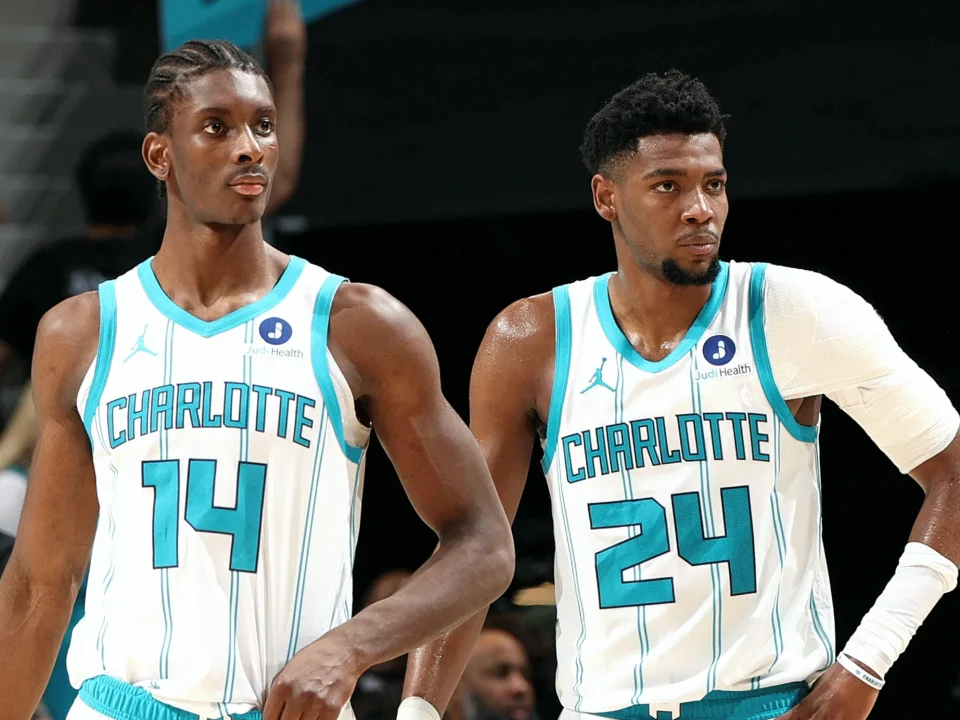
Charlotte’s backcourt and wing rotation is largely in place, but coach Charles Lee will spend camp sorting through a crowded big-man room after the Hornets reshaped their roster around Brandon Miller and Kon Knueppel. Naz Reid arrives as the likely centerpiece up front, while Moussa Diabate, rookie Hannes Steinbach, Ryan Kalkbrenner, Grant Williams, Royce O’Neale and possibly Tidjane Salaun give Lee sharply different frontcourt looks.
The Hornets are coming off a 44-38 season, their strongest record since 2015-16, though they finished ninth in the East and exited in the SoFi NBA Play-In Tournament. This summer changed the direction of the roster: LaMelo Ball and Miles Bridges, two of Charlotte’s leading players a year ago, were moved as the organization committed more fully to Miller and Knueppel.
From the locker room
Lee enters his third season with a roster built to balance young scorers, experienced perimeter defenders and future financial flexibility. Executive vice president of basketball operations Jeff Peterson added Grayson Allen, Christian Anderson, Dorian Finney-Smith, O’Neale, Reid, Dennis Schröder and Steinbach.
The guards and wings offer a fairly clear outline. Coby White, Knueppel, Schröder and Allen are the primary backcourt group, while Miller, Sion James, O’Neale and Finney-Smith fill out the wing minutes. Miller will be expected to carry considerably more of the offensive workload, especially while his availability is monitored after May surgery on his left shoulder.
Miller posted 20.2 points, 4.9 rebounds, 3.3 assists and 1.0 steal per game in his third NBA season. The 6-foot-7 forward shot 43.5% overall and 38.3% from three-point range. With Ball and Bridges no longer absorbing possessions, Miller has an opening to push toward an All-Star level and become a 20-point, five-rebound, five-assist producer with improved efficiency.
Knueppel, already one of the club’s better long-range threats, scored 18.5 points per game as a rookie. The Miller-Knueppel pairing is now the central development project in Charlotte.
Reid should be a major part of that plan. Acquired from Minnesota in the Ball trade, the 2023-24 Sixth Man of the Year averaged 13.6 points and 6.2 rebounds last season. He brings scoring range to the frontcourt and is positioned for a larger offensive role while remaining a key defensive piece.
Diabate averaged 26 minutes a night last season and has made his mark as an energetic, particularly effective offensive rebounder. Steinbach, selected 14th in the 2026 NBA Draft, is a mobile 6-foot-11 option who showed scoring touch and rebounding instincts in Summer League. Kalkbrenner supplies a more conventional center profile with board work and rim protection, while Williams brings veteran experience. O’Neale can slide down to power forward when Lee wants to go smaller.
Salaun, the sixth selection in the 2024 draft, remains another variable in the competition for minutes. The Hornets have enough frontcourt options to play bigger around Reid, use Diabate’s activity in a second unit, or lean into switchable lineups with O’Neale and Finney-Smith.
Replacing Ball’s creation
Charlotte’s offense improved more than any other team in the league last season, aided by Ball appearing in 25 more games than he did the year before. But the on-off numbers underline the scale of the adjustment ahead: the Hornets scored 123.2 points per 100 possessions with Ball on the court and 110.6 when he sat, a 12.6-point gap.
Among 263 players who logged at least 1,000 minutes for one team, only Nikola Jokić and Jamal Murray posted a larger offensive on-off separation. Ball led Charlotte in time of possession, and the offense will need a new organizing structure without him.
His shot selection was not always an asset. Among 183 players with at least 500 field-goal attempts, Ball ranked 174th in shot quality, the lowest mark among Charlotte regulars by a wide margin. His passing was a different story. Of 139 players whose teammates took at least 500 shots from their passes, Ball created the 13th-best shot quality, easily the best figure on the Hornets.
White and Schröder will have to shoulder more creation duties, while Allen and Knueppel can benefit from cleaner catch-and-shoot opportunities. Miller’s growth as a ballhandler and decision-maker may be the biggest factor in whether Charlotte can keep its offense from slipping.
The Hornets should remain competitive, but the division has become more demanding with Giannis Antetokounmpo now in Miami. Atlanta and Orlando reached the playoffs last season, and Washington is expected to improve. Charlotte’s ceiling rests on how quickly its new core can cover Bridges’ lost scoring and Ball’s playmaking.
Next tip
- Oct. 24: Heat at Hornets. Charlotte opens a first-week stretch featuring three division opponents, starting with Miami’s new Antetokounmpo-led group.
- Dec. 29: Magic at Hornets. The game closes a run of four straight division matchups and will offer a useful checkpoint before the calendar turns.
- Feb. 15: Timberwolves at Hornets. Ball returns to Charlotte after six seasons with the franchise, which selected him third overall in 2020. He won Rookie of the Year and later became an All-Star as a Hornet.
- March 26: Knicks at Hornets. Charlotte hosts the defending champions during the final three weeks of the regular season; the clubs will meet twice in that period.
- April 11: Hornets at 76ers. The regular-season finale could carry postseason-seeding implications for both teams.