
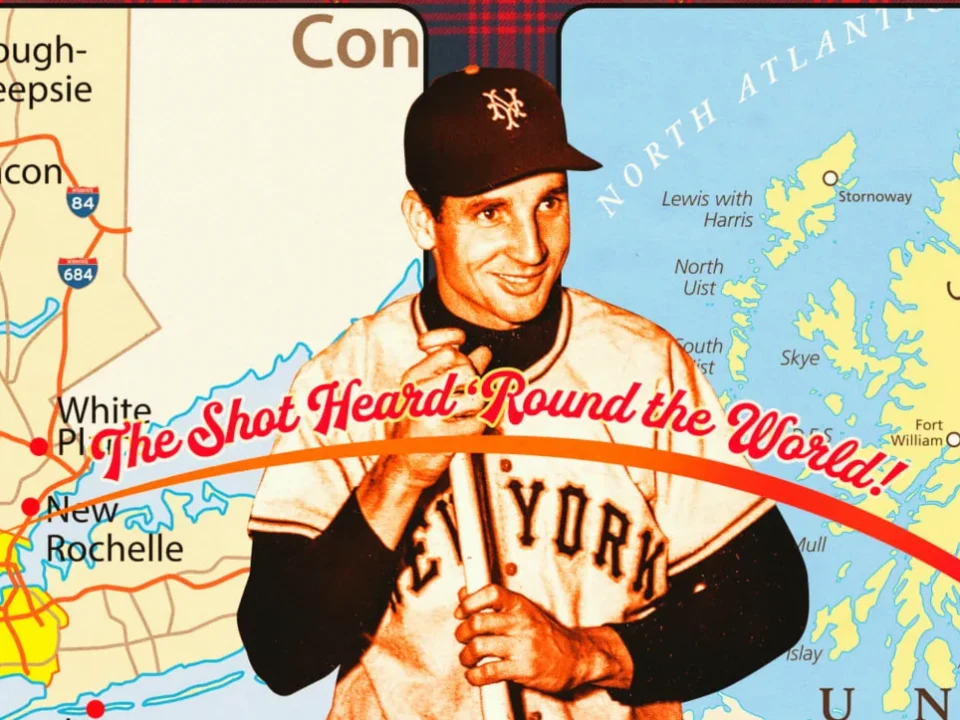
Bobby Thomson’s pennant-winning homer off the Brooklyn Dodgers on Oct. 3, 1951 remains one of baseball’s permanent calls, a swing that sent the New York Giants to the World Series and gave Russ Hodges a moment generations of American fans still know by heart. The game reached far beyond the ballpark, too: national radio and television carried it across the United States, while Armed Forces Radio delivered the broadcast to service members overseas. And the man at the center of it had been born in Glasgow.
The result
Thomson, remembered as the “Staten Island Scot,” was born Robert Brown Thomson in a cramped two-room Glasgow tenement before his family emigrated to New York. The famous home run, often called “The Shot Heard ’Round the World,” earned its international label in more ways than one. Its hero had crossed the Atlantic as a child, and its broadcast reached listeners around the globe.
Still, the homer has not become a daily piece of sporting lore in Scotland. John Tafe, president of Baseball Scotland, said some people recognize Thomson’s name, but the Giants legend does not occupy the same place in Scotland that he does in American baseball memory.
There has been meaningful recognition. Thomson entered the Scottish Sports Hall of Fame in 2003 and returned to Scotland that year. During the visit, he met players from the Edinburgh Diamond Devils, whose field took his name. The club later relocated from Tranent, outside Edinburgh, into the city, but retained the Bobby Thomson Field name.
Paul Convoy, a former Baseball Scotland president now involved with national-team development, recalled that Thomson’s appearance was modest: a short ceremony and photographs with players. That low-key setting fit the family’s own view of the man.
A Glasgow beginning
Thomson’s cousins, Iain and Ken Thomson, grew up in Glasgow and now live nearby, with Ken in Linlithgow and Iain in Perth. Neither was raised as a baseball devotee. Ken said he learned about the home run while young, but baseball felt like an American game rather than a Scottish one. Had Bobby been a celebrated soccer player, he said, the family’s awareness might have been different.
Iain said the family’s reserved nature also mattered. Neither his parents nor Bobby’s branch of the family tended to advertise accomplishments, leaving the scale of the moment less apparent to younger relatives.
Ken has become the family’s informal historian. His research into the 1921 census traced the family to 29 Tennant Street in Glasgow’s Townend district, then a crowded industrial neighborhood shaped by decades of migration following the Irish Great Famine and the Highland Clearances.
The census showed James Thomson, his wife and four children in the apartment. By the time Bobby arrived in 1923, two more children had joined the household, bringing eight family members into a flat with two rooms and neither a bathroom nor a toilet.
The hardship ran deeper than the housing. James Thomson had served in the First World War, survived trench fighting and a poison-gas attack, and lost his brother in the conflict. That brother, killed while fighting the Ottomans in what is now Iraq, was the namesake for Robert Brown Thomson.
Two days after Bobby was born, James left for New York in search of work. He spent 32 months in America before he could afford to bring over his family. Bobby did not see his father again for roughly two and a half years.
Family ties across the Atlantic
Years later, Iain made the trip to Staten Island to meet Bobby and his family. His visit came on the day of the first moon landing in 1969. After spending the day with Thomson, his wife and children, Iain rode the ferry away from Staten Island as the astronauts reached the moon.
The cousins never turned into committed baseball followers, but they came to appreciate the unusual reach of their relative’s achievement. Iain, who worked as a scientist and met people from many countries, said Americans nearly always recognized Thomson’s name. On a basketball team that included several Americans, he once mentioned the family connection and found teammates lining up for his autograph.
Thomson himself never denied the pull of his birthplace. When he returned to Scotland in 2003, he said he felt Scottish in his blood, feelings and thoughts, and that he knew his roots. Though he had left Glasgow at age 2, he said his sisters’ stories of the city stayed with him and that his personality and upbringing remained Scottish.
Ken sees the family’s story in that identity: James Thomson’s drive to build a better life, a close community built among people with little money, and a habit of looking after others. He said Bobby’s charitable work reflected that Glasgow character.
The home run is still an American baseball landmark, the kind of October swing that lives in old broadcasts and ballpark conversation. But its path began in a Glasgow tenement, carried through Staten Island, and remains stitched into a Scottish family that remembers the man behind the call.