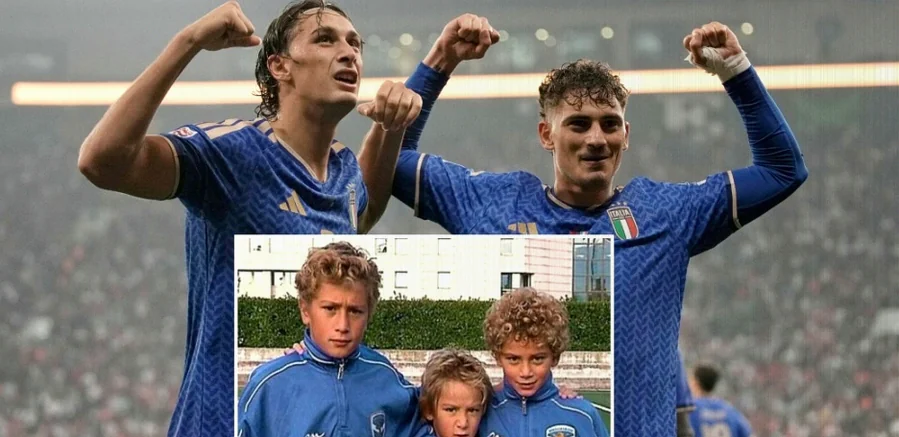
For the Esposito brothers, a move that shaped three careers began with a single day of consideration. In 2014, with Brescia facing the prospect of bankruptcy, Salvatore, Sebastiano and Pio left a difficult situation behind and entered Inter’s academy together. More than a decade later, Sebastiano and Pio have made Italian football history as the first brothers to start for Italy’s senior national team since the Cevenini brothers, 111 years earlier.
The coach and the club
The proposal reached Roberto Samaden, then Inter’s long-serving youth-sector chief and now at Atalanta, through agent Roberto La Florio. La Florio had first shown the three boys to several Serie A clubs, but each discussion came with reservations. Inter’s response was more decisive.
Samaden asked for a day to assess the opportunity. By the following day, he had called back to complete the agreement. Salvatore was 14, Sebastiano 12 and Pio only nine; all three joined Inter without a transfer fee.
The family’s journey had begun in Castellammare di Stabia before a move to Brescia, prompted by the late Roberto Clerici. Their parents, Agostino and his wife, their sister and the three boys relocated together. La Florio said that, with support from Nike and his established relationship with the company through other players, an arrangement was found that allowed the whole family to make the move to Milan.
- The Esposito family moved north from Castellammare di Stabia to Brescia.
- With Brescia in financial danger in 2014, the brothers sought a new club.
- After other Serie A sides hesitated, Inter watched the brothers and signed all three.
- Sebastiano and Pio later started together for Italy, ending a 111-year wait for such a moment involving brothers.
A family story reaching Italy
La Florio has built much of his work around young players and had already represented a long list of footballers, including Sandro Tonali, Stephan El Shaarawy, Salvatore and Sebastiano Esposito, Mattia Zanotti, Modena goalkeeper Luca Bacchin, Marco Biagianti, Federico and Emiliano Moretti, Fabio Ceravolo and Andrea Dossena.
He remembers Sebastiano as a natural scorer from his earliest years. “He kept scoring and I no longer knew what small reward to give him,” La Florio recalled. “I kept raising the target. Even as a boy, he always found the net.”
Pio’s talent also left an early impression. La Florio still keeps a photograph taken in Naples on the day of Pio’s first communion, when he was 10 years old. He remembers a boy who already stood apart from the others on local pitches.
Seeing Sebastiano and Pio reach the senior Italy side has brought particular pride. La Florio also pointed to Tonali, whom he followed throughout his time at Brescia before the midfielder moved to Milan, as a player who had already become an established figure.
For La Florio, however, the Esposito chapter remains especially personal. Sebastiano and Pio represent part of Italy’s future, with Pio in particular having shown his potential from childhood. What began as a family decision in a moment of uncertainty has become a rare chapter in the history of the national team.