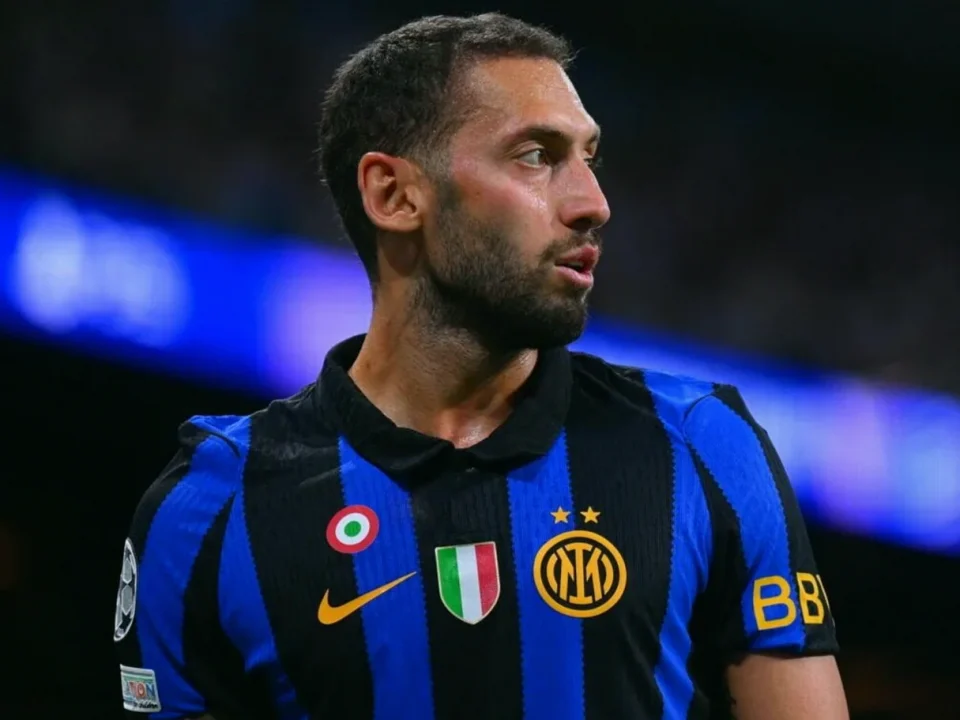
Inter’s dependence on Hakan Calhanoglu has become one of the defining threads of the club’s recent seasons. Nearly four years after his move into the role in front of the defence, the Turkish midfielder remains the player who gives the Nerazzurri both direction and balance — and his current recovery is being handled with the Champions League visit of Club Brugge firmly in mind.
From an emergency decision to Inter’s reference point
Calhanoglu was first installed at the base of midfield in October 2022, when Simone Inzaghi had to find an answer to Marcelo Brozovic’s injury. Kristjan Asllani, then the more natural alternative, had not yet offered sufficient certainty, so Inzaghi turned to Calhanoglu.
It was not entirely unfamiliar territory for him. He had previously been used in that position under Marco Giampaolo at Milan, notably in a defeat to Udinese, but that experiment had brought poor results. At Inter, however, the change reshaped both the player’s career and the team’s identity.
- Calhanoglu became the organiser of Inter’s play from deep.
- His passing range allows the side to move between short construction and longer deliveries.
- He offers an outlet for team-mates under pressure, usually receiving and releasing the ball without unnecessary touches.
- Without possession, he acts as protection for the back line, reading danger early and helping the side retain its balance.
Inter can occasionally manage without him, and Piotr Zielinski has provided valuable assistance when called upon. Yet certain matches expose what is missing when Calhanoglu is unavailable.
Roma offered a reminder of what Inter lack
The recent meeting with Roma was the latest illustration. Inter began with too little intensity, while the midfield struggled both to shield the defence and to create play despite appearing to have an advantage on paper.
It cannot be stated with certainty that Calhanoglu’s presence would have changed every aspect of the match, but it is difficult to imagine Inter losing control to the same extent with him directing matters. His ability to take responsibility for possession, choose the next pass quickly and vary the rhythm of the game has repeatedly made him a stabilising figure.
The broader defensive pattern has also been revealing. Inter have fallen two goals behind in four successive matches, and Calhanoglu was absent for three of those games. He did play in Madrid, although the goals conceded there followed serious individual mistakes rather than a failure of his usual midfield cover.
Chivu’s confidence and the question of fitness
Inzaghi recognised the value of Calhanoglu in the role; Cristian Chivu has reached the same conclusion. The Romanian coach was determined last summer that the midfielder should remain at the club, even if that meant allowing him to approach the end of his contract in 2027.
That mutual confidence has helped keep the situation calm. There were again reports from Turkey, as there had been in the past, but no meaningful unrest developed because nobody within the club gave those suggestions momentum.
The concern is not his commitment or his tactical importance. It is the physical reality of a player who will turn 33 in February and whose recent seasons have been affected by muscular problems. He has already had to stop this season, and Inter know they cannot assume that his body will offer the same resilience as before.
- Calhanoglu’s deal runs until 2027.
- He will be 33 in February.
- Muscle issues affected each of the previous two campaigns.
- He has already suffered an interruption through injury this term.
Parma may have to wait
Chivu has accepted the calculation because Calhanoglu remains an unusually complete player for Inter’s needs. Having him in peak condition for 20 or 25 matches is considered preferable to losing him altogether.
For that reason, his return in the coming weeks will be treated cautiously. His involvement against Parma after the break is not assured, with the more demanding Champions League fixture against Club Brugge a possible priority. For Inter, the question is not simply when Calhanoglu can play again, but when his presence can most meaningfully restore the order he has supplied since that decisive autumn of 2022.