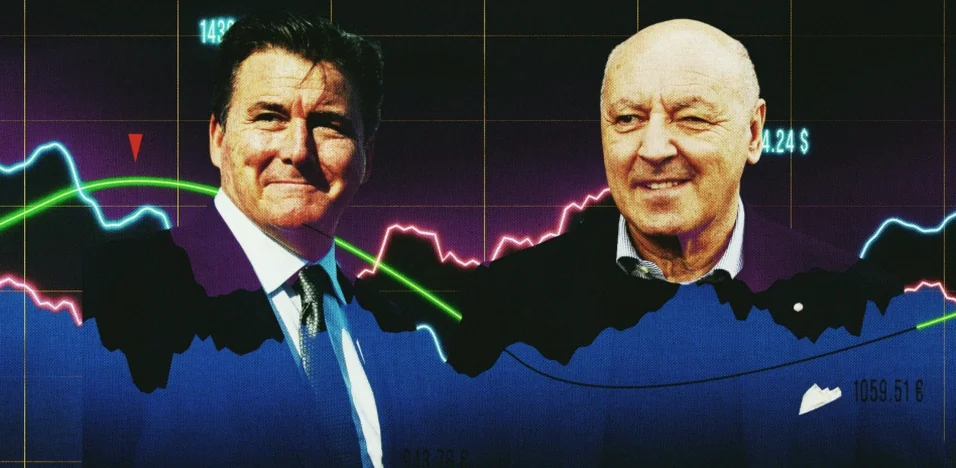
Roma and Inter arrive at the Olimpico level on points, with Gian Piero Gasperini and Cristian Chivu preparing for a meeting that offers a familiar Serie A contradiction: the table has brought the clubs together, while their corporate scale remains far apart.
On the pitch, Sunday can compress those differences into 90 minutes. Away from it, Inter’s estimated enterprise value stands at €2.137 billion, almost three times Roma’s €730 million.
Quick facts
- Inter are valued at €2.137 billion, compared with €730 million for Roma.
- In 2016, the gap was narrow: €399 million for Inter and €358 million for Roma.
- Inter posted record revenue of €546 million in 2024-25; Roma reported €222 million.
- Inter made a €35 million profit in 2024-25, while Roma recorded a €54 million loss.
- Over the past decade, Inter’s value has risen 435%, against Roma’s 104% increase.
The valuations come from Football Benchmark’s annual European assessment, published in June and based on the 2023-24 and 2024-25 accounts. Enterprise value represents the overall worth of a club and its assets, with revenue multiples adjusted through factors including profitability, social-media reach, squad value, broadcasting arrangements and stadium ownership.
A decade ago, there was little to separate the two Italian clubs in that measure. Inter were estimated at €399 million in 2016, Roma at €358 million. The decisive break began to emerge from 2019, when the difference had reached €176 million.
Inter then moved close to a €1 billion valuation gap in 2022, rose to €1.7 billion in 2025 and passed the €2 billion mark in 2026. Roma’s growth was slower, reaching €555 million in 2023 before picking up in the more recent period.
The reasons lie in the different routes taken by the clubs. Inter left the difficult final years of the Erick Thohir era and entered the Zhang ownership period, first marked by substantial investment and later by financial constraints linked to the ownership’s debt position. Oaktree’s arrival in 2024 brought a medium-to-long-term plan built around greater stability.
Through those changes, Inter sustained their sporting level. They won three Scudetti, remained regular participants in the Champions League and reached two finals in the competition. That continuity has also kept the club visible in international markets, strengthening the value of the Inter brand.
Roma changed hands in 2020, when the Friedkin group succeeded James Pallotta, continuing the American ownership presence at Trigoria that began in 2011. The 2018 Champions League semi-final was followed by a long absence from Europe’s leading club competition, lasting seven years before this season’s return.
The Conference League win in 2022 ended Roma’s wait for a trophy, but it did not produce the same financial momentum as Inter’s Champions League runs. Their earlier positions were once reversed: ten years ago Roma generated €219 million in revenue excluding player trading, ahead of Inter’s €183 million.
At that stage Roma were competing near the top of Serie A and collecting the rewards that came with UEFA football, while Inter were still adjusting after the end of Massimo Moratti’s ownership. The subsequent shift has been sharp.
Inter’s €546 million revenue total in 2024-25 was roughly two and a half times Roma’s €222 million. The Milan club have also reshaped their accounts, moving from a €246 million loss in 2020-21 to a €35 million profit in 2024-25 after cutting costs and increasing income.
Roma’s losses have fallen under Friedkin, from €219 million in 2021-22 to €54 million in 2024-25, but the club has not yet completed the same turnaround. The 2025-26 accounts, still to be approved, are expected to remain in the red, while Inter are forecast to record a second successive profitable year.
That is the wider chapter behind the Olimpico fixture. Inter’s management, led by Giuseppe Marotta, have joined sporting success to a more sustainable financial model. Roma’s task is to narrow that distance by balancing the books while making Gasperini’s sporting project work.
Friedkin’s decision to appoint Gasperini last year was tied to that broader need for progress. Both Roma and Inter also continue to look towards new stadium projects, a development that could shape the next phase of their growth. Before then, however, the standings offer Roma a simpler message: for one afternoon, they can meet Inter on equal terms.