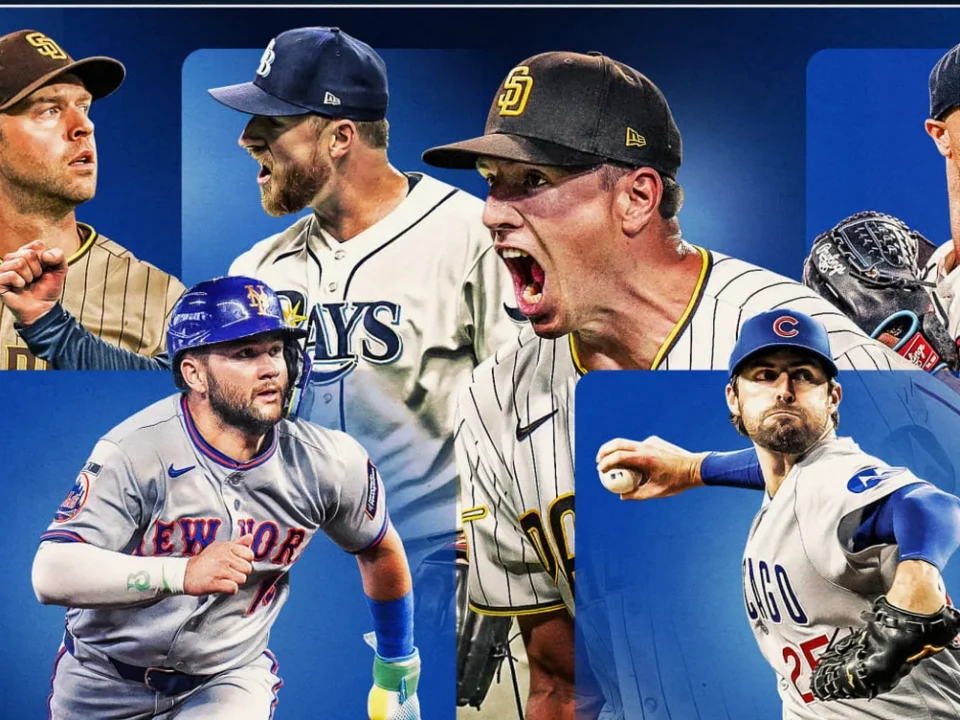
The postseason is still sorting out the World Series field, but the next roster-building season has already begun in front offices across the game. Six prominent players carry contract decisions that could reshape rotations, budgets and free-agent plans for 2027, with player options, club options and one rarely exercised mutual option all in play.
The largest questions sit on the mound. San Diego could lose Michael King while deciding whether an injury-shortened year changes its view of Nick Pivetta. Boston’s Sonny Gray appears headed toward the market despite an 18-win season. Tampa Bay must weigh whether Drew Rasmussen is worth a salary level the Rays have almost never carried. In New York, Bo Bichette has little reason to walk away from his deal, while former Mets starter Clay Holmes is positioned to do just that.
The option decisions at a glance
| Player | Club | 2027 contract decision |
|---|---|---|
| Bo Bichette | Mets | $42 million player option, with another $42 million player option for 2028; $5 million buyout on each year |
| Sonny Gray | Red Sox | $30 million mutual option; $10 million buyout |
| Clay Holmes | Cubs | $12 million salary, but he can opt out |
| Michael King | Padres | $28 million player option; $5 million buyout, followed by a $30 million player option for 2028 |
| Nick Pivetta | Padres | $14 million club option; exercising it preserves an $18 million player option for 2028 |
| Drew Rasmussen | Rays | $20 million club option |
King and Pivetta could remake San Diego’s rotation
King restored his standing as a frontline starter after an abbreviated 2025, when he made 15 starts and worked 73 1/3 innings. He signed a three-year, $75 million agreement with the Padres last offseason and then answered the durability questions in 2026, making 32 starts and setting a career high with 185 innings. His 3.21 ERA put him in position to decline the $28 million option and test free agency again at age 31.
His October work strengthened that case. King opened the National League Wild Card Series against the Cubs with seven scoreless innings, then allowed one run in five innings against Milwaukee in Game 2 of the NL Division Series. Two days later, with closer Mason Miller away for the birth of his first child, King came out of the bullpen for two innings in Game 3 and recorded his first postseason save.
Tarik Skubal figures to headline the free-agent pitching class, but King should draw heavy interest from clubs seeking a proven starter near the top of a rotation. San Diego is expected to pursue both King and reliever Adrian Morejon, though retaining both would be difficult.
Pivetta presents a more complicated call. The right-hander’s original contract with San Diego was a four-year, $55 million deal signed before the 2025 season. After producing ERAs in the 4.00 range from 2021 through 2024 with Boston, he delivered a 2.87 ERA across 181 2/3 innings for the Padres in 2025.
His 2027 option changed from a player decision to a club decision after he spent more than 130 straight days on the injured list with a right elbow flexor strain. Pivetta still posted a 2.86 ERA in 2026, but he made only eight starts and threw 34 2/3 innings after missing nearly five months.
The Padres cannot treat the $14 million option as a simple one-year wager. If they exercise it, Pivetta keeps his $18 million player option for 2028, effectively creating a potential two-year, $32 million commitment. He returned for four September starts, totaling 18 2/3 innings, and added two postseason starts covering 7 2/3 innings. A reworked contract could be discussed in light of the elbow concern.
San Diego’s 2027 staff has other moving parts. Randy Vásquez is due back, Joe Musgrove is recovering from Tommy John surgery, and Yu Darvish’s status remains uncertain after elbow surgery last year. Casey Mize, Robbie Ray, Walker Buehler, Lucas Giolito and Griffin Canning are also headed for free agency.
Gray’s mutual option points toward the open market
Gray’s 2026 season made the former Cardinals arrangement look easy on paper. He led the majors with 18 victories, logged 169 innings over 29 starts and posted a 2.72 ERA for Boston. Had the Red Sox held a straightforward club option, retaining him at $30 million would have been an uncomplicated decision.
But the clause became a mutual option when St. Louis traded Gray to Boston last November. Gray waived his no-trade protection in exchange for that change, and the buyout rose from $5 million to $10 million after his 2026 pay was cut by $4 million. Since both player and club must agree, the arrangement is likely to send him into free agency. The last mutual option exercised by both sides was Aramis Ramirez’s 2015 return to Milwaukee.
Gray has said he intends to pitch at age 37 and still wants the World Series ring missing from his résumé. Boston should remain a serious bidder, although a destination closer to his Tennessee home could hold appeal.
Holmes has earned a starter’s market
Holmes was signed by the Mets after the 2024 campaign on a three-year, $38 million contract designed around an ambitious conversion: turning a career reliever into a full-time starter. The experiment worked quickly. He made 165 2/3 innings in 2025 with a 3.53 ERA.
His 2026 began even better, as he registered a 1.86 ERA through eight starts. Then a line drive in his ninth outing fractured his right leg, shelving him for more than two months. Holmes was eventually dealt to the Cubs and made nine starts for Chicago after returning, recording a 4.25 ERA down the stretch.
Despite the interruption, the 33-year-old has established himself as a credible rotation arm. Opting out of the final $12 million on his contract is expected, allowing him to seek a deal as a starter for the first time. Because he changed teams during the season, he cannot receive a qualifying offer, meaning his next club would not surrender Draft compensation to sign him.
Bichette is likely to stay put in Queens
Bichette signed for three years and $126 million with the Mets last season, landing player options for 2027 and 2028 worth $42 million apiece. Each year carries a $5 million buyout. The $42 million average annual value ranked sixth all-time, an enormous guarantee for a player whose first seven major league seasons produced just under 20 WAR.
His first Mets season did not provide a case for leaving early. Bichette finished at .260/.312/.390 with 18 home runs, 78 RBIs, a .702 OPS and a 97 OPS+. Those marks trailed his career .788 OPS and 117 OPS+.
A .570 OPS over his first 61 games left him chasing the season, though he recovered to post a .784 OPS across his final 99 contests while playing mostly in line with his established production. After a 1.9 fWAR campaign, a free-agent deal near $42 million annually would be difficult to envision. Bichette is therefore expected to remain with the Mets and look for a stronger 2027 for both player and club.
Rasmussen’s price tests Tampa Bay’s habits
Rasmussen completed the two-year, $8.5 million extension that covered his last arbitration seasons with the Rays. His 2027 club option began at $8 million, then climbed to $20 million after he met contract incentives tied to starts and avoiding time on the injured list.
He earned that bump with the finest season of his career: a 16-5 record, 2.67 ERA, 30 starts and a personal-best 172 innings. Since arriving from Milwaukee in the 2021 Willy Adames trade, Rasmussen has fashioned a 2.71 ERA in 133 appearances, including 111 starts. His 2023 and 2024 seasons were interrupted by elbow surgery, making his healthy 2026 workload particularly meaningful.
For most clubs, a $20 million option for that kind of starter would be ordinary business. For Tampa Bay, it would be unprecedented territory. Charlie Morton’s $15 million annual salary in 2019 and 2020 remains the largest single-season figure in Rays history, and only seven players have ever collected at least $10 million from the club in one season.
Tampa Bay has often moved players as their salaries reached eight figures, so picking up Rasmussen’s option may not settle his future. The Rays could keep him atop their rotation or leverage his value in a trade for younger, cheaper talent. Pitching coach Kyle Snyder has called Rasmussen baseball’s most underrated pitcher and described his work ethic as the sport’s standard, praise that could make him an exception to the organization’s usual payroll pattern.