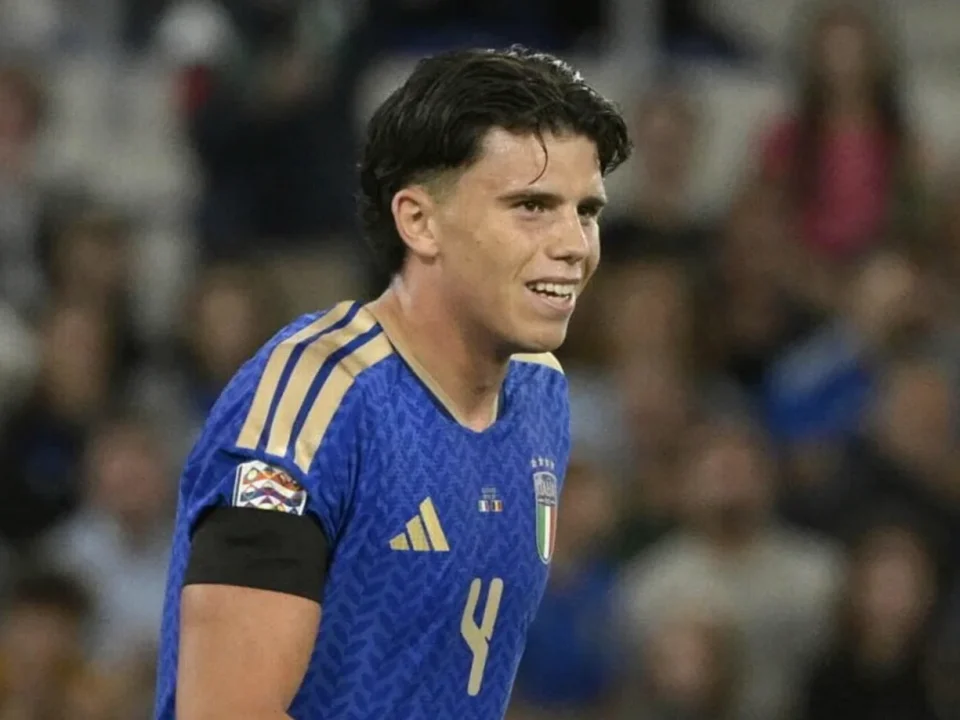
Alessandro Romano’s first night for Italy arrived under the harsh lights of the Olimpico: a 20-year-old midfielder handed responsibility in a side still being assembled, facing a Belgium team led by Kevin De Bruyne and supported in midfield by Youri Tielemans. Italy lost 2-0, but the result should not turn Romano’s debut into a final verdict.
A difficult first step at the Olimpico
- Romano entered the Italy set-up little more than a month after choosing the Azzurri over Switzerland, the country where he had developed his international career. His Italian family background comes through his father Umberto, of Neapolitan roots, and his mother Chiara, who is from Lecce.
- His parents watched discreetly from the Monte Mario stand as he made the most significant appearance of his young career. Born in 2006, Romano arrived with limited senior experience and without the benefit of a settled national-team environment around him.
- Italy began poorly against Belgium, who controlled possession for much of the opening half-hour. Sandro Tonali and Nicolò Barella were below their usual standards, while Romano was asked to direct the midfield on his first appearance.
- An error contributed to Italy falling behind, with the defensive cover also failing to prevent the damage. Belgium went on to win 2-0, having already secured a place among the World Cup’s last eight.
- Romano did show elements of his game: a one-two with Pio Esposito before driving towards the penalty area, several first-time forward passes and the willingness to receive the ball in central areas.
A player Italy moved quickly to secure
The pressure around Romano’s debut was heightened by his connection with Roma. Three months earlier, the club had sold him, with capital-gain considerations and doubts over his place under Gian Piero Gasperini forming part of the background to his departure.
Switzerland had viewed him as a possible successor in midfield, with some observers there likening his left-footed ability to move the ball quickly to Granit Xhaka. Others saw similarities with Remo Freuler. His decision to represent Italy was therefore a significant loss for the Swiss national side.
For Italy, however, the choice was not simply about heritage. Claudio Ranieri had encouraged the national-team staff to involve Romano in the new project, having followed his route at Trigoria from Roma’s Primavera side towards the first team.
Coach Roberto Mancini had also made clear before the Belgium match that he held Romano in high regard. After the defeat, he again backed the midfielder, saying: “I believe he will become an important player for Italy’s future.”
Finding the right midfield role
Mancini used the training week at Coverciano to assess Romano as a deep-lying midfielder, placing him ahead of Rolando Mandragora and Samuele Ricci in the pecking order for the Belgium match. Ricci had been called up in place of Bryan Cristante, while Manuel Locatelli was also unavailable before the camp began.
That experiment differs from Romano’s club role at Cagliari. In Fabio Pisacane’s 4-4-2, he works on the right of a two-man midfield, while the Englishman Harry Winks takes on the principal organising duties. Romano is encouraged to break forward and use his powerful shooting from advanced positions.
The distinction matters. Italy are searching for a midfield structure capable of restoring control without assuming that Romano is a direct replacement for Jorginho. Mancini still has the possession-based model of the Wembley era in mind, where the central playmaker set the rhythm and provided the foundation for the whole side.
Romano’s profile appears broader and more mobile. He can play with speed, carry the ball and arrive in the final third, which may make him better suited to a constructive mezzala role than to carrying the entire burden of regista play. Mancini’s recent description of Nicolò Fagioli offered a useful comparison: a player able to operate at the base of midfield, but seen principally as a passing, build-up midfielder in the mould of Marco Verratti.
Mandragora was tested as the deepest midfielder at the Vialli training ground, although those sessions are not a definitive guide to the next selection. Romano remains part of Mancini’s plans for the coming three Nations League fixtures and for November’s squad. The task now is not to rush his development, but to give him the matches, mistakes and protection that a young midfielder requires.