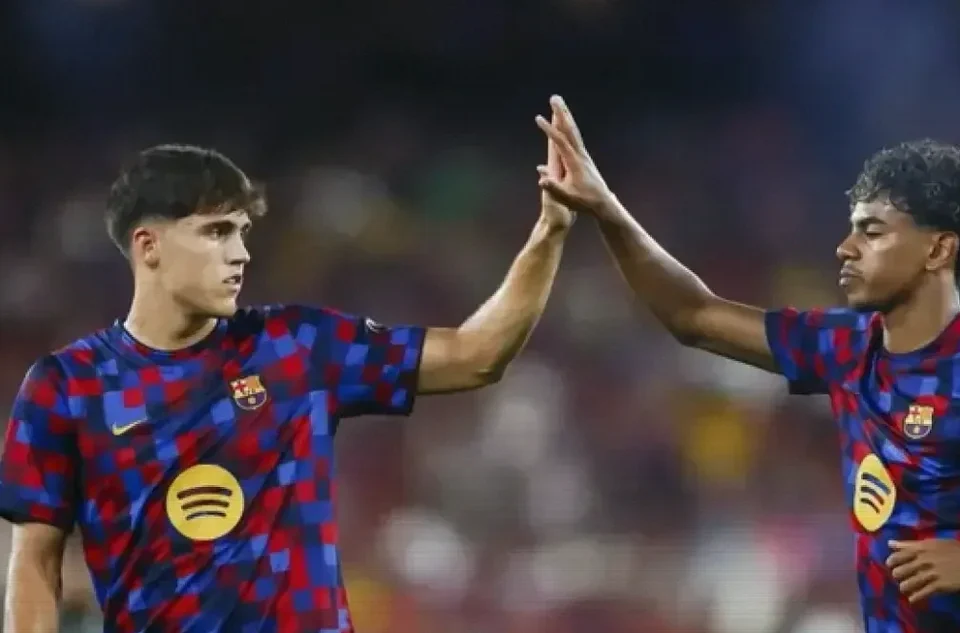
Barcelona’s academy has become a reference point far beyond Catalonia, with Lamine Yamal’s rise offering Italy a vivid example of what can happen when elite young players are trusted early. At 19, the forward is already viewed among the game’s outstanding talents and has put another Barça-developed player in the Ballon d’Or conversation.
The wider message travels beyond one exceptional teenager. Barcelona’s tradition of backing homegrown footballers has helped shape Spain’s success this century, while other Spanish clubs have increasingly added to that pathway from academy football to the senior international side.
Italy is now examining that model as it looks to restore a national team with a historic winning record. Roberto Mancini’s new Azzurri project is expected to draw heavily on a substantial group of young players, many currently involved with the Under-21s because of European Championship qualifying and Olympic priorities.
Quick facts
- Lamine Yamal, 19, is the central example for Italy’s youth-first planning.
- Spain used Yamal at Euro 2024 while he was still 17.
- Italy’s young prospects could join Roberto Mancini’s senior group within a year.
- The plan is aimed at building towards future European Championship and World Cup campaigns.
- Club minutes will be decisive in determining how quickly the prospects progress.
Yamal is not presented as a standard case. His acceleration is remarkable even in a system built to develop young talent, and it follows a Barcelona lineage that includes Lionel Messi, winner of eight men’s Ballons d’Or, alongside Aitana Bonmatí’s three and Alexia Putellas’ two in the women’s game.
Yet the Italian argument is that an abundance of prospects is not enough on its own. The country has repeatedly identified promising generations, but the key question is whether clubs and the national set-up can create a joined-up route — and, crucially, give those players meaningful first-team football.
There has been a caution against swinging from the disappointment of the Belgium match to excessive optimism after victory over Turkey. Nevertheless, the depth of Italy’s emerging pool has encouraged belief that a stronger senior side can be assembled if the players receive regular competitive opportunities.
Goalkeepers Filippo Pessina, 18, and Alessandro Daffara, 21, are among those being monitored. The defensive options include full-backs Michael Kayode, 22, Marco Palestra, 21, Lulli, 19, and Costantino Favasuli, 22.
At centre-back, Italy’s list features Giovanni Leoni, 19, Honest Ahanor, 18, Matteo Palma, 18, Luca Comuzzo, 21, Fabio Chiarodia, 21, Mané, 21, and Reggiani, 18. The intention is to establish a clearer bridge from youth selection to the senior squad rather than wait for a crisis to force a change.
In midfield, Alessandro Romano, 20, Luca Lipani, 21, Doumbia, 22, Niccolò Pisilli, 22, Cher Ndour, 22, Giacomo Faticanti, 22, and Mattia Liberali, 19, have been identified as possible candidates for the next phase.
The attacking group includes Samuele Inacio, 18, Cissé, 19, Pio Esposito, 21, Antonio Raimondo, 22, Francesco Camarda, 18, and Ekhator, 19. Their progress at club level will determine whether Italy can turn a long list of names into a functioning international side.
For Mancini, the Spanish example is not simply about finding another Yamal. It is about making room for the next generation in a coherent team structure, with Barcelona’s Yamal and Pau Cubarsí serving as the most visible reminders of what early conviction can produce.