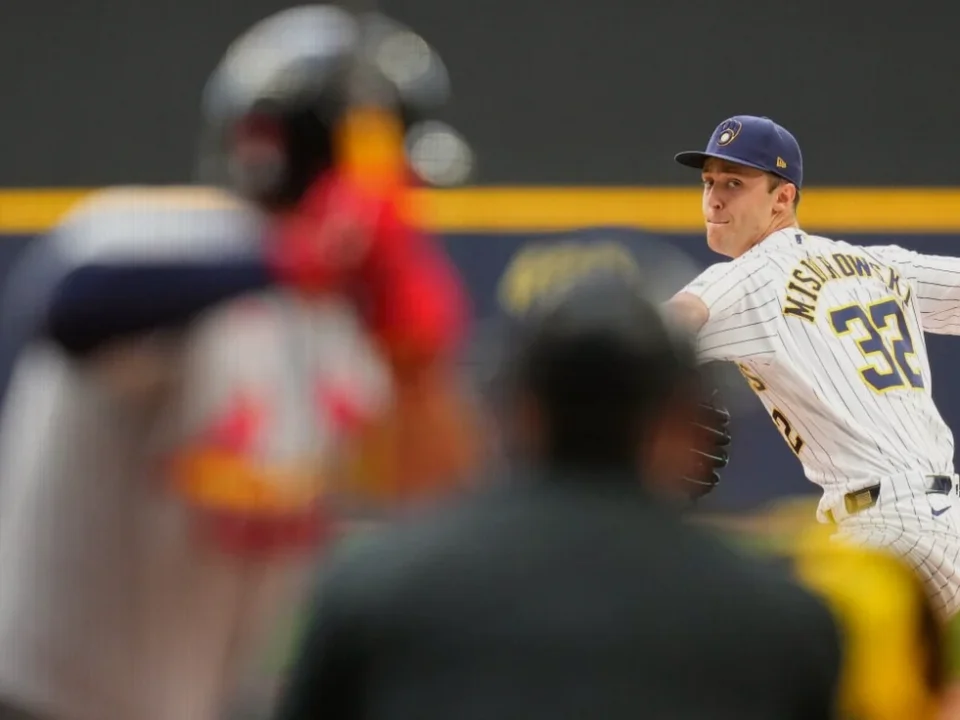
Jacob Misiorowski will hand the Brewers the ball for Saturday’s National League Division Series opener against the Padres, carrying the kind of fastball that has spent the season turning even established big league hitters into witnesses.
Milwaukee’s 6-foot-7 right-hander finished the regular season atop the Major League leaderboard with a 1.80 ERA, 252 strikeouts, a 0.80 WHIP and a .157 opponents’ batting average. Those numbers have made him the overwhelming choice for the National League Cy Young Award, but the scouting report around the game is even simpler: the heater arrives faster than hitters expect, from an angle they do not often see, and everything else becomes nastier once they gear up for it.
Game 1 is scheduled for 8:30 p.m. ET Saturday at American Family Field, with FS1, FOX Deportes and FOX One carrying the broadcast.
A fastball with no comfortable answer
Aaron Judge got an early look in May, when Misiorowski struck out 11 Yankees and reached 103.6 mph in his first Major League start against New York. Judge said that pure velocity did not fully explain the challenge.
“There are pitchers throwing 103, but you have a little more time against them,” Judge said. “With him, it feels like he is dropping the ball right into the mitt. It makes for a difficult day.”
Judge had watched Misiorowski before stepping in himself and came away convinced Milwaukee had found a special young arm.
“What he has done is impressive,” Judge said. “They have a great young star over there.”
The Phillies saw the same thing on June 12, exactly one year after Misiorowski made his Major League debut. He needed only 95 pitches to throw a complete-game shutout, facing 27 batters and striking out 15 at American Family Field. Philadelphia came within one Kyle Schwarber swing of being held without a hit over nine innings.
Bryce Harper recalled teammate Brandon Marsh telling him afterward that Misiorowski might be the best pitcher he had faced. Harper compared the upper-zone fastball to Matt Harvey’s riding heater, while acknowledging the modern version had another gear.
“The 104 mph part is obviously different,” Harper said.
Harper also saw value in getting a look at Misiorowski before a possible October meeting, saying the Phillies were glad to learn firsthand what the right-hander’s stuff looked like.
Extension, angle and the pitches behind the heat
Minnesota ran into Misiorowski on Aug. 9, when he became the second-fastest pitcher in history to reach 200 career strikeouts. He opened that outing with 21 straight four-seam fastballs. Royce Lewis saw a 103 mph pitch in his first trip to the plate and called it among the toughest pitches he had ever faced.
Brooks Lee noticed the distance Misiorowski creates as he drives down the mound, along with a delivery that begins from the first-base side of the rubber. The ball can look visible out of his hand, then rush past the barrel.
“You feel like you pick it up well, and then it is by you,” Twins infielder Kody Clemens said. “Especially up in the zone.”
Clemens said a high fastball from Misiorowski was “almost impossible” to hit. Twins manager Derek Shelton pointed to the late life on the pitch, which forces hitters to decide whether it will finish inside the strike zone while trying to catch up to triple-digit velocity.
Colorado’s hitters found no relief in the radar-gun readings. Misiorowski struck out each of the first seven Rockies he faced in one start, then punched out 12 of the first 13. He threw 66 pitches at 100 mph or better, the most in a single game since pitch tracking began.
“That is a one-of-one fastball,” Rockies manager Warren Schaeffer said, citing the 103 mph velocity and Misiorowski’s extension. “It is hard to react to, and he throws it all the time.”
Rockies outfielder Cole Carrigg said Colorado spent the game “scratching and clawing” for any path to an answer.
Then comes the rest of the arsenal. In August, Misiorowski worked six scoreless innings against Atlanta in a matchup with Chris Sale, one of the pitchers he admired growing up. Sale called it perhaps the most remarkable fastball he had seen. Braves manager Walt Weiss said hitters cannot simply sell out for the heater because cutters and sliders are waiting behind it.
“You are preparing for 100, then you have to handle cutters and sliders,” Weiss said. “It is one of the hardest at-bats.”
The Cubs found a crack, then watched it close
Chicago had more familiarity with Misiorowski than most clubs, and Craig Counsell’s group identified the basic approach: try to get something lower in the strike zone. The high fastball, Counsell said, can be nearly unhittable even when the hitter knows it is coming.
“When he executes, you are in trouble,” Counsell said. “That is what great pitchers do.”
The Cubs broke through at Wrigley Field on Sept. 2. They scored five runs over the first two innings and sent Misiorowski to the dugout after four frames, ending his run of 25 consecutive outings in which he had allowed three earned runs or fewer. Alex Bregman hit a low slider for a home run, then drove in two more with a single against a 102 mph fastball.
It was a rare winning formula, and it did not last long. Six days later, Misiorowski faced Chicago again and struck out Pete Crow-Armstrong to begin the game with a 103.7 mph fastball. He hit 104.5 mph against Seiya Suzuki, yielded one run in 6 1/3 innings and threw his 1,000th pitch of the season at 100 mph or above.
“That is how I pitch,” Misiorowski said. “The guys on the other side know that is coming.”
Suzuki had already seen the ceiling in June, when Misiorowski fired a 105.5 mph fastball against Crow-Armstrong, tied for the third-fastest pitch recorded since tracking began in 2008. Suzuki said the Cubs had quality plate appearances, but Misiorowski was simply better that night.
Now it is San Diego’s turn. The Padres will arrive with a plan, as every opponent has, but the postseason question remains the same: can anyone stay on time against the fastball long enough to handle the cutter and slider that follow?