
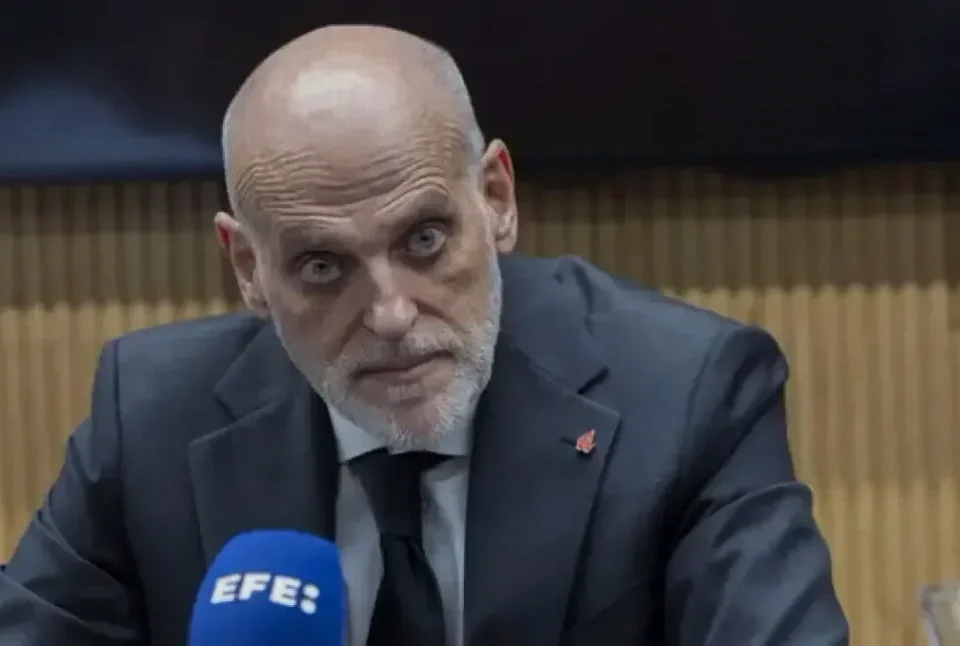
Javier Tebas has returned to Manchester City’s long-running financial case, arguing that the latest developments have revived a warning he first made in the city almost nine years ago. The LaLiga president says the issue is not aimed at one club alone, but at the wider question of whether football’s biggest sides are operating under the same economic rules.
In a post on X, Tebas recalled speaking at Soccerex in Manchester in September 2017, when he raised concerns about what he described as financial doping in European football. He cited both City and Paris Saint-Germain as clubs whose spending power, in his view, was supported by vast external resources rather than solely by their usual football income.
At the time, Tebas questioned sponsorship deals which he believed were valued above normal market levels. His concern was that such arrangements could push up wages, transfer fees and running costs across the game, leaving other clubs to cope with an inflated market they had not created.
He said the intervention brought an immediate response from City, who publicly called his comments “ill-informed” and “pure fiction”, while indicating that legal action was being considered. Tebas said it was an unpleasant episode, though hardly an isolated one in a campaign that has brought criticism, threats and what he termed plenty of trouble.
A case that has run for years
Tebas also looked back to February 2020, when UEFA handed Manchester City a two-season ban from its club competitions and a €30m fine. UEFA had found serious breaches of financial-control rules, including matters involving the reporting of certain sponsorship income.
That exclusion was overturned by the Court of Arbitration for Sport in July 2020. CAS ruled that some alleged conduct had become time-barred, while other allegations had not been proven to the required standard. It did, however, uphold a finding that City had failed to cooperate with UEFA’s investigation, reducing the financial penalty to €10m.
The LaLiga chief said he had never accepted what he regarded as an unusual ruling. In his view, it damaged confidence in CAS as an independent sporting arbitration body and weakened the credibility of European football’s financial-control system. He believes the basic principle must be that every club is subject to the same rules.
Tebas insisted that his position is about defending a sustainable model rather than pursuing any individual club. Financial regulation, he said, should not be dismissed as bureaucracy or a whim, and success should be founded on sound management, self-generated income and stronger team-building rather than the deepest backing behind a club.
His comments come after published reports that an independent Premier League commission has found 114 of the 115 financial allegations brought against Manchester City to be proven. Tebas stressed that the process has not yet reached its conclusion, with the possible punishment still to be determined.
For Tebas, though, the case has reinforced an argument he has made since that Manchester appearance in 2017: transparency, economic oversight and equal treatment are necessary if football is to protect both its competitive integrity and its long-term health. He accepts that stance has come at a cost, but says he remains of the same mind nearly nine years on.