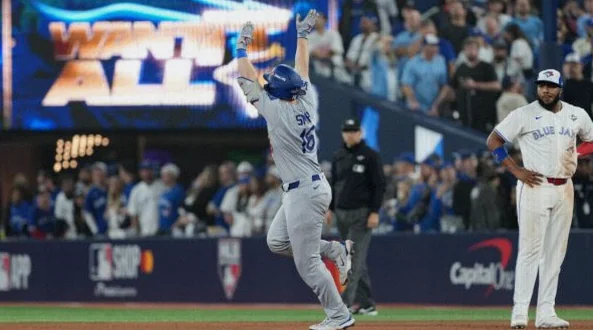
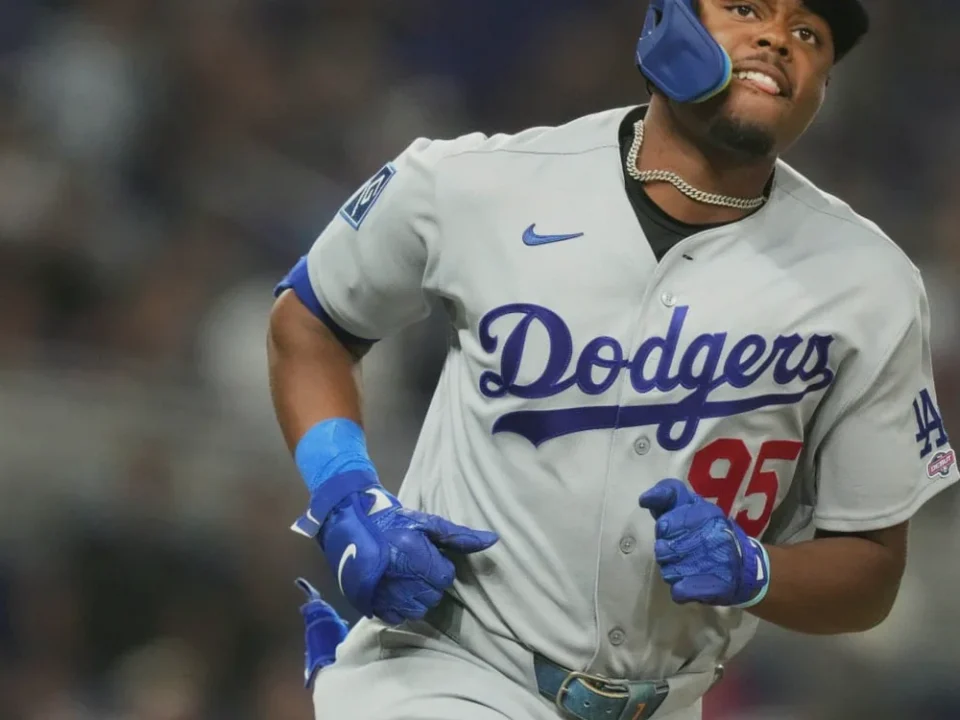
Josue De Paula did not take long to make loanDepot park remember him. On Sept. 13 in Miami, the Dodgers’ 21-year-old rookie drove a 98 mph Eury Pérez fastball into the right-field seats for a three-run homer, his first Major League hit. The ball left his bat at 108.2 mph and traveled 416 feet, the loudest swing in an 11-game audition that has put him in the Dodgers’ October roster discussion.
The result
De Paula finished his brief Major League stay with a .323 average, a .500 on-base percentage and a .581 slugging percentage over 42 plate appearances. He scored seven runs, drove in seven and, perhaps most notably for a young hitter meeting big league pitching for the first time, drew 11 walks against five strikeouts.
Only Andy LaRoche in 2007 and Jim Gilliam in 1953, each with 12, collected more walks through their first 11 games as Dodgers. De Paula’s patience carried over from Double-A Tulsa, where he posted a .303/.401/.547 line with 27 homers while taking 81 walks and striking out 87 times.
His Sept. 13 performance was a fair snapshot of the tools. De Paula walked, then later lined a double at 101.9 mph off the wall in right-center before delivering the home run. Of his 26 balls in play during the callup, 12 were struck at 95 mph or better and five topped 100 mph.
He also kept his swing decisions under control. De Paula offered at only 18 of 97 pitches outside the strike zone, an 18.6% chase rate. The Dodgers finished 2026 with a 27.5% chase rate, third lowest in the Majors, and the rookie’s approach fit comfortably with that club identity.
Even in a limited sample, the expected numbers supported the production: a .311 expected batting average, .496 expected slugging percentage and .437 expected wOBA. De Paula put 34.6% of his batted balls into the air to the pull side, a figure just above the 34.0% Major League-leading mark posted this year by National League MVP favorite Pete Crow-Armstrong.
“He has a rare hitting ability,” manager Dave Roberts said, pointing to De Paula’s early pitch recognition and refusal to chase. Roberts added that the youngster’s composure should play in the postseason and that the stage would not be too large for him.
A difficult path to October at-bats
The Dodgers optioned De Paula to Triple-A Oklahoma City on Sept. 23, the move coinciding with Shohei Ohtani’s return from the injured list. Roberts nevertheless said De Paula had earned a place in the conversation for the National League Division Series roster.
The question is less about the bat than where it can be used. De Paula divided his Tulsa work between left and right field, but he logged only two defensive appearances and six innings in left for Los Angeles. With the Dodgers intending to preserve an average outfield defense, his clearest big league role is designated hitter.
That is a crowded address with Ohtani healthy and back in the lineup. Dalton Rushing’s return from the injured list two days after De Paula’s demotion further narrowed the available postseason at-bats.
Still, the Dodgers promoted De Paula directly from Double-A, making him their first player to skip Triple-A on the way to the majors since 2014. There remains a useful October lane for him: a left-handed pinch-hitter against right-handed pitching, or a DH option if Ohtani is not in the lineup.
De Paula hit .314 with a 1.016 OPS against right-handers at Tulsa. At 6-foot-3 and 185 pounds, he has below-average sprint speed, but his instincts and aggression helped him steal 31 bases in 41 attempts in the minors this season. He can still create pressure after reaching base.
The Dodgers open the NLDS in Game 1 on Saturday at 4 p.m. ET and 1 p.m. PT, with FS1, FOX Deportes and FOX One carrying the game. Whether De Paula is on that first roster or becomes an option later in October, his September introduction made one thing clear: Los Angeles has a young left-handed bat worth keeping close.