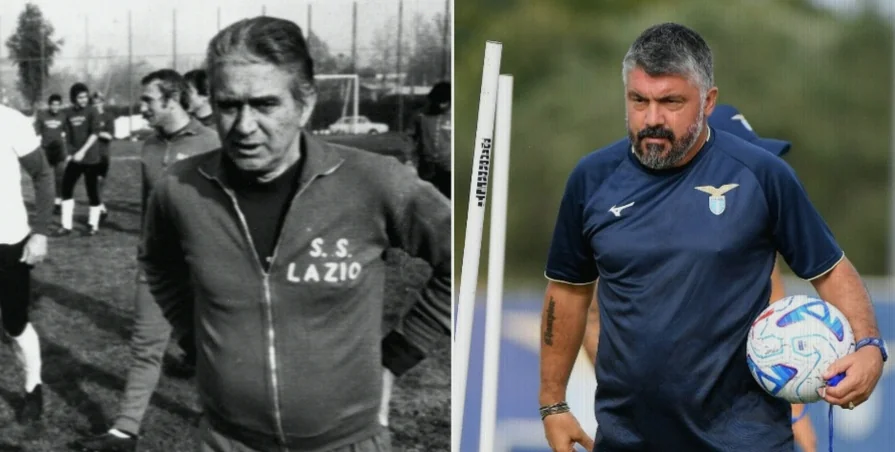
Lazio’s early place at the summit has given the season an unexpected historical echo. Six rounds have produced the best start in the club’s history, even beyond the title-winning sides led by Sven-Göran Eriksson and Tommaso Maestrelli. It is far too soon to place Rino Gattuso beside those figures, but the work at Formello has already brought comparisons with the more collective, hard-built Lazio of 1974.
The decision
Massimo Maestrelli, son of Lazio’s first Scudetto-winning coach, sees the connection principally in the manager’s relationship with his players. He met Gattuso at Formello a couple of weeks ago and came away impressed by the coach’s commitment to the group.
“We spoke at length and I found an extraordinary person, deeply in love with his work,” Maestrelli said. “There is an important similarity with my father: the almost obsessive attention Rino gives to every player. It takes time and patience, but it creates a unique and lasting bond with the squad.”
Gattuso’s task is different in scale. Maestrelli noted that the current coach must manage a group of around 30 players, whereas his father worked with 13 or 14. Yet the characters in the 1974 dressing room were demanding enough to make the burden broadly comparable.
For Maestrelli, the clarity of those relationships has been central to Lazio’s progress. The squad has become close-knit, he believes, working in a calm environment and carrying that unity onto the pitch.
The pair’s conversation also recalled a meeting from three decades ago, when Gattuso was 18 and in Perugia’s Primavera side. He had become close to Marco Materazzi, who was also at Perugia and represented at the time by Massimo Maestrelli and his brother. Materazzi used to take Gattuso to the Olimpico in the hope that he might become a Lazio supporter.
Gattuso was expected to bring determination and personality, but Maestrelli has also been struck by the quality of Lazio’s football. He described it as attractive and modern, with a high defensive line and full-backs pushing into wide attacking positions, an approach he feels has some resemblance to his father’s team.
He also pointed to the talent within the present squad. Davide Frattesi has been described as outstanding, while Nuno Tavares has reached an exceptional level. Tijjani Noslin and Reda Belahyane have also exceeded expectations with their performances.
Sunday’s picture
Lazio are first in Serie A after six matches and have collected more points at this stage than any previous Lazio side. The achievement has arrived despite an unpromising opening chapter: elimination from the Coppa Italia by Mantova.
That setback offers another, less celebrated, link to the Maestrelli era. In their first Serie A season, Lazio were knocked out of the Coppa Italia during the summer by Serie B club Taranto at the Flaminio.
Massimo Maestrelli believes the current team should resist setting fixed targets. “It is better to take one step at a time,” he said, agreeing with Gattuso’s own position. “Only between November and December will we properly understand this team’s potential.”
Still, he considers a European place a realistic ambition if Lazio maintain the level shown in their opening six fixtures.
The one disappointment has been the atmosphere at a half-empty Olimpico, with supporter protest continuing around the club. Maestrelli did not wish to address the dispute itself, but argued that a rapprochement would benefit everyone.
“With all their supporters behind them, this side could really take off,” he said. “As Gattuso often says, football without fans is not football. It would be good to see the situation resolved.”
The discussion also returned to the Flaminio, which has been mentioned as a possible future home for Lazio. Maestrelli said restoring the abandoned stadium would be important for Rome, and that it would be especially meaningful if Lazio returned there and the ground were named after his father.