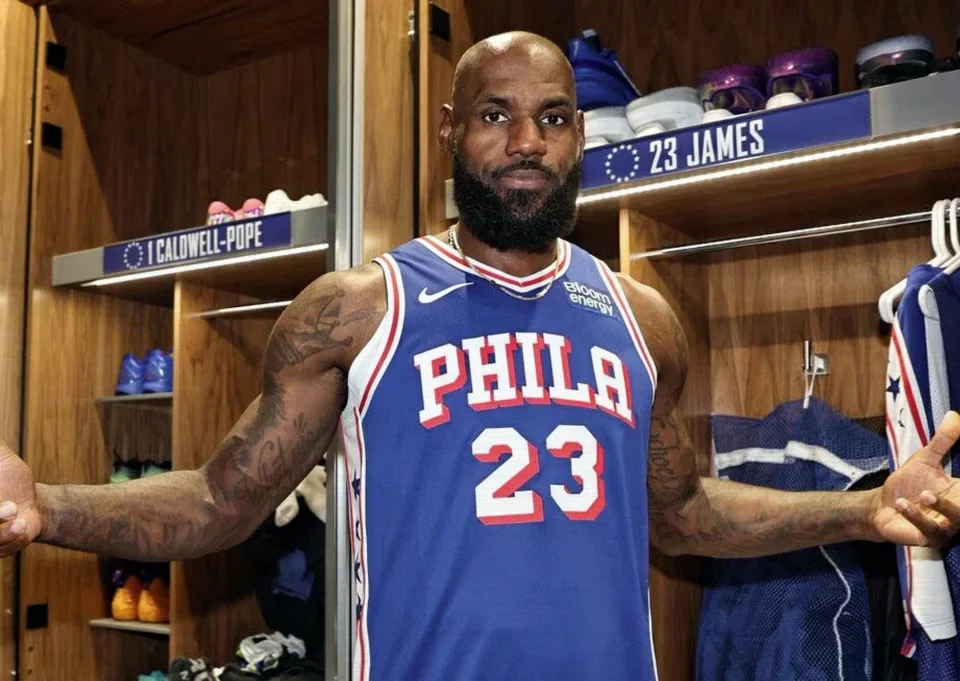
CAMDEN, N.J. — Philadelphia opened camp with a different kind of gravity Monday: LeBron James and Jaylen Brown now sharing a building with Joel Embiid and Tyrese Maxey, a four-star arrangement that has pushed the 76ers squarely into the front of an upgraded Eastern Conference. The talent is obvious. The harder work is fitting possessions, defensive assignments and closing-time responsibilities together well enough to send Philadelphia past the conference semifinals for the first time in 26 years.
James said Maxey was central to his decision to come East. He considered several possible destinations, but his longstanding connection with Philadelphia’s lead guard gave him an unusually direct view of Maxey’s career plans and his belief in the organization. James also wanted to know whether his arrival — and all the attention and demands that accompany it — would help the group or complicate it. “He was one of the main deciding factors,” James said of Maxey.
The relationship started in 2020, when Rajon Rondo connected them during Maxey’s pre-draft preparation and James’ ramp-up for the Orlando bubble. Maxey moved a 6 a.m. workout to 10 a.m. so James could join him; by the following summer, Maxey said he had James back in the gym at 6. Their offseason sessions became an annual routine. Seeing James at the Sixers’ Camden facility, though, still struck Maxey as surreal.
Maxey made an earlier recruiting attempt two years ago without much traction. The equation changed after Philadelphia landed Brown in early July and James appeared headed out of Los Angeles. Maxey said Brown’s arrival made the possibility feel real, and a later conversation with James gave him the sense that the pitch was finally gaining ground.
Embiid’s availability still frames the season
Embiid arrived looking leaner, though he declined to detail the program behind his weight loss. He said he feels good and believes his preparation has put both himself and the club in a stronger position. The Sixers’ new depth should ease the burden in the minutes Embiid sits, an area where Philadelphia has repeatedly struggled during his decade with the franchise.
Only in 2019-20 have the Sixers outscored opponents with Embiid off the court across his 10 Philadelphia seasons. Including postseason play, Philadelphia has posted a plus-8.0 net rating with Embiid on the floor and a minus-3.2 mark without him — an 11.2-point swing per 100 possessions. In regular-season terms, the club has played at a 53-win pace when Embiid appears and a 33-win pace when he does not.
His defensive range has been less reliable in recent seasons, and Philadelphia still needs him to establish a physical interior presence offensively. But the central issue is health. Embiid has appeared in only 42 percent of the Sixers’ games over the past three years. He said the organization has a plan to build him up carefully, with the goal of having him at his peak in April and May while still getting him on the floor as much as possible beforehand.
That plan may shape the nightly rotation as much as any tactical choice. Brown and James give Philadelphia more creation and playmaking in non-Embiid stretches, theoretically reducing the need for Maxey or Embiid to carry every possession. It also gives the Sixers more options when Embiid’s minutes are managed during the regular season.
Four stars, fewer shots and a new job for Maxey
James made clear that the offensive adjustment cannot be treated as a loss. With Embiid, Brown, Maxey and James on the same unit, usage and shot volume will come down for everybody. James described that sacrifice as a competitive advantage rather than a concession: passing up a shot can preserve enough energy for a fourth-quarter charge, an offensive rebound, a recovery sprint or a chase-down block — the possessions that may not inflate a scorer’s line but decide playoff games.
He also warned that chemistry will not arrive on opening night. James said a contender cannot expect “instant oatmeal”; it requires daily repetition and a willingness to embrace uncomfortable work. His blunt version of the alternative was a team praised for its roster on paper before exiting in the second round. James said he did not leave his family to accept that ending.
Maxey’s role is set to shift more visibly away from the ball. Last season, just 40 percent of his 3-point attempts came on catch-and-shoot looks, the 14th-lowest share among 305 players who took at least 100 threes. Yet he made 41.8 percent of those catch-and-shoot attempts, compared with 33.3 percent on pull-up threes.
With James and Brown able to initiate offense, Maxey expects more transition chances, screen actions, handoffs and spot-up threes rather than always returning to collect the inbound and start the possession. He noted that Embiid, VJ, Anfernee Simons and Labaron Philon can also advance the ball. Maxey will still run pick-and-rolls and operate as a primary handler, but the roster gives him more ways to score without having to manufacture everything himself.
That is the early Philadelphia blueprint: preserve Embiid for the games that matter most, let James and Brown absorb more organizing responsibility, and turn Maxey’s speed and shooting into a weapon that can move between lead-guard and off-ball duties. Camp has only begun. The Sixers already understand that the rotation will not be solved by name recognition alone.