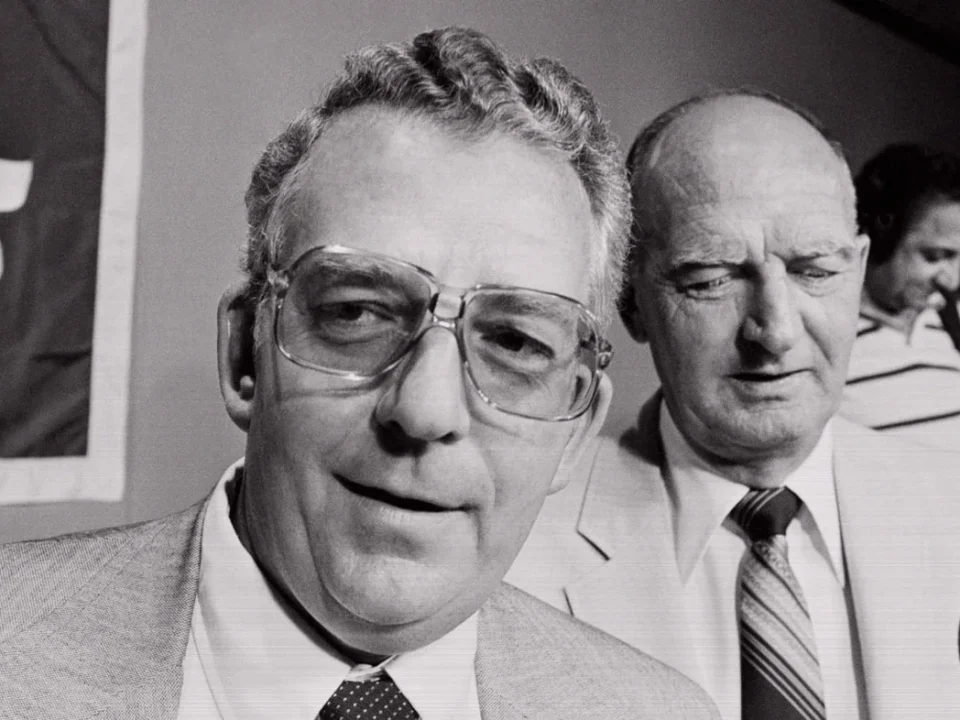
Bill Giles spent a lifetime figuring out how to fill a ballpark, but Philadelphia will remember him for far more than the stunts, giveaways and packed gates. The longtime Phillies executive, whose death was announced Friday at age 92, helped turn a struggling club into a civic fixture, helped bring Pete Rose to town, gave the franchise its unmistakable green mascot and presided over two National League pennant winners.
Giles arrived with showman’s instincts and left a permanent imprint on the Phillies. His approach was simple: give fans a reason to walk through the gates, then give them a reason to return.
A baseball life from Cincinnati to Philadelphia
- William Yale Giles was born Sept. 7, 1934, in Rochester, New York, into a family already deeply rooted in the game. His father, Warren C. Giles, ran the Cincinnati Reds as president and general manager from 1946 through 1951, then served as National League president from 1951 to 1969.
- His godfather was Branch Rickey, the executive who broke baseball’s color barrier by bringing Jackie Robinson to the majors in 1947. Much of Giles’ youth was spent around Cincinnati’s Crosley Field.
- After graduating from Denison University, Giles served three years as a navigator in the Strategic Air Command of the U.S. Air Force.
- He returned to pro ball in 1959 as general manager of the Nashville Vols, then joined the Houston Colt .45s as traveling secretary and publicist.
- In Houston, Giles helped usher in the Astrodome’s opening in 1965. He was among those associated with the building’s famous “Eighth Wonder of the World” nickname.
- The Carpenter family brought him to Philadelphia after the 1969 season as vice president of business operations. He later moved up to executive vice president as the club prepared to leave Connie Mack Stadium for Veterans Stadium in 1971.
One of his early personnel calls was hiring Harry Kalas away from Houston to join the Phillies broadcast booth. Kalas would become one of the most beloved voices in Philadelphia sports.
Making Veterans Stadium a destination
The Phillies were not winning often in the late 1960s and early 1970s, and Giles understood that the club needed to create a different kind of draw. Staff meetings became idea sessions devoted to getting people to buy tickets, even when the product between the lines was rough.
Giles later explained that the promotions were a first step: attract somebody for one game, make the experience memorable, and perhaps turn that visitor into a 10-to-15-game customer before eventually earning a full-season-ticket holder.
- On Opening Day in 1972, Giles arranged for a hang glider known as “Kiteman” to deliver a baseball from an upper-deck ramp to the pitcher’s mound for Mayor Frank Rizzo. The flyer crashed into the upper deck but survived.
- Giles’ reaction carried his usual blunt humor: a fatality, he said, would have been a terrible sign for the opening of a baseball season.
- In 1973, Karl Wallenda of the Flying Wallendas crossed nearly 640 feet of Veterans Stadium on a high wire, hundreds of feet above the field and without a safety net. Wallenda made the walk and repeated it in 1976.
The wild promotions earned Giles comparisons to P.T. Barnum, but the circus atmosphere was never his whole game. It was a plan to cultivate a following for a franchise trying to establish itself in a new stadium.
The Phanatic and the push for a championship
Giles also gave his marketing staff room to create. In the late 1970s, marketing director Dennis Lehman and promotions director Frank Sullivan believed the Phillies needed a new mascot. Giles approved the project.
Jim Henson was approached but directed the club to Bonnie Erickson and Wayde Harrison. Giles’ instructions were wonderfully specific: make the character green, heavyset, hard to identify and lovable. He wanted something children would want to hug. When early concepts arrived, he requested an even bigger body and a larger nose.
The result was the Phillie Phanatic, now inseparable from the Phillies’ identity and one of the sport’s most recognizable mascots.
Giles’ most consequential work came in building a winner. Philadelphia had fallen in three straight National League Championship Series from 1976 through 1978. When Pete Rose became a free agent after the 1978 campaign, the Royals, Braves, Cardinals and Pirates all made serious bids, and the Phillies initially were not at the top of the financial pile.
- While driving Rose to the airport, Giles opened the National League Green Book, the league record guide once distributed to clubs and media.
- He appealed to Rose’s pursuit of history, warning that signing in the American League would leave him behind in the National League’s all-time hitting categories.
- Giles stressed that Rose’s children and grandchildren would see him lower on those National League lists rather than at the top.
- He then persuaded Philadelphia station WPHL-TV to add $200,000 annually in broadcast-rights money to improve the offer.
- Rose signed with the Phillies, and the club captured its first World Series title in 1980.
Owner, president and Philadelphia institution
In 1981, Giles led the group that purchased the Phillies from the Carpenter family. He served as team president from 1981 to 1997, a stretch that included National League pennants in 1983 and 1993. After David Montgomery became president in 1997, Giles moved into the chairman’s role.
Major League Baseball named him honorary National League president in 2001. He received the Bud Selig Executive Leadership Award from the Professional Baseball Scouts Foundation in 2010, recognizing a lifetime in the sport. He also served on the National Baseball Hall of Fame’s Veterans Committee.
His work reached well beyond Citizens Bank Park and the old Vet. Giles was involved with the Philadelphia Convention and Tourism Bureau, the Philadelphia Chamber of Commerce, Philadelphia Sports Congress, Boy Scouts of America, Corporate Alliance for Drug Education, Pennsylvania Chamber of Commerce, Police Athletic League, Salvation Army, Union League, Temple University Medical School and Temple University Journalism School.
Remembered as the man who changed the franchise
Phillies managing partner and CEO John Middleton said Giles transformed the club from a conventional baseball operation into a visible entertainment and business enterprise. Middleton said Giles’ influence on one of the strongest periods in franchise history, on the field and away from it, will endure.
Hall of Famer Mike Schmidt called Giles a dear friend of the Phillies family and said he had been the organization’s heart and soul for more than two decades. Schmidt said Giles was personally close to many people connected to the club and would always occupy an important place in Phillies history.
Giles once said his guiding purpose was to make people happy. For the Phillies, that meant more than a daredevil at the ballpark or a cash scramble in the stands. It meant changing the way a city viewed its team, then helping build the club that finally delivered a championship.
Former Phillies public-relations vice president Larry Shenk put it most plainly: in his view, Giles saved the franchise.