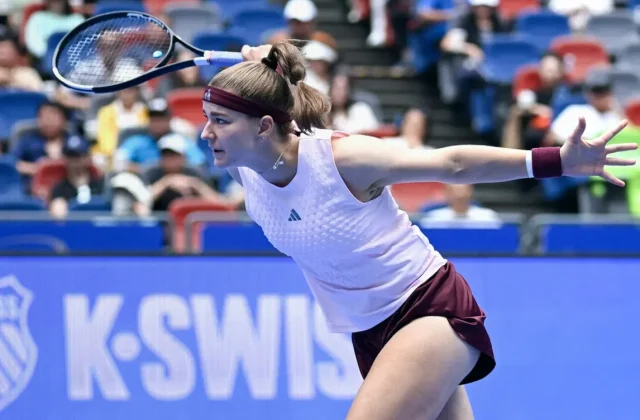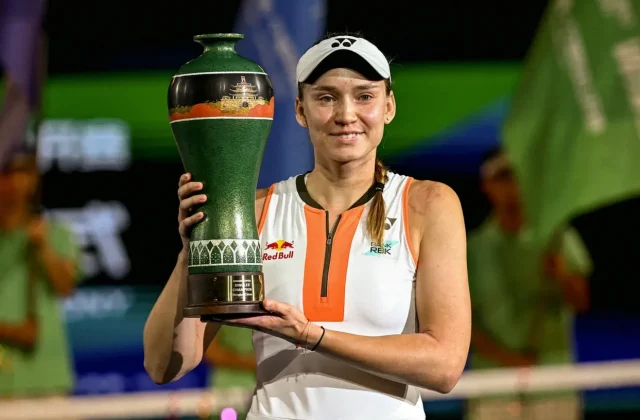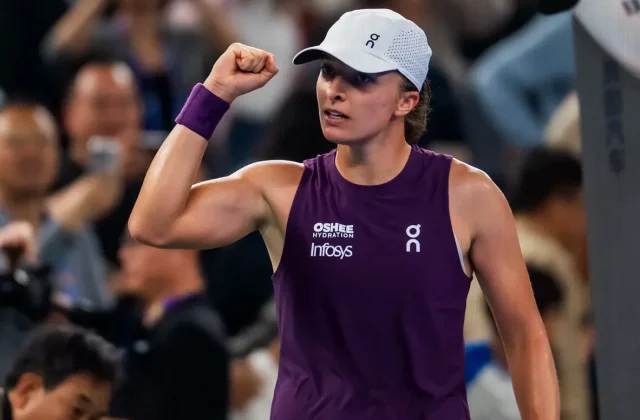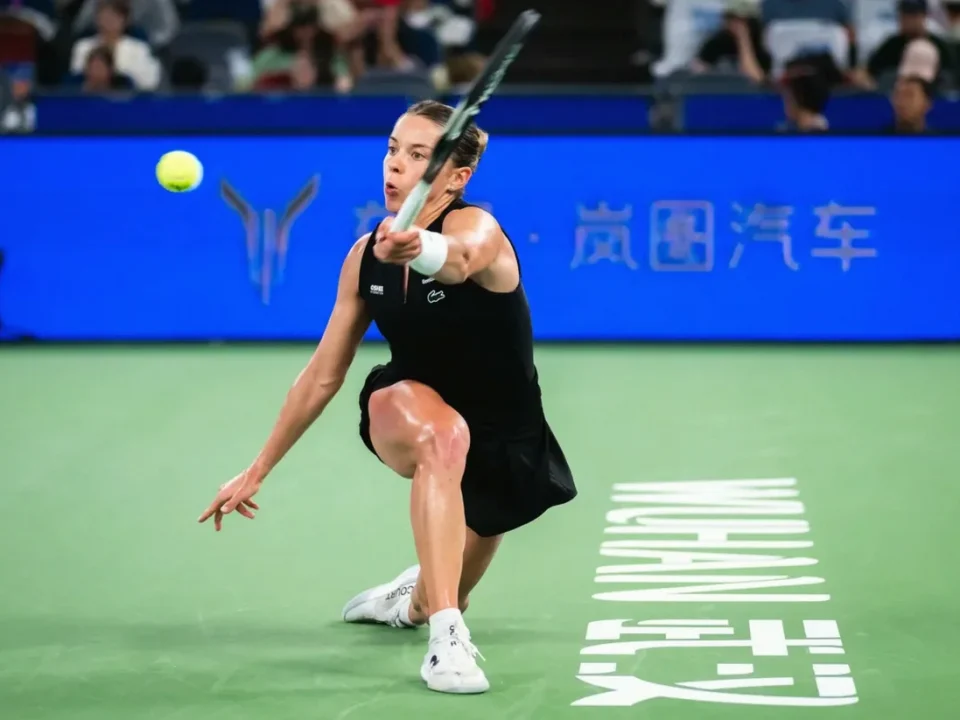
Maja Chwalinska fought through a 2-hour, 35-minute quarterfinal against Maria Sakkari on Friday, recovering from a second-set reversal to win 6-0, 3-6, 7-5 and reach the Dongfeng Voyah Wuhan Open semifinals. The No. 16 seed’s run guarantees her first appearance inside the WTA Top 20 when the new rankings are released on Monday.
Key takeaways
- Chwalinska defeated former world No. 3 Sakkari after converting her third-set pressure into a decisive break in the final game.
- The 25-year-old Pole is through to her third tour-level semifinal and her first at an outdoor hard-court event.
- Her semifinal opponent will be Iga Swiatek, her longtime friend, former junior doubles partner and fellow Pole.
- The match will be the first all-Polish semifinal in WTA 1000 history.
- Chwalinska has gone 7-2 during her first Asian swing, collecting the first two Top-20 wins of her career.
Chwalinska withstands Sakkari’s comeback
The opening set belonged entirely to Chwalinska. Her mix of angles, slices and changes of pace repeatedly pulled Sakkari out of position, while the Greek accumulated 14 unforced errors. Chwalinska lost only one point behind her first serve and completed the 6-0 set with a sharply angled passing shot, her fifth bagel set at tour level.
One extraordinary point underlined the Pole’s touch. Pulled far beyond the doubles alley by Sakkari’s attacking combination, the left-hander reached the ball with her right hand and floated a precise lob back into play before eventually finishing the exchange with backhand winners.
Sakkari responded swiftly after escaping a break point in the first game of the second set, when Chwalinska sent a sliced backhand narrowly wide. The former world No. 3 broke in the next game with a forehand winner and protected that advantage throughout the set. She struck 17 winners against eight unforced errors in the second set, a sharp contrast to her difficult start.
The deciding set remained on serve for 11 games, with Sakkari repeatedly resisting danger. She saved the first five break points she faced in the set and finished the contest having erased 11 of 15 overall. Yet Chwalinska faced much less pressure on her own delivery, saving four of five break points during the match. Her only break point against her in the final set was dismissed with a drive-volley winner in the fifth game.
As Sakkari’s groundstrokes became more secure, Chwalinska increasingly turned to the drop-shot-and-lob sequence. She used it four times during a five-game middle stretch of the decider and won every one of those points. The pattern helped her create one last opening in the closing game.
Sakkari had a game point to force a tiebreak, but netted a forehand. On Chwalinska’s first match point, a short Sakkari backhand found the net to end the contest.
“I was surprised by that number,” Chwalinska said of the break-point figures. “I was not thinking about it. In the third set I felt very solid on serve and had some chances in her service games. She played the break points very well, so there was not much I could do. I think I was simply very solid in my own games.”
The result continued a developing rivalry between the pair. Sakkari won their first meeting in Rome qualifying earlier in 2025, while Chwalinska took their Roland Garros third-round rematch 1-6, 6-3, 6-2 on her way to the final in Paris.
“It was a very physical match,” Chwalinska said. “I knew it would be difficult against Maria. We had played twice before and both matches were extremely tough. Today was no different.”
A landmark Polish semifinal awaits
Chwalinska’s Wuhan performance has brought a second semifinal in the past month, following her last-four showing in Singapore. Her Paris breakthrough demonstrated the value of her inventive all-court game on clay; the Wuhan draw has shown that the same variety can trouble elite opponents on hard courts.
Next comes a particularly familiar opponent in Swiatek. The pair grew up competing alongside each other and won European Junior Championships doubles titles at under-14 level in 2015 and under-16 level in 2016. They later reached the 2017 Australian Open girls’ doubles final, where Bianca Andreescu and Carson Branstine took the title.
Swiatek has won both of their previous head-to-head matches. She beat Chwalinska 6-1, 6-4 in the quarterfinals of an under-14 event in Opalenica in 2014, then won 6-2, 6-3 in the second round of the Stockholm W10 in 2016, only the second professional event of Swiatek’s career.
“It feels as if I have known her forever because we started playing tournaments together,” Chwalinska said. “It would be amazing for both of us and for Polish tennis. She is such a great champion and has achieved almost everything in our sport, so it would be a privilege to play her.”
For Chwalinska, the Wuhan semifinal offers another ranking breakthrough as well as the chance to extend an Asian run that has already reshaped her season.