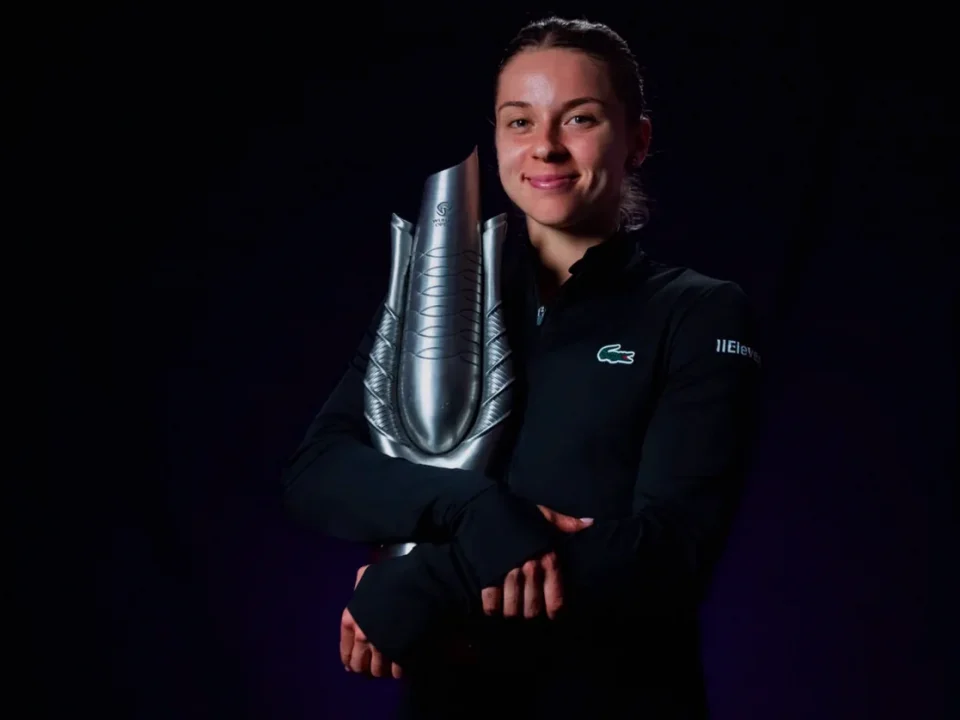
WUHAN — Maja Chwalinska’s first WTA 1000 trophy at the Dongfeng • Voyah Wuhan Open has capped a season that transformed her standing on tour, from a player outside the top 140 early in the year to world No. 11. The Polish player’s hard-court title in China followed a difficult adjustment to the attention created by her Roland Garros run and has restored momentum after a troubled summer.
From Paris breakthrough to Wuhan champion
- Chwalinska came through qualifying to reach the Roland Garros final, a surge that lifted her ranking from No. 114 to No. 21 and brought a new level of scrutiny beyond the court.
- She said the North American hard-court season became particularly difficult as social-media reaction, media attention and heightened expectations accumulated. “It was very tough for me,” she said. “Tennis stays the same, but off court it’s just so much different.”
- Her summer was further disrupted when she was injured on match point during a first-round defeat at Wimbledon. She won only one match before exiting in the opening round of the US Open.
- After taking time to reset and concentrate again on her tennis, Chwalinska said she began to feel more settled in Singapore, where she reached the semifinals.
- Her Asian swing has now produced a 9-2 record and the biggest title of her career in Wuhan, where she added a WTA 1000 crown to her breakout campaign.
The Wuhan result has reinforced Chwalinska’s conviction that her game can travel beyond clay. Earlier in the season, she had questioned whether her less conventional style could consistently challenge the elite, despite her evident comfort on the red dirt.
“I’m most happy that I proved it to myself,” Chwalinska said after the final. “I can play on every surface, be very good and win on every surface as well.”
A ranking rise built on adjustment
Chwalinska said the period after Paris required her to acknowledge the strain caused by her sudden profile rather than attempt to ignore it. “I’m just a human,” she said. “After the French Open, it was very tough for me, but I continued working hard. I’m very grateful that the work paid off today.”
Now at No. 11 in the PIF WTA Rankings, she is not setting a ranking target for the remaining part of the season or the opening months of 2027. Instead, she intends to retain the approach that took her from a top-100 ambition at the start of the year to a place just outside the top 10.
“My mentality will not change because it works for me,” she said. “I want to give my best, try to win every match and leave with no regrets. If I win, that’s great. If I lose, that is how it is. I focus on what I can improve in my tennis and in myself.”
Polish reunion in the Wuhan draw
Chwalinska’s route to the trophy included a semifinal against Iga Swiatek, another landmark meeting for two players who have shared much of their tennis upbringing. A video interview from Stockholm, filmed when both were 15, resurfaced after their Wuhan match and offered a reminder of how long their paths have run alongside each other.
Chwalinska said she and Swiatek are the same age, come from the same country and have played many of the same events since they were around 10. She noted that Swiatek has dominated the sport and collected the game’s major prizes, while expressing pride in the different route that has brought her to a WTA 1000 title.
“When you’re young, you dream about big things,” Chwalinska said. “It’s very nice to see what we have done. I know what my journey has been, and I’m grateful for what I’ve achieved.”
She added that their shared progress carries significance for Poland, which she said is still developing as a tennis nation. In China, where fans regularly create affectionate player nicknames, Chwalinska has also acquired one of her own: “Moon sister.” Her response to it was simple: “Why not?”