Italian football’s governing structures are approaching a decision that could place Giovanni Malagò’s position, and the FIGC’s institutional standing, under renewed scrutiny. Within two days, the voting members of the CONI Executive Board and National Council are expected to assess the legal opinions requested by the Olympic Committee and by the football federation, after a procedural issue cast doubt over an election won with almost 70 per cent of the vote.
The legal assessments support the principle that registration is required in order to stand for election. They do not, however, offer a clear answer on whether the FIGC should be placed under administration. That unresolved point has left room for competing readings of the rules, with the eligibility of individual voters becoming one of the central questions before CONI.
A vote shaped by potential abstentions
The most sensitive issue concerns possible conflicts of interest among members of the Executive Board. The relevant provision in Article 7, paragraph 4, of the CONI Statute requires a person to abstain only when a conflict relates to a specific measure or decision. There is no stated “cooling-off” period between leaving an assignment and taking part in a vote.
Diana Bianchedi’s position has become the clearest example. CONI’s vice-president was contracted by the FIGC from 17 to 30 September as head of delegation. She subsequently stepped back from that role, following public comments from Sports Minister Andrea Abodi.
Formally, her departure ended her direct contractual connection with the FIGC. Yet there remains an expectation within CONI that she could be prevented from voting. The National Anti-Corruption Authority clarified two matters: there was no incompatibility between Bianchedi’s posts as CONI vice-president and FIGC head of delegation, while the question of whether she should vote in the Executive Board falls outside its remit and must be settled internally by CONI.
It is not yet clear which CONI body will make that determination, although the organisation’s three auditors could be involved. The statute itself does not identify a reason why Bianchedi should automatically be excluded, and neither her recent FIGC role nor her wider professional relationship with Malagò through CONI and the Milan Cortina project appears, on its own, to create an explicit prohibition.
The wider question of impartiality
The uncertainty has raised a broader concern: if every connection with the federation is open to challenge, the boundaries of a conflict of interest can become increasingly difficult to define.
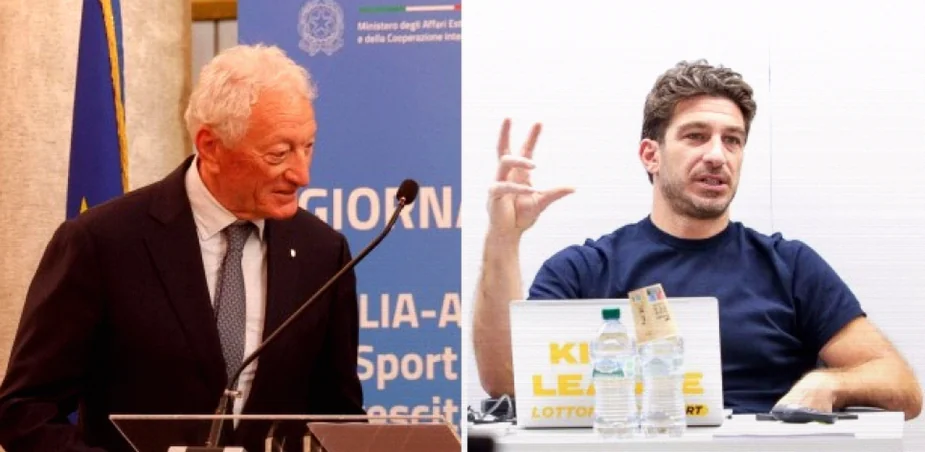
That logic could also be applied to CONI president Luciano Buonfiglio. His son, Marco, is commercial director of Kings League Italy, the competition created by Gerard Piqué outside the federal football system. Kings League has previously clashed with the Amateur League, the FIGC component that represents grassroots football and carries the largest presence in the Federal Council.
The disagreement centred on the participation of Serie D and Eccellenza players. A number of clubs opposed their registered players taking part, citing concerns over injuries, fatigue and distractions, while some sides ended relationships with players involved in the parallel tournament.
Marco Buonfiglio has no role in the current institutional dispute, and his career is separate from that of his father. An established international executive, he spent more than eight years with Red Bull and worked on the marketing of several events, including the 2015 Canoe World Championships in Milan.
Still, the episode illustrates the risk facing CONI as it prepares to decide. A process triggered by a technical eligibility question now depends as much on consistent interpretation as on the original legal issue. With the FIGC and Malagò awaiting clarity, the decisive requirement is a transparent explanation of who may vote, who must abstain, and on what grounds.