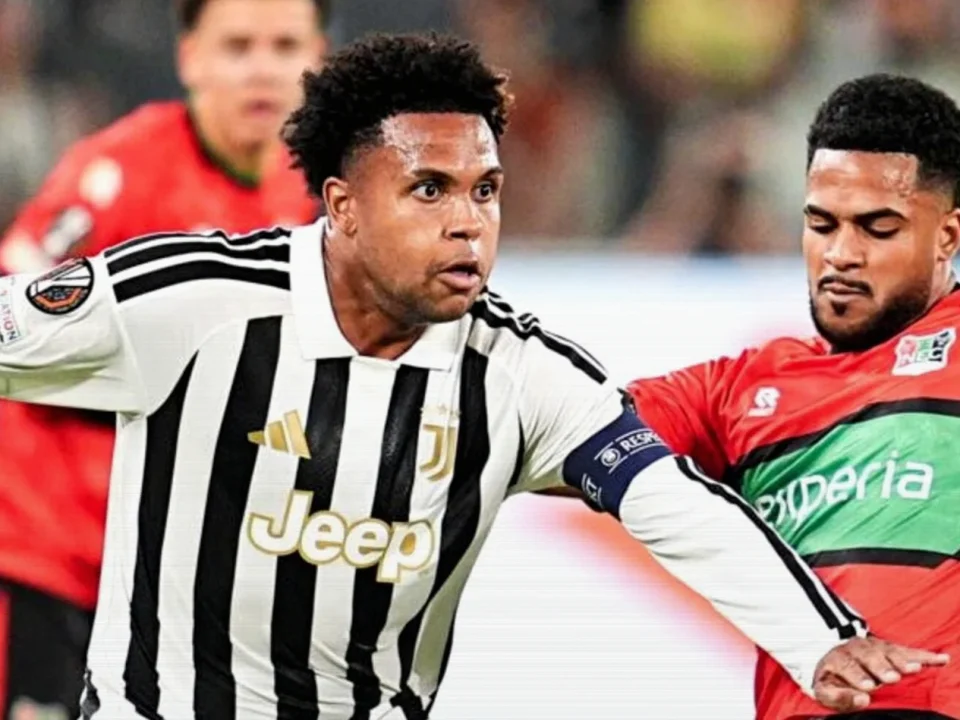
Juventus’ five-goal European night against NEC Nijmegen offered Luciano Spalletti more than relief after the disorder seen at the Mapei Stadium. It gave him a practical answer to an injury-hit moment in the season: bring Weston McKennie back into the side, add a midfielder rather than another forward, and restore the three-man defensive structure that had previously delivered results.
McKennie’s return was central to the adjustment. Used on the left flank, the American allowed Juventus to move into a 3-4-2-1 and defend with greater protection, particularly against a NEC side whose aggressive pressing and open approach invited a more cautious Juventus shape. Spalletti had wanted McKennie available as soon as possible, and afterwards made clear why he considers him difficult to define. “I do not know whether to give McKennie one specific role,” the coach said. “He can do everything.”
With the same starting XI used in the Europa League opener, Juventus could also have taken up a 4-2-3-1 had McKennie been moved closer to the attacking midfield line. But the coach appeared more inclined to continue with the back three, at least while the squad remains stretched. The system recalled last season’s framework, with McKennie on the left and Celik on the opposite side.
Spalletti’s reasoning is rooted in Juventus’ need to recover compactness. At Reggio Emilia, the team had been exposed in open spaces, with long distances between the lines; Adzic’s goal in the 3-2 sequence was one example of a side too easily split apart. The coach referred, with a note of irony, to criticism that Juventus had been “wandering around the pitch” too much. Against NEC, the extra centre-back brought more cover and helped Juventus form the lower block Spalletti believes is currently necessary.
“Last year, playing this way, we won many matches,” he noted, underlining that the return to a three-man defence was not merely an emergency measure invented for one European evening. After an hour against the Dutch side, Bremer replaced McKennie, Celik switched to the left and Kalulu stepped forward, reprising a role he had also performed under Tudor.
Limited options before Atalanta
The choice is nevertheless shaped as much by absences as by preference. Spalletti has alternated between the 3-4-2-1 inherited from the previous regime and his favoured 4-2-3-1 depending on the opponent, but Juventus are without the long-term injured Locatelli and Thuram. McKennie himself had only recently become available again, while Sarr was making his first start.
Andrea Cambiaso must also be recovered and remains doubtful for the meeting with Atalanta. If Juventus remain with three central defenders, McKennie and Celik are the most natural wide options, with Kalulu able to operate more defensively. There is little depth for those roles, because the squad was assembled primarily around attacking wingers.
The absence of Yildiz and Boga helps explain why Spalletti has temporarily reduced the number of forwards in his selection. Conceiçao, Alajbegovic, Nico Gonzalez and Zhegrova remain attacking alternatives, while Kolo Muani could be used behind Woltemade if the coach chooses that route. In midfield, the rotation is similarly narrow: Sarr, Koopmeiners, Douglas Luiz, McKennie and Owusu are the available resources.
Spalletti has been direct about the risk attached to a more attacking 4-2-3-1. “You can play with four attackers only if you keep the ball, not if you lose it,” he said. Juventus had already shown the danger of that imbalance against Milan, while matches against Frosinone and Parma were not sufficient evidence that such an approach could hold over time. For now, McKennie’s versatility gives the coach a more guarded route through the next part of the campaign.