
Milan’s early work under Ruben Amorim has become a useful test of Italian football’s patience. Five league matches into a season reshaped in the summer, the Rossoneri remain unbeaten, yet the debate has often moved faster than the team’s development.
Key takeaways
- Milan have collected three wins and two draws, including away points against Juventus and Lazio.
- They are the only unbeaten side in Serie A outside the division’s top three.
- Amorim has been in charge for four months after arriving to oversee a significantly changed squad.
- Inter and Roma have benefited from continuity, with the same coaches and largely settled groups over the past year and a half.
- Kayode’s display for Italy in Turkey underlined how quickly young players can be reassessed after leaving Italian clubs.
A project still taking shape at Milan
The contrast around the leading clubs is clear. Inter and Roma are rightly praised for the coherence of their work, but both sides have had time to build under familiar coaches with around 90 per cent of their personnel retained. Milan began from a different place: a new manager, several important arrivals and a group asked to absorb fresh ideas at speed.
That context does not remove the need for results, nor does it mean that every concern is misplaced. Some of Milan’s mechanisms are still incomplete and certain players have not yet found their best level. But the table is not as bleak as the louder judgments suggest. The draws at Juventus and Lazio were not negligible outcomes, and the undefeated start leaves Milan with a base from which to grow.
The criticism has centred on the absence, so far, of a fully recognisable Amorim side. There is truth in that observation. Yet the Portuguese coach is attempting to introduce his own identity rather than simply preserve what was there before. Whether that work succeeds will be decided over a longer stretch than a handful of autumn fixtures.
Italian football has seen the cost of conclusions delivered too early. Arrigo Sacchi’s Milan would never have been allowed to exist if every project had been judged solely by its first setbacks. Luis Enrique’s brief and difficult spell at Roma also came long before he won the Champions League twice in succession elsewhere. Neither example guarantees Amorim a similar outcome; they merely underline that a beginning is not a verdict.
Kayode and the familiar question of recognition
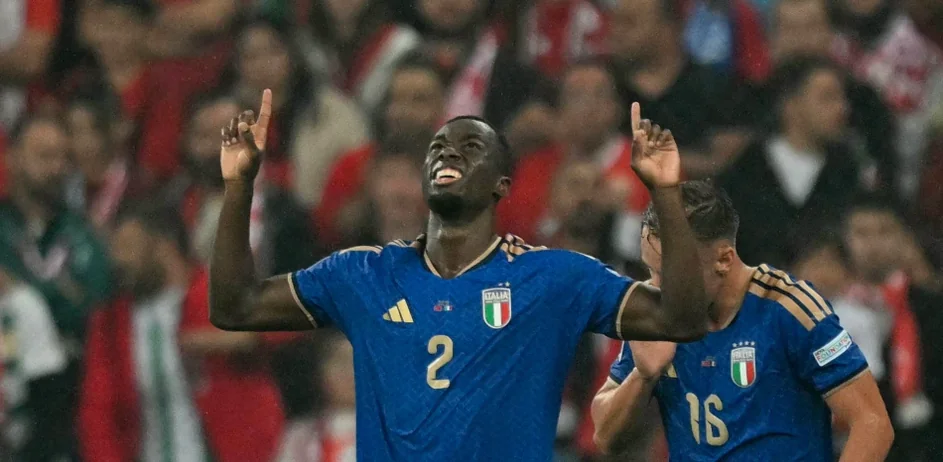
The issue was sharpened by Kayode’s emergence in Italy’s match in Turkey. At 22, he commanded the right flank with confidence, repeatedly arriving in the opposing area and celebrating his goal with a slide across the wet pitch. It was an eye-catching performance built less on display than on courage and readiness to take responsibility.
For Juventus, who released him when he was still very young, and Fiorentina, who had him for two seasons, there may have been an uncomfortable element to the occasion. Fiorentina gave Kayode an opening after Dodo’s injury, but he later slipped back to the margins before moving to the Premier League. In England, he has not merely settled in; he has made himself noticed.
His path recalls other Italian cases in which talent found greater recognition after leaving its original environment. Marco Verratti remains an obvious reference point, while Riccardo Calafiori was not fully understood at Roma before Bologna developed him and his progress eventually took him to the Premier League.
Kayode spent seven years in Italy without securing that level of belief. Amorim has had four months at Milan. The situations are plainly different, but the underlying question belongs to the same championship: how quickly should clubs, supporters and observers decide that a player or a coach has already shown all he can become?
Milan’s answer will come on Sunday afternoons rather than in early-season arguments. For now, the results have kept the project standing. The more demanding task is to allow it enough time to reveal whether its unfinished parts can become a stronger whole.