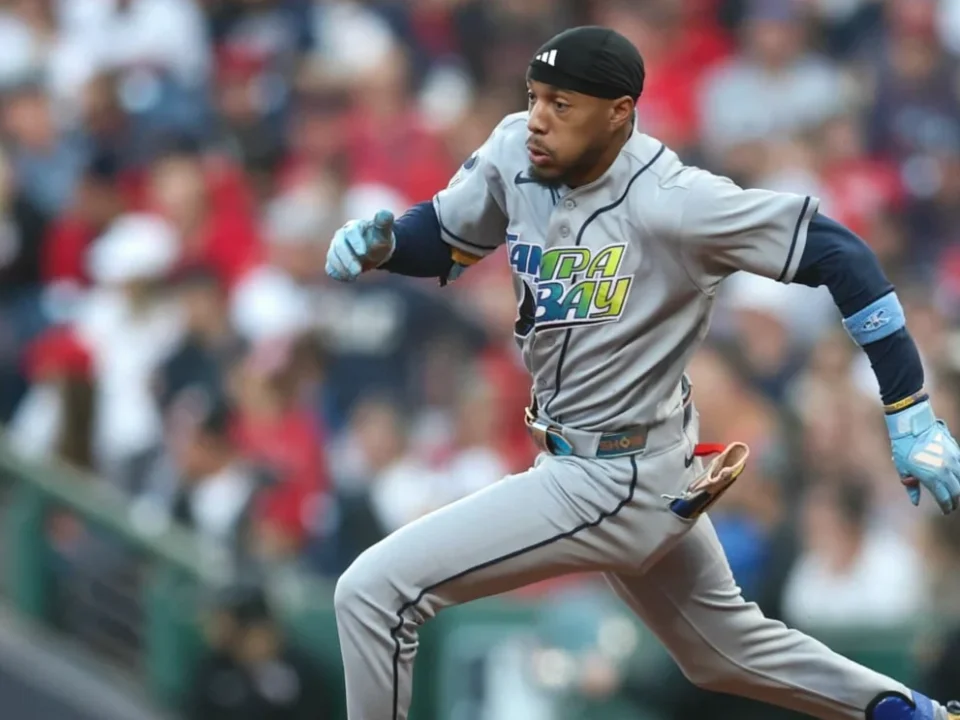
Chandler Simpson’s game has always moved to its own beat. Before the Tampa Bay Rays rookie began turning ground balls into base hits and base hits into stolen bases, he was a sixth-grader taking over a school auditorium with a dance routine to Rick Ross’ “No Worries.” Now, with the Rays opening the World Series against the Brewers in Milwaukee, that old video has resurfaced and given fans a glimpse of the rhythm behind one of October’s most unusual weapons.
Simpson said he had been the kid who danced at school, inspired in part by Michael Jackson. Once the music started, he felt compelled to move. Years later, he sees at least a small connection between those stage routines and the footwork required in the outfield and on the bases.
“There’s rhythm involved in every sport,” Simpson said.
The World Series stage will be far larger than that middle-school auditorium, but Simpson has already shown he can handle attention. He finished the regular season with a .306 average, led the American League with 46 steals and topped the Majors with 42 infield hits. His speed forces defenders to rush plays that might be routine against almost anyone else.
A different kind of offensive threat
Simpson has not hit a Major League home run. Still, he became the first qualified hitter since Florida Marlins infielder Luis Castillo in 1999 to bat .300 or better without going deep during a season. That does not make him a limited hitter in the Rays’ eyes. It makes him a player with a clear identity.
His approach is built around low liners through the middle and balls put in play on the ground. Rays manager Kevin Cash said Simpson remains committed to that plan through batting practice, repeatedly driving the ball toward shortstop rather than chasing loft.
Cash compared that discipline to stories he had heard about Tony Gwynn and Pete Rose, hitters who treated the middle of the diamond as their personal target during their work.
“It’s an old-school kind of dynamic that you do not see very often,” Cash said. “The most impressive thing about Chandler is how well he understands both his game and himself. He is going to keep working at it.”
Simpson’s father, Ralph, helped shape that outlook on fields around Atlanta, teaching his son long ago that reaching base mattered more than trying to hit every pitch over the fence. Simpson believes there is room for both power and small ball in a winning lineup.
“That’s something I take a lot of pride in,” Simpson said. “I was taught my whole life that it belongs in the game. Home runs have their place, and small ball has its place. Together, they can lead to winning baseball.”
Teammate Cedric Mullins has no interest in seeing Simpson alter that formula in pursuit of a modest home-run total.
“Nobody should ever come to him and say they can turn him into a guy who hits 10 home runs,” Mullins said. “He should not listen. He is exactly what he should be.”
Defense catches up with the speed
Simpson’s offensive profile was never in doubt, but his outfield defense needed attention. In 2025, he posted minus-5 Outs Above Average and minus-9 Defensive Runs Saved, as his speed occasionally covered for problems with reads, routes and first jumps.
He made that work a priority in the offseason and through Spring Training. With help from Corey Dickerson, Jared Sandberg and Kevin Kiermaier, Simpson improved to plus-9 Outs Above Average and plus-9 Defensive Runs Saved this season. The progress made him a Gold Glove Award finalist.
Cash called the turnaround one of the season’s best stories for Tampa Bay.
“Every part of my game needed to improve going into my second year,” Simpson said. “I knew defense was an area where I had to put in the work during the offseason and in Spring Training if I wanted to become a more complete player.”
The improvement has made Simpson more than a specialist at the top of an order. He can run down balls in the outfield, create chaos with a bunt and deliver extra-base damage when pitchers make a mistake. In Game 4 of the American League Championship Series, he smoked a 102.1 mph two-run triple, a reminder that his game has some punch even without the home-run line.
Mullins particularly enjoys Simpson’s reaction when a bunt becomes a hit. The rookie treats it as a full-speed accomplishment, chest pumping and shouting after beating the play.
“He gives everything to it,” Mullins said. “Bunting is not easy. You are still trying to square up a pitch coming in at more than 90 mph.”
From talent-show clip to October stage
Simpson still laughs about the old talent-show video, especially because he did not win that day. In his view, the clip’s renewed popularity has offered a form of delayed victory.
“I don’t know how I didn’t win,” he said with a smile. “But it has become the video everyone has seen from that talent show, so maybe I did win after all.”
The Rays are four victories from their first World Series championship, and Simpson will enter the series as a player the Brewers must account for on every ground ball, every bunt attempt and every trip to first base. The audience is bigger now. So is the prize.