At the Metropolitano, where derby nights often leave their mark long after the final whistle, José Mourinho turned his post-match attention away from the 2-1 defeat and towards the officiating. The Portuguese coach said two first-half challenges should have reduced Atlético to nine men before his own side later had to play with ten.
Mourinho’s case after the derby
-
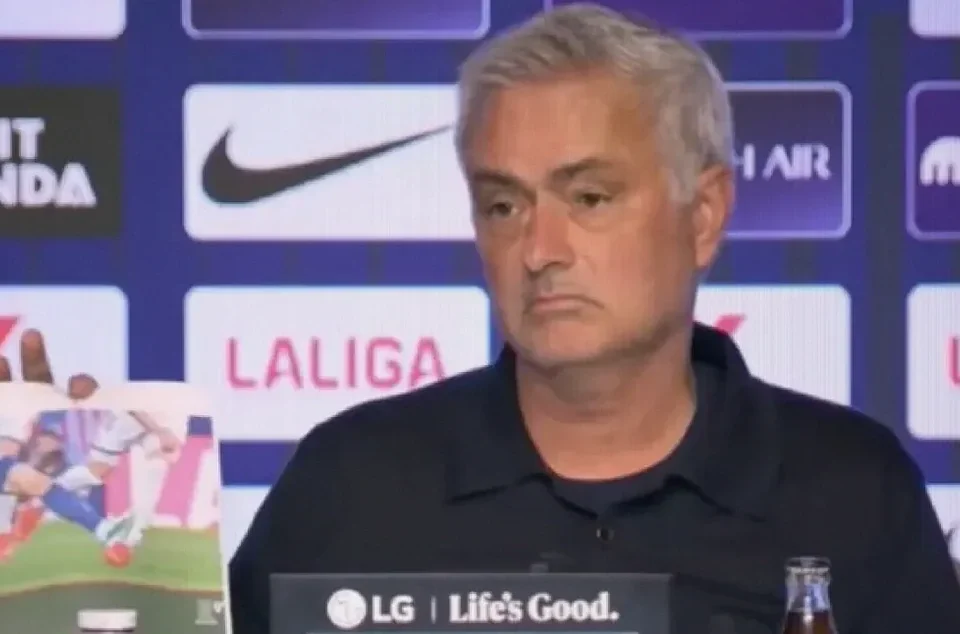
Mourinho arrived at the press conference carrying a sheet showing the incidents involving Romero on Jude Bellingham and Kang-in on Federico Valverde. He argued that both tackles merited straight red cards, saying the images told the story more clearly than a lengthy media appearance could.
-
He believed the derby should have been played for around 50 minutes with an 11-against-nine advantage. Instead, he said his team faced the challenge of continuing with a man down after Huijsen’s dismissal, praising his players for their effort, character and the quality of their opening half.
-
On Huijsen’s red card, Mourinho said he had not yet seen the incident closely enough to offer a final judgement. He accepted that it would be a foul and dismissal if the infringement began outside the penalty area, and also accepted a red card if it occurred inside the box with a clear attempt to prevent play through shirt-pulling.
-
His complaint was rooted in what he considered the missed decisions before the interval. Mourinho said the second half became an 11-versus-10 contest and showed how hard his players had to work merely to remain competitive; in his view, the earlier sending-offs would have transformed the match.
Questions over the appointment and VAR
Mourinho also criticised the process behind the referee’s selection. He said the identity of the official had become known a week before the derby, rather than the usual 24 hours beforehand, and suggested the refereeing committee would be pleased with its appointment.
The coach described the 41-year-old referee as inexperienced for an occasion of this scale, noting that he is not an international official. Mourinho said the referee had been unable to withstand the atmosphere at the Metropolitano, which he compared with a type of pressure more associated with Spanish football in the 1980s.
His criticism extended to the video officials in Las Rozas. Mourinho said Trujillo, working on VAR duty, did not recommend an on-field review for either of the first-half challenges. He referred to Trujillo’s previous involvement in Real Madrid matches, including Copa fixtures against Real Sociedad, Osasuna and Girona, and questioned why VAR had not intervened from a setting he described as free of stadium pressure.
“I would have liked to leave with the win and without needing to speak about this,” Mourinho said. “But I have only been here three months, and I do not want to go down this road.”
A wider frustration with the season
Mourinho said the derby added to concerns that had already surfaced during his brief spell at the club. He cited two red cards in the match at Elche, while also recalling an early yellow card for Diomande in another recent game.
He stressed that his team wants to lead the table rather than sit second, third or fourth, but argued that a league campaign is decided at its conclusion rather than in its opening stretch. In that context, he referred to recent decisions at the same stadium and elsewhere: Osasuna’s disallowed goal, a penalty decision in San Sebastián and Barcelona’s penalty.
The Portuguese also alluded to the referee’s treatment of a young player he described as highly talented. He said he had expected a different league from the one he left years ago, only to be told that little had changed.
For all his anger, Mourinho’s final message was for his squad. He said the players left disappointed, but that he embraced them because he understood what they had experienced on the pitch. He singled out their pride and determination, insisting he had no criticism of their commitment despite a second half made far more difficult by the numerical disadvantage.